Best Time to Visit Rabat
Why Rabat stays cooler in summer than inland Morocco, plus spring storks at Chellah and autumn light.
Because Rabat sits directly on the open Atlantic coast at the mouth of the Bou Regreg River, its climate is far milder and more temperate than inland Marrakech or Fez. While desert winds can push summer afternoons in Marrakech past 40°C, ocean breezes keep Rabat comfortable nearly all year, with the finest conditions falling in April to June and September to November.
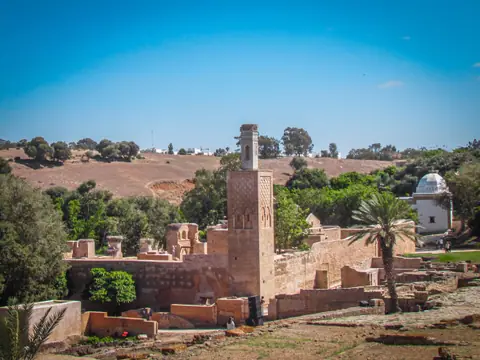
Spring (April to June) brings clear blue skies, daytime highs climbing gently from 21°C to 25°C, and jacaranda and bougainvillea blooming across the Andalusian Gardens and the Ville Nouvelle. Spring is also the peak season to watch white storks raising chicks in their giant twig nests atop the minaret and Roman arches of Chellah; their rhythmic bill-clattering echoes across the entire valley. Late spring frequently hosts the city's major Mawazine music stages along the Bou Regreg and in historic gardens.
Summer (July and August) is dry, bright and surprisingly pleasant by North African standards, with average afternoon highs around 27°C to 28°C. A cool marine mist often hangs over the Kasbah of the Udayas first thing in the morning before burning off by mid-morning. Moroccan families flock to the beaches of Skhirat and Temara south of the city and promenade along the Bou Regreg marina after sunset, so book coastal or riad stays early.
Autumn (September to November) offers warm sea breezes, golden afternoon light on the red ochre ramparts of Bab er-Rouah and Bab Oudaia, and highs between 22°C and 26°C. October and early November are superb for combining Rabat's outdoor archaeological parks with indoor afternoons at the Mohammed VI Museum of Modern and Contemporary Art before the main winter rains begin.
Winter (December to March) is mild by day (17°C to 19°C) with crisp, cool nights dropping to 8°C or 9°C and periodic Atlantic rain showers (6 to 8 wet days per month). Bring layers for unheated courtyard riads and consult what to wear in Rabat before packing.
Weather by month
Rabat is warmest in August, with average highs around 28°C, and coldest in January, when nights drop to about 8°C. November is the wettest month by rainfall (82 mm), with rain on about 8 days. For mild weather with fewer rainy days, aim for May, June, September and October.
| Month | Low | Range | High | Rain | Rainy days |
|---|---|---|---|---|---|
| Jan | 8°C | 18°C | 74 mm | 8 d | |
| Feb | 9°C | 18°C | 62 mm | 7 d | |
| Mar | 11°C | 20°C | 58 mm | 7 d | |
| Apr | 12°C | 22°C | 44 mm | 6 d | |
| May | 15°C | 24°C | 21 mm | 3 d | |
| Jun | 17°C | 26°C | 5 mm | 1 d | |
| Jul | 19°C | 27°C | 1 mm | 0 d | |
| Aug | 19°C | 28°C | 1 mm | 0 d | |
| Sep | 18°C | 27°C | 14 mm | 2 d | |
| Oct | 15°C | 25°C | 46 mm | 5 d | |
| Nov | 12°C | 21°C | 82 mm | 8 d | |
| Dec | 9°C | 18°C | 79 mm | 8 d |
Averages of daily values from 2015 to 2024. Rainy days are days with at least 1 mm of rain. Source: Open-Meteo · Compare destinations by month.
Where it is
- 1Rabat
- Mohammed V International Airport (CMN) · about 100 km from Rabat in a straight line
- Directions in Google Maps
Stations and taxi ranks: OpenStreetMap. Airports: OurAirports. Distances are in a straight line.
Traveller tips
Real advice from people who have been to Rabat. Every tip is read by our team before it goes live.
No tips yet. Been here? Yours could be the first.
Thank you! Your tip will appear here after a quick review.
More in Rabat
Continue exploring Rabat with related neighbourhood, food, and planning guides