Photo: Seasider53 · CC BY-SA 4.0
Best Things to Do in Savannah: Historic Squares, Coastal Forts, and Riverfront Walks
Plan your trip to Savannah with essential sightseeing itineraries covering historic squares, riverfront promenades, antebellum museums, and barrier island excursions.
Strolling Forsyth Park, Bull Street, and the Twenty-Two Historic Squares
Savannah was founded in 1733 on the Savannah River as the oldest city in Georgia, laid out on an innovative grid system of shaded civic squares. Walking through these leafy sanctuaries remains the quintessential city experience. We recommend starting early at the northern edge of the Historic District and heading south along Bull Street. You will pass through Johnson, Wright, Chippewa, Madison, and Monterey Squares, admiring centuries of preserved architecture under interlocking branches of Southern live oaks draped in Spanish moss.
The Bull Street spine culminates at the thirty-acre expanse of Forsyth Park. Its crown jewel is the white cast-iron fountain installed in 1858. During spring, from March through April, the surrounding grounds erupt into colour as pink, magenta, and white azaleas, dogwoods, and wisteria bloom across the perimeter. March sees comfortable average highs of 22.1°C, making it an ideal period for unhurried walking tours before midsummer humidity settles in. If you want a detailed walking route through the central green spaces, explore our guide to Forsyth Park and the Bull Street squares.
East of Bull Street, take time to wander brick-paved Jones Street, celebrated for its high-stoop Greek Revival and Italianate townhouses. The surrounding historic district allows travellers to experience the city at a calm pedestrian pace. For an exhaustive neighbourhood walk, refer to our overview of walking all twenty-two historic squares.
Exploring Riverfront History, Factors Walk, and Plant Riverside
Savannah's commercial heritage unfolded along its river bluff. Between the river level and the street grid above sits Factors Walk, where historic cotton brokers once operated. You can cross the network of nineteenth-century iron catwalk bridges that span the gap between historic brick storehouses and upper street levels before descending ballast-stone ramps to the Savannah River.
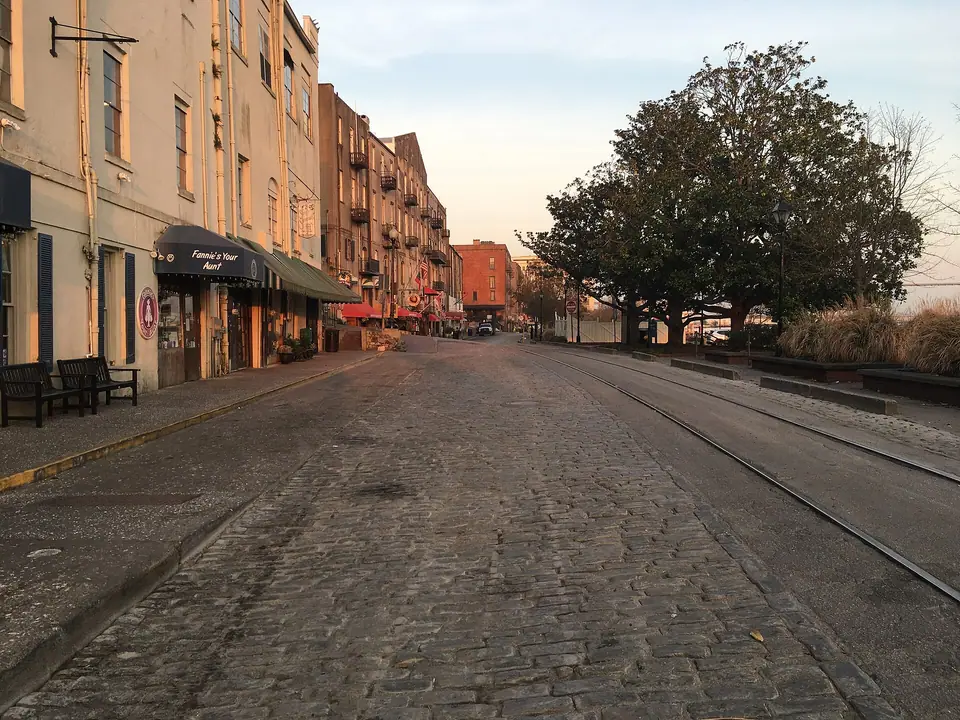
River Street retains its centuries-old paving stones, constructed from ship ballast stones hauled ashore by merchant vessels. Today, visitors gather on the waterfont promenade to watch massive container ships glide past on the Savannah River channel toward the port. The western end of the riverfront features the Plant Riverside District, a restored 1912 power plant reimagined as an entertainment complex. Here you can sample warm butter-pecan pralines, listen to riverside music, and study restored maritime machinery. You can read more about navigating the waterfront in our guide to River Street, Factors Walk, and Plant Riverside.
Touring Notable Cultural Sites and Historic Houses
Savannah holds some of the South's most significant cultural institutions and architectural monuments. The Telfair Academy of Arts and Sciences, located on Telfair Square, opened to the public in the nineteenth century and is recognized as one of the first public museums in the Southern region. It displays fine American and European art within an 1819 neoclassical townhouse designed by architect William Jay.
History enthusiasts should visit the Georgia Historical Society, the oldest continually operating historical society in the South, which curates an extensive archive of regional manuscripts and records. Just north on Montgomery Street, the historic First African Baptist Church represents one of the oldest African-American Baptist congregations in the United States, established in 1773. Visitors interested in civic leadership can also tour the Girl Scout First Headquarters and the birth home of Juliette Gordon Low, the founder of the Girl Scouts of the USA.
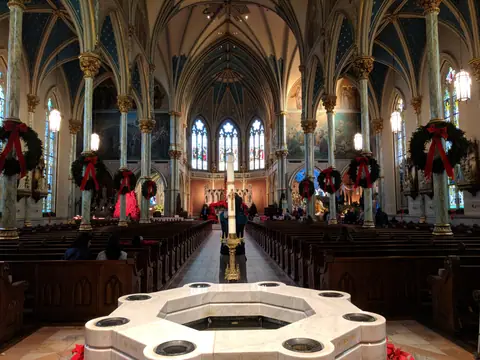
Architectural exploration continues at the Cathedral Basilica of St. John the Baptist on Lafayette Square, famed for its towering twin spires and Austrian stained glass. Close by, the Owens-Thomas House and Slave Quarters provides essential historical context on nineteenth-century urban living and domestic enslavement. For details on touring these landmarks, review our guide to the Cathedral Basilica and historic house museums.
Experiencing Bonaventure Cemetery, Wormsloe, and Coastal Forts
A short drive beyond the downtown core reveals dramatic coastal landscapes and antebellum burial grounds. Bonaventure Cemetery rests on a bluff above the Wilmington River east of the city. Established in 1846, its Victorian marble monuments and moss-draped live oaks gained global fame through the Mercer Williams House and the non-fiction narrative Midnight in the Garden of Good and Evil. Learn how to navigate the memorial avenues via our dedicated guide to Bonaventure Cemetery and the Mercer Williams House.
South of the city on the Isle of Hope, Wormsloe State Historic Site features a dramatic 1.5-mile entrance avenue flanked by more than four hundred interlocking live-oak trees. At the end of the road stand the 1736 oyster-shell tabby ruins of colonial founder Noble Jones, the oldest surviving standing structure in Savannah. Further details are outlined in our feature on the Wormsloe Historic Site and tabby ruins.
Heading twenty minutes east across salt marsh causeways leads to Fort Pulaski National Monument on Cockspur Island. Constructed with twenty-five million bricks between 1829 and 1847, the fort still bears rifled-cannon scars from the Civil War siege of 1862. Past the fort, Tybee Island provides wide Atlantic ocean beaches and Georgia's tallest standing lighthouse, originally constructed in 1736. Consult our itinerary for Tybee Island beach and Fort Pulaski to coordinate your excursion.
Savannah Sightseeing Comparison: Activities and Travel Styles
| Experience & Location | Primary Appeal | Ideal Traveller Segment | Key Practical Factor |
|---|---|---|---|
| Bull Street & Forsyth Park | Landscaped civic squares, spring azalea blossoms, 1858 fountain | Couples and slow-paced walkers | Level walking routes across historic pedestrian zones |
| River Street & Factors Walk | Riverboat traffic, ballast stone ramps, praline confectionery shops | Families with kids and casual sightseers | Uneven cobblestone surfaces require sensible flat shoes |
| Telfair Academy & Owens-Thomas | Neoclassical fine art collections and 1819 domestic architecture | Adults and architecture enthusiasts | Centrally located on historic squares within the downtown grid |
| Wormsloe State Historic Site | 1.5-mile oak avenue and 1736 colonial oyster-shell tabby ruins | Photographers and state park explorers | Requires vehicle transport south towards Isle of Hope |
| Fort Pulaski & Tybee Island | Civil War brick engineering, salt marshes, and Atlantic beaches | Families with children and outdoor history buffs | Located twenty minutes east along maritime highway corridors |
Evening Tours, Local Gastronomy, and Practical Arrival
As darkness falls, Savannah's rich folklore surfaces on guided walking routes. The city's layered past has earned it a reputation as one of America's most haunted settlements. Evening groups congregate near the 1750 Colonial Park Cemetery, where centuries of burials rest within the Historic District, or gather outside the historic 1753 seamen's tavern at The Pirates' House. To reserve an evening walk, read our guide to Savannah ghost tours and Colonial Park Cemetery.
Dining represents an equal cornerstone of the regional culture. Lowcountry cuisine blends coastal seafood with regional agricultural staples. Visitors queue on Jones Street for communal family-style platters of fried chicken, okra, and cornbread at Mrs. Wilkes' Dining Room, or enjoy Lowcountry shrimp and grits along Broughton Street. For dessert, a stop at the 1919 Leopold's Ice Cream parlour offers classic Tutti-Frutti scoops. Check out our culinary breakdown covering what to eat in Savannah and Mrs. Wilkes' Dining Room.
Air travellers fly into Savannah/Hilton Head International Airport, which operates under the IATA code SAV. The airport connects directly to downtown motor routes and regional transport options. Sports fans travelling in late autumn can attend the Allstate SEC Volleyball Tournament held at the Enmarket Arena in November. Autumn brings mild weather, with November experiencing average highs of 21.2°C and low rainfall of 62 millimetres across 5.6 wet days, providing crisp conditions for enjoying the city's sights.
Where it is
- 1Savannah
- Savannah Hilton Head International Airport (SAV) · about 11 km from Savannah in a straight line
- Directions in Google Maps
Stations and taxi ranks: OpenStreetMap. Airports: OurAirports. Distances are in a straight line.
Traveller tips
Real advice from people who have been to Savannah. Every tip is read by our team before it goes live.
No tips yet. Been here? Yours could be the first.
Thank you! Your tip will appear here after a quick review.
More in Savannah
Continue exploring Savannah with related neighbourhood, food, and planning guides
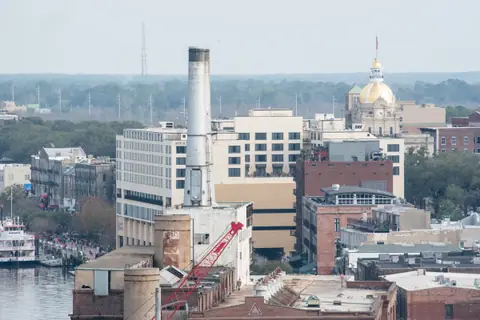
River Street Cobblestones, Factors Walk Iron Bridges & the Plant Riverside District
Savannah, United States
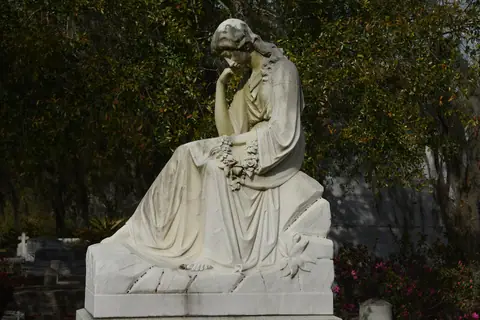
Bonaventure Cemetery (Spanish Moss & 'Bird Girl') & the Mercer Williams House ('Midnight in the Garden')
Savannah, United States
Wormsloe State Historic Site (1.5-Mile Live-Oak Tunnel), 1736 Tabby Ruins & Isle of Hope
Savannah, United States
Cathedral Basilica of St. John the Baptist & Savannah's 4 Best Historic House Museums
Savannah, United States
