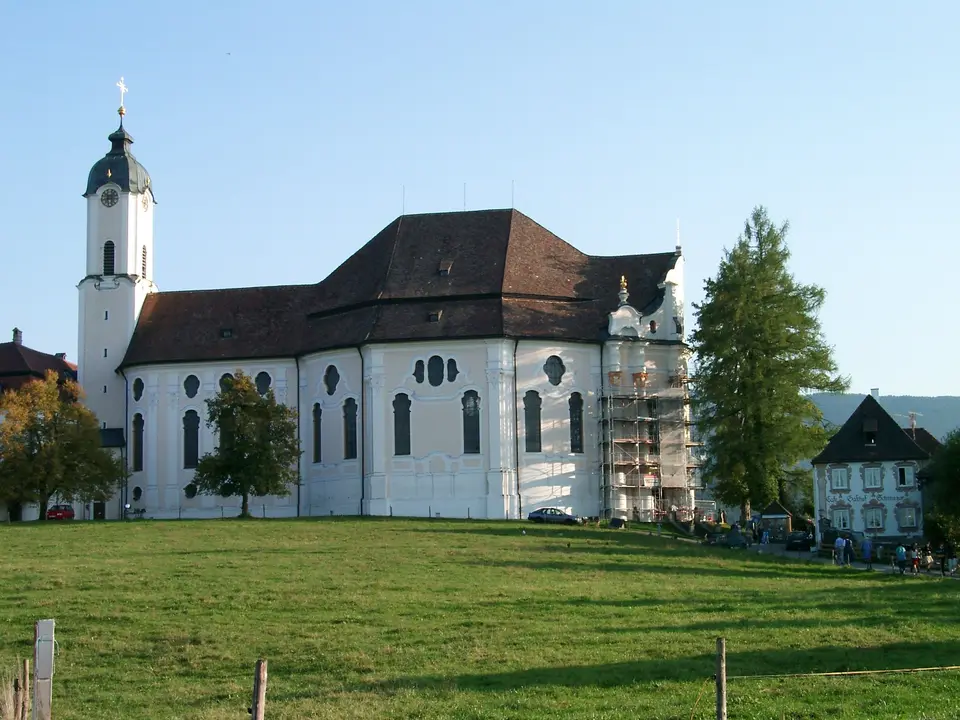
Quick Field Data
- UNESCO Inscription: 1983 (Cultural Criteria i, iii)
- Scale & Footprint: A 0.1-hectare oval church in an 8.4-hectare buffer zone of Alpine pasture in Upper Bavaria
- Access & Ticketing: A working Roman Catholic pilgrimage church in the Diocese of Augsburg; check the official site for service times, concerts and rules for groups
- Arrival Logistics: In the village of Wies, in the municipality of Steingaden (Weilheim-Schongau district), south-west of Munich in the foothills of the Ammergau Alps
A Masterpiece of Bavarian Rococo in the Ammergau Meadows
The Pilgrimage Church of Wies stands in a quiet Alpine valley in the foothills of the Ammergau Alps, the range between southern Bavaria and the Austrian Tyrol. In German it is the Wieskirche, or "Meadow Church", short for the "Pilgrimage Church of the Scourged Saviour on the Meadow". It is one of the finest works of Bavarian Rococo. UNESCO listed it in 1983 under cultural criteria i and iii, with a core of 0.1 hectares and a meadow buffer zone of 8.4 hectares; see our UNESCO World Heritage Atlas. The Roman Catholic church lies in the tiny village of Wies, south-east of Steingaden in the Upper Bavarian district of Weilheim-Schongau, south-west of Munich. It belongs to the Weilheim-Schongau deanery of the Diocese of Augsburg. The brothers Dominikus and Johann Baptist Zimmermann built it together between 1745 and 1754. Inside its oval walls, bright and joyful Rococo art sits in full harmony with the farmland outside.
The church's story began in the hamlet of Wies in 1738. According to the account of the miracle, tears were seen on a simple, worn wooden figure of the Scourged Saviour. It showed Christ bound to the column of his flogging, and the Premonstratensian canons of nearby Steingaden Abbey had withdrawn it from public worship. News of the miracle quickly drew pilgrims from town and country to pray before the figure. In 1740 a small wooden chapel was built in the fields at Wies to house it. Soon, however, the crowds from Bavaria, Austria, Bohemia and Italy grew too large for the chapel. The abbot of Steingaden therefore decided to build a separate, splendid church in the meadow, despite the huge cost.
The Zimmermann Brothers at Work (1745 to 1754)
Work on the new church began in 1745 under the architect Dominikus Zimmermann. His brother Johann Baptist Zimmermann painted the stucco decoration and the large ceiling frescoes. Building took nine years. The eastern choir was consecrated first, in 1749, so that services could continue around the miraculous figure, and the rest of the church was finished in 1754. Dominikus was so attached to the church that he left the town of Landsberg to live at Wies. He spent his last eleven years in a new house beside the church and died there in 1766.
To hold large processions of pilgrims and fill the interior with Alpine daylight, Dominikus Zimmermann chose an oval plan. A semicircular porch leads in from the west, and a deep choir extends to the east:
- The Western Semicircular Porch: In front of the oval body of the church, the semicircular porch forms a threshold and gathering space between the open meadow and the bright interior.
- The Oval Plan and Twin Columns: Inside the oval nave, pairs of columns stand just in front of the outer walls. They carry a playfully cut-out cornice and a flattened wooden vault, creating a second, lighter space inside the outer shell.
- Direct and Indirect Light: Daylight from the windows and the round openings above passes through the gap between the outer walls and the inner ring of columns. It falls both directly and indirectly across the cornice and vault, so the structure seems weightless and full of light at every hour.
- The Long Eastern Choir: Beyond the oval nave, a long, deep choir is framed by lower and upper galleries. These layers draw every pilgrim's eye towards the high altar, where the wooden figure of the Scourged Saviour is venerated.
Wessobrunn Stucco and Trompe-l'Œil Ceiling Painting
Inside the Wieskirche, architecture, sculpture, painting, stucco, wood carving and wrought iron are joined in one design. This rich interior contrasts on purpose with the calm, plain exterior and its meadow setting. In every bay, the Zimmermann brothers set out to make the heavenly world feel close, with sculpture and painting working together before the eyes of the faithful. The elaborate stucco on the twin columns, the cornice and the choir galleries follows the famous Wessobrunn tradition. Johann Baptist Zimmermann painted it in soft, bright colours to blend with the carved wooden statues, gilded altar frames and decorative ironwork.
Above the cornice, the flattened wooden ceilings of the nave and choir carry trompe-l'œil frescoes that seem to open the roof onto a shimmering sky. Over the centuries, many worshippers praying before the figure of Christ have reported cures from illness. This living tradition has kept the church a lasting place of European pilgrimage, as well as an outstanding witness to 18th-century Bavarian Rococo.
Surviving the 19th Century, the 1985 to 1991 Restoration and Visitor Access
Local folklore long held that the Bavarian state planned to sell or demolish the church during the secularisation of the early 19th century, and that protests by local farmers alone saved it. Surviving records show, however, that the state commission in charge clearly supported keeping Wies open for pilgrims, despite financial objections from the abbot of Steingaden. After its listing in 1983, the church underwent a six-year restoration from 1985 to 1991 to conserve its painted stucco, ceiling paintings and timber structure.
- Entry and Route: The Wieskirche lies in the village of Wies, south-east of Steingaden in the Weilheim-Schongau district of Upper Bavaria. Drivers from Munich or the Alps leave the A95 motorway at the Murnau am Staffelsee / Kochel am See exit. Rail travellers can take the Ammergau Railway between Murnau am Staffelsee and Oberammergau to the nearest stations, Bad Kohlgrub-Kurhaus and Saulgrub. On summer weekends a direct bus, the DAV BergBus (line 996), has run between Munich-Pasing station and the Wieskirche; check the current timetable.
- Tickets and Viewpoints: As a working pilgrimage church in the Diocese of Augsburg, the Wieskirche welcomes visitors outside services. Sightseeing in the nave and choir stops during services and organ recitals, so check the official site for service and concert times before you travel.
- Timing and Onward Connections: Come on a clear morning or afternoon, when sunlight through the windows lights up the twin columns, the stucco and the painted sky. Afterwards, walk the quiet meadow paths of Steingaden with views of the Ammergau Alps, where you can take in the contrast between the plain rural exterior and the richly gilded and painted interior.
