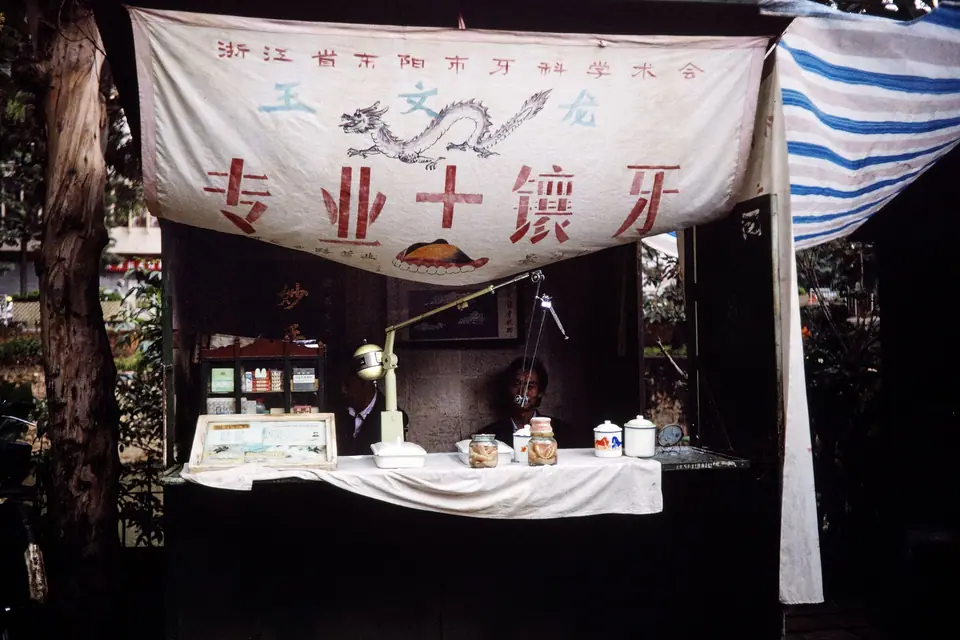
Hongqiao Pearl Market: Freshwater Pearls, Silk and Bargaining
Navigating the five floors of Hongqiao Market opposite the Temple of Heaven for freshwater pearls, silk and custom tailoring.
Hongqiao Pearl Market is a practical stop for travellers interested in pearls, jewellery and Chinese handicrafts. It sits in southern Dongcheng, near the Temple of Heaven, so it fits naturally into a day around that part of Beijing. Treat it as a focused shopping visit rather than a city-wide attraction that needs several hours. The official Beijing tourism description lists pearls, cloisonné, paper cuttings, kites and embroidery, along with customisation and appraisal services. That gives you a better starting point than the older online descriptions that promise a fixed floor plan or a particular assortment.
The current tourism listing places the market at No. 8 Tiantan East Road. For public transport, the Temple of Heaven’s official guide lists Tiantandongmen on Subway Line 5 and Tianqiao on Line 8. Check the market’s current access information before setting off. If you are already visiting the Temple of Heaven, decide whether you want to shop before you enter the park or after. Carrying purchases through a large outdoor site is less convenient, while arriving late may leave less time to compare items.
Start with a clear reason for going
The name can suggest that every shop specialises in pearls. In practice, the official tourism page describes a broader mix that includes traditional crafts and souvenir goods. Decide whether your aim is to compare pearl jewellery, find a small gift or simply look around. That helps you avoid browsing every counter without a clear reference point. If pearls are not on your list, the market may be a short stop rather than a priority.
Do not rely on older pages that describe a specific product floor as if the arrangement were permanent. Retail layouts and tenants change. Ask staff where the relevant section is when you arrive, then compare several sellers before making a decision. A short conversation about materials, design and aftercare can tell you more than a broad claim that one stall is the best in the building.
Compare pearls by qualities you can see
The Gemological Institute of America recommends looking at size, shape, colour, lustre, surface, nacre and matching. You do not need to grade a pearl professionally to use those terms. Compare similar items under the same light and look for sharp reflections, consistent colour and surface marks that you are comfortable with. For a necklace or pair of earrings, compare the pieces together. Matching is about how consistently the pearls work as a set, not whether every pearl is perfectly identical.
Ask the seller to explain whether the pearls are cultured or natural, freshwater or saltwater, and whether they have been treated. Request any available written identification or appraisal documentation and check who issued it. Do not assume that a shop display card or an informal label is an independent gem report. If the answer is unclear, pause the purchase and ask a second seller. The point is not to distrust every counter, but to understand exactly what is being represented.
Round pearls are not the only design worth considering. Baroque shapes can be intentionally irregular, while drop, oval and button shapes suit different jewellery styles. Decide what you will actually wear before comparing pieces. A dramatic shape may be more distinctive than a uniform strand, while a matched pair can matter more for earrings. Look at the finished item from a normal viewing distance and under the kind of light in which you expect to use it.
Make custom work specific before you agree
The current Beijing tourism page says merchants offer on-site processing and customisation. Before agreeing to a customised piece, clarify the design, materials, measurements, completion time, collection arrangements and what happens if the finished work differs from the sample. Ask for the agreed details in writing. A sketch, photograph or description can prevent misunderstandings, especially when you are commissioning a necklace or adapting a clasp.
Use the market’s appraisal services as an option to investigate, not as an automatic guarantee of independent verification. Ask who performs the appraisal, what it covers and whether you receive written results. If a purchase matters enough that you need a formal report, check whether the report comes from a recognised independent gemological laboratory. The market page confirms that appraisal consultation is available, but does not say every seller provides the same service or documentation.
Keep negotiation calm and precise
When a seller quotes a figure, make sure you understand what it includes. Is it for one item or a set? Does it include custom work, a chain or a clasp? If you are comparing two pieces, ask the same questions about both. This gives you a useful comparison without turning the conversation into a dispute about a single number. Take a moment to inspect the item again before you agree.
Polite, direct questions work better than a rehearsed bargain strategy. If you are unsure, say you are comparing options and step away. You do not need to buy something because a seller has spent time explaining it. Avoid pressure to decide immediately, particularly if a claim about origin, rarity or certification has not been documented. A clear receipt with the seller’s details and a description of the item is useful for future care or questions.
Choose souvenirs with care
The market’s official listing includes traditional handicrafts such as cloisonné, paper cuttings, kites and embroidery. These categories make it easier to choose a gift with a link to Chinese craft traditions, but the label alone does not tell you how an item was made. Ask what material you are buying and whether the piece is handmade, assembled or produced in a workshop. If that distinction matters to you, look for a specific answer instead of relying on a broad cultural description.
For fragile pieces, check how the item will travel in your luggage. Ask for protective packaging and keep small receipts or care notes together. For jewellery, consider how the clasp, setting and stringing feel, not only how the item looks in the case. Pearl strands are soft, and the GIA notes that pearls can be scratched and affected by heat, acids, perfume and cosmetics. Store them separately from harder jewellery and wipe them with a soft clean cloth after wearing.
Pair the visit with the Temple of Heaven
Hongqiao works best as a compact indoor stop around the Temple of Heaven area. The park and the market serve different purposes: one is a large historic landscape, the other a shopping centre. Visit the market when you have a specific item in mind or want to compare crafts. If you have no shopping list, give more of the day to the park and treat Hongqiao as optional.
Before departure, check current location and access details through the official Beijing tourism listing. Keep enough time to return to your hotel or continue to another district without carrying purchases through a long day. For the surrounding area, see our Temple of Heaven guide, transport guide and Beijing travel guide. Those pages help fit the market into a practical route rather than treating shopping as a separate trip across the city.
Where it is
- 1Hongqiao Pearl Market
- Beijing Capital International Airport (PEK) · about 26 km from here in a straight line
- Directions in Google Maps
Stations and taxi ranks: OpenStreetMap. Airports: OurAirports. Distances are in a straight line.
Traveller tips
Real advice from people who have been to Beijing. Every tip is read by our team before it goes live.
No tips yet. Been here? Yours could be the first.
Thank you! Your tip will appear here after a quick review.
More in Beijing
Continue exploring Beijing with related neighbourhood, food, and planning guides
Dashilar and Yangmeizhu Byway: Guild Facades and Bookshops
Beijing, China
Qianmen Street and Zhengyangmen: Arrow Tower and Time-Honoured Shops
Beijing, China
Prince Gong's Mansion (Gongwangfu): Qing Courtyards and Gardens
Beijing, China
National Museum of China: Ancient Bronzes and Booking Rules
Beijing, China
