Photo: madmack66 · CC BY-SA 4.0
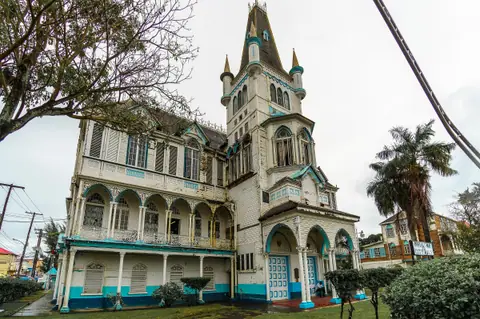
St. George's Cathedral, City Hall and Georgetown Wooden Heritage
Discover Georgetown's Victorian timber heritage, featuring the soaring spire of St. George's Cathedral, Gothic Revival City Hall, and historic Demerara greenheart landmarks.
Nineteenth-century British Guiana lacked accessible stone quarries across its coastal mudflats. The colony possessed vast rainforests rich in dense, rot-resistant hardwoods. Victorian master builders adapted European Gothic Revival and neoclassical styles into native Demerara Greenheart (Chlorocardium rodiei), Wallaba shingles, and imported pitch pine. This architectural adaptation produced one of the most remarkable collections of monumental timber civic buildings anywhere in the Americas. A walking route down Company Path, Avenue of the Republic, and High Street reveals how colonial civil engineers engineered durable monuments atop unstable alluvial soils.
Travellers exploring historic wards will notice how these structures stand raised on timber stilts or broad foundations to combat seasonal standing water. When planning a broader architectural route through the capital, check our comprehensive Georgetown Travel Guide: Wooden Garden City, Historic Wards and Travel Logistics for ward maps and regional context. The survival of these massive timber landmarks depends on continuous conservation efforts overseen by the National Trust of Guyana.
St. George's Cathedral: Engineering a 43.5-Metre Timber Spire
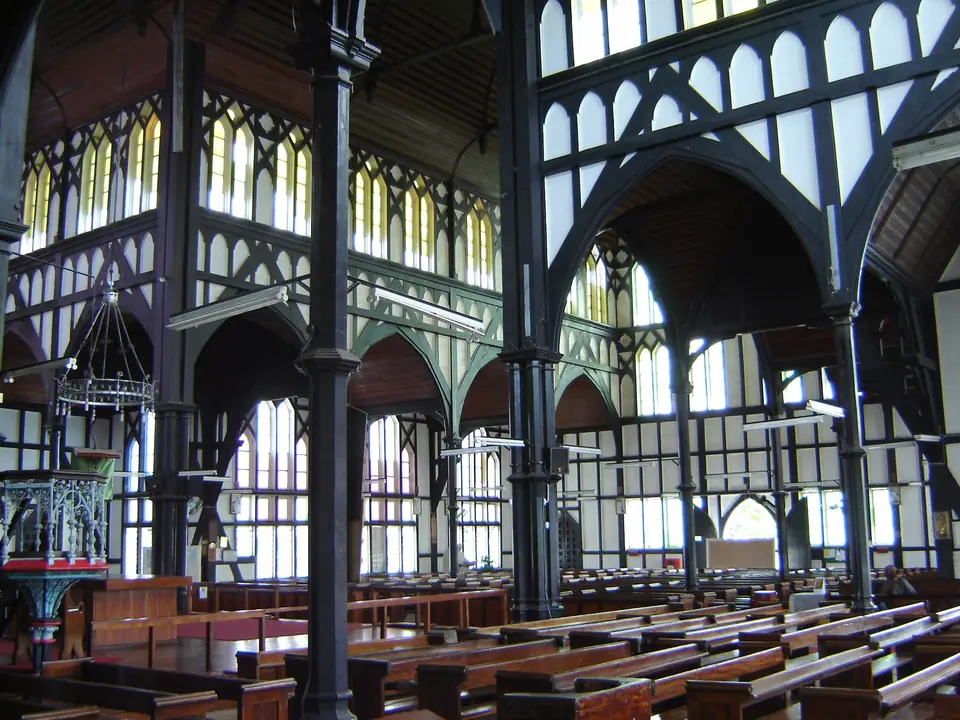
Standing on Company Path between Church Street and North Road, the Cathedral Church of St. George serves as the seat of the Anglican Bishop of Guyana. Three earlier brick and timber churches on the site sank and cracked because the soft coastal mud could not bear their weight. English Gothic Revival architect Sir Arthur Blomfield solved this foundation crisis by designing a lightweight timber cathedral resting upon a reinforced concrete raft foundation.
Construction began on 21 November 1889, relying on hand-hewn Demerara greenheart timber for its structural framework and pitch pine for interior surfaces. The church held its opening service on 24 August 1892, with full construction finishing in 1899. Rising to 43.5 metres (143 feet) at the peak of its tower, the building ranks among the tallest freestanding wooden churches in the world.
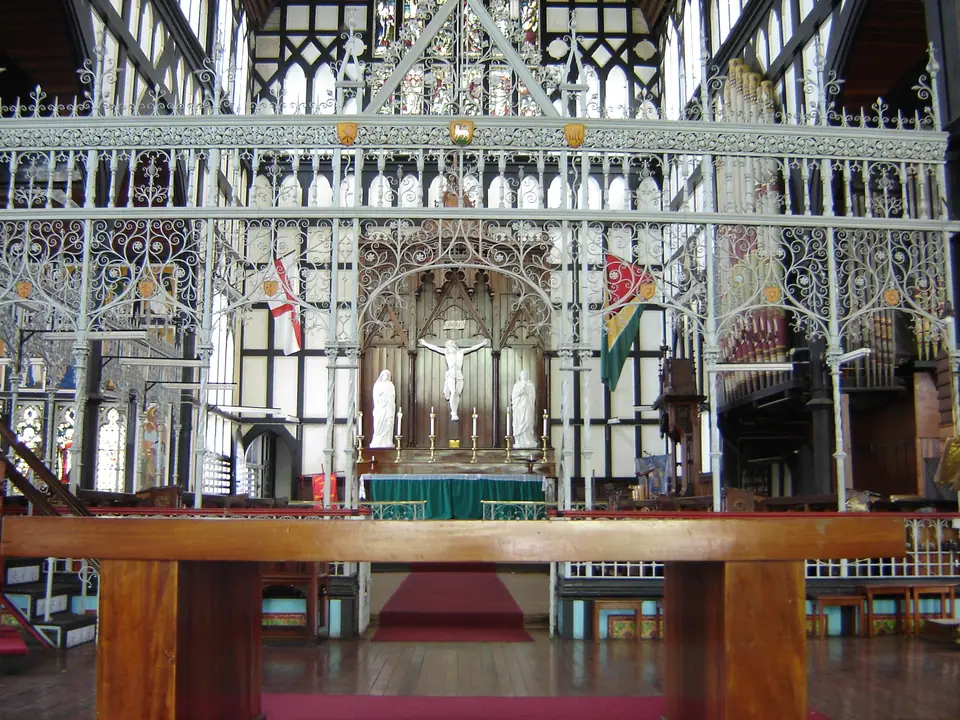
Step inside to examine the cavernous vaulted timber nave, which showcases exposed greenheart beams joined by traditional carpentry techniques. The interior houses an ornate wrought-iron chancel screen, lancet stained-glass windows, and colonial memorial tablets lining the aisles. Suspended high above the nave hangs a massive crystal chandelier presented by Queen Victoria to celebrate her Golden Jubilee. Deep exterior eaves, louvered timber shutters, and soaring flying buttresses provide essential shade and natural cross-ventilation in the tropical climate.
Georgetown City Hall: French Gothic Revival in Native Greenheart
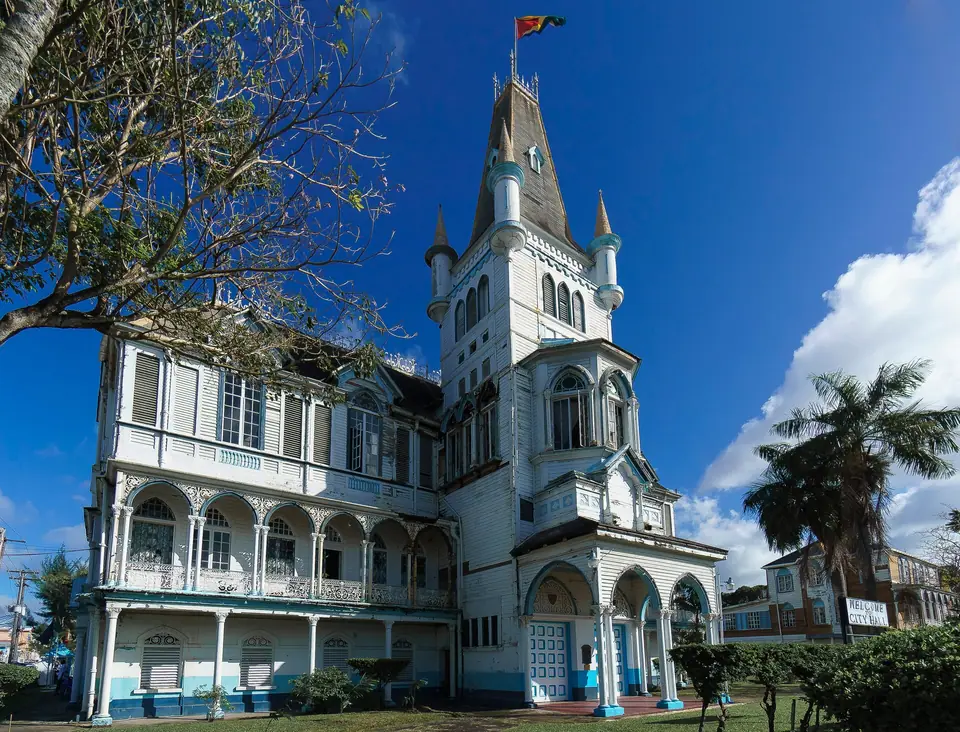
Located at the corner of Avenue of the Republic and Regent Street, Georgetown City Hall presents a whimsical interpretation of French Gothic Revival architecture. Designed by architect and Jesuit priest Father Ignatius Scoles, the municipal headquarters officially opened on 1 July 1889. Father Scoles designed a fantasy of pointed medieval arches, slender spires, and elaborate wooden fretwork executed in local forest hardwoods.
The building features cast-iron columns that support broad exterior galleries, a prominent turreted clock tower, and scalloped timber cornices. Intricate wooden fretwork covers the upper storeys, serving both as decorative filigree and functional ventilation grilles that allow trade winds to cool the council chambers. The structure represents the peak of Victorian civic pride during the nineteenth-century sugar boom in Demerara.
Decades of high equatorial humidity and driving rain took a serious toll on the delicate decorative woodwork and structural joints. In recent years, international conservation teams and the municipal government launched extensive timber restoration programmes to replace rotted framing with freshly milled greenheart. For visitors combining architecture walks with central city shopping, our Stabroek Market, Bourda Market and Water Street Guide provides walking itineraries through the immediate commercial streets.
Victoria Law Courts and Colonial Timber Mansions
A short stroll south along Avenue of the Republic leads to the Victoria Law Courts. Designed by Baron H. Siccama, the legal complex opened on 24 May 1887 to mark Queen Victoria's Golden Jubilee. A marble statue of Queen Victoria still stands in the landscaped front garden. The building features half-timbered gables, sweeping balconies, and louvered shutters that reflect Tudor Revival styling adapted for tropical rainfall.
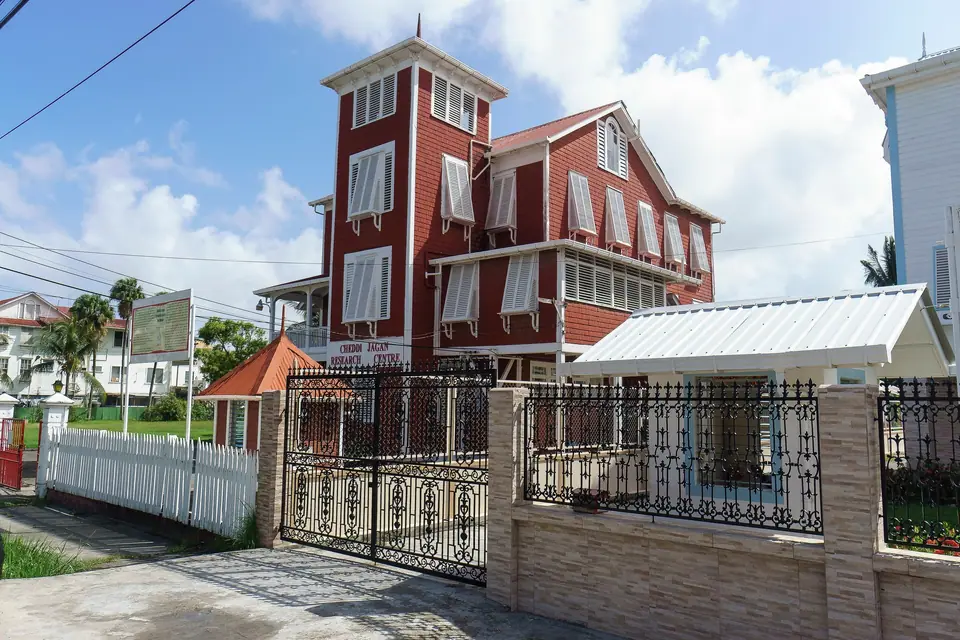
Further north on High Street in Kingston stands Red House, also known as Kamana Court. This nineteenth-century wooden mansion was constructed entirely of local timber with red-painted Wallaba exterior weatherboarding. The building once served as the official residence of colonial dignitaries and Cheddi Jagan. It now functions as the Cheddi Jagan Research Centre, preserving original timber floors, sweeping verandas, and high ceilings that demonstrate upper-class domestic design from the colonial era.
Travellers admiring these classic residences will find similar architectural features along Main Street. Consult our guide on Main Street, Walter Roth Museum of Anthropology and National Museum Guide to extend your walking survey through the shady promenades of Lacytown and Kingston.
Notable Historic Timber Landmarks in Central Georgetown
Georgetown contains an exceptional concentration of nineteenth-century timber structures. The table below outlines key wooden landmarks, their primary architectural styles, and notable design elements.
| Monument | Opening Year | Architect | Architectural Style | Signature Timber Feature |
|---|---|---|---|---|
| St. George's Cathedral | 1892 | Sir Arthur Blomfield | Gothic Revival | 43.5-metre spire and vaulted greenheart nave |
| Georgetown City Hall | 1889 | Father Ignatius Scoles | French Gothic Revival | Turreted tower with intricate fretwork |
| Victoria Law Courts | 1887 | Baron H. Siccama | Tudor Gothic Revival | Timber gables and louvered verandas |
| Red House (Kamana Court) | 19th Century | Colonial Public Works | Demerara Domestic Timber | Wallaba weatherboarding and high ceiling verandas |
Practical Guidance for Timber Architecture Walking Tours
Georgetown sits just above sea level on the Atlantic coast, resulting in hot, humid conditions throughout the year. Based on historical weather observations from 2015 to 2024, daytime highs remain steady between 28.8°C in January and 31.8°C in October. Nighttime lows hover consistently between 23.3°C and 24.7°C across all twelve months.
Rainfall follows a distinct bimodal pattern that dictates walking comfort. June represents the wettest month with an average of 161mm over 23 wet days, followed closely by July with 147mm across 21 wet days and May with 133mm over 19 wet days. Heavy downpours can fill the historic street drainage canals and leave pavements slick. By contrast, the driest months occur in September and October, each averaging 63mm across 9 wet days, with February and March receiving 70mm over 10 wet days.
To avoid midday equatorial heat, begin architectural walking tours early in the morning when the northeastern trade winds blow gently off the ocean. Wear sturdy walking shoes with rubber soles, as wooden walkways and damp brick pavements can turn slippery after brief tropical showers. Dress modestly when stepping inside active places of worship such as St. George's Cathedral. Because maintenance projects and religious services affect building access, always check the official National Trust of Guyana site for current preservation notices before setting out.
Where it is
- 1St. George's Cathedral, City Hall and Georgetown Wooden Heritage
- Eugene F. Correia International Airport (OGL) · about 6 km from here in a straight line
- Cheddi Jagan International Airport (GEO) · about 36 km from here in a straight line
- Directions in Google Maps
Stations and taxi ranks: OpenStreetMap. Airports: OurAirports. Distances are in a straight line.
Traveller tips
Real advice from people who have been to Georgetown. Every tip is read by our team before it goes live.
No tips yet. Been here? Yours could be the first.
Thank you! Your tip will appear here after a quick review.
More in Georgetown
Continue exploring Georgetown with related neighbourhood, food, and planning guides

How to Get to Georgetown: Cheddi Jagan (GEO) and Eugene F. Correia (OGL) Airports
Georgetown, Guyana

Best Time to Visit Georgetown: Dry Seasons, Trade Winds and Mashramani
Georgetown, Guyana

Where to Stay in Georgetown: Kingston, Main Street and Queenstown
Georgetown, Guyana
3 Days in Georgetown Itinerary: Victorian Timber Heritage, Markets and Kaieteur Flight
Georgetown, Guyana
