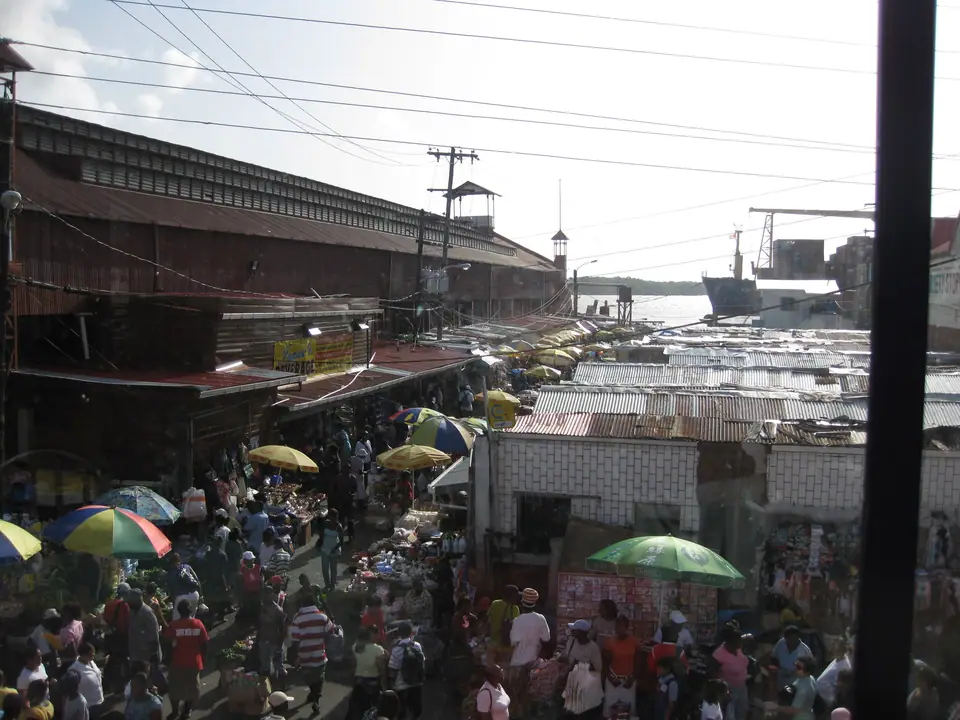
Photo: Loriski · CC BY-SA 4.0
Things to Do in Georgetown: Historic Architecture, Markets, and Rainforest Day Trips
Plan your time in Georgetown with our guide to historic timber architecture, coastal markets, botanical gardens, and rainforest day trips across Guyana.
Georgetown presents a distinctive urban landscape formed by Dutch colonial drainage canals and grand nineteenth-century timber buildings. Built predominantly from rot-resistant native greenheart wood, the capital of Guyana stands below sea level along the Atlantic coast. Travellers who pause to explore the city before heading into the interior rainforest find historic markets, urban wildlife sanctuaries, and important anthropological collections. You can link these key sights together through our structured 3-day Georgetown itinerary.
St. George's Cathedral and Downtown Timber Architecture
Georgetown contains some of the finest wooden Victorian structures in the Americas. At the centre stands St. George's Cathedral, designed by Sir Arthur Blomfield and officially opened on 24 August 1892. Reaching a height of 43.5 metres, or 143 feet, this Anglican cathedral remains one of the tallest freestanding timber churches in the world. Its vast interior features soaring Gothic arches, hanging brass chandeliers, and intricate woodwork assembled without steel structural frames.
Walking south down Avenue of the Republic reveals additional architectural landmarks. These include the 1889 Gothic Revival wooden City Hall designed by Father Ignatius Scoles, the 1887 Victoria Law Courts, and the 1858 State House. Nearby stands the 1834 Parliament Building, designed by Joseph Hadfield with classical brick and stucco. These civic structures represent an ambitious era of coastal construction that relied heavily on local greenheart timber to withstand humidity and tropical insects.
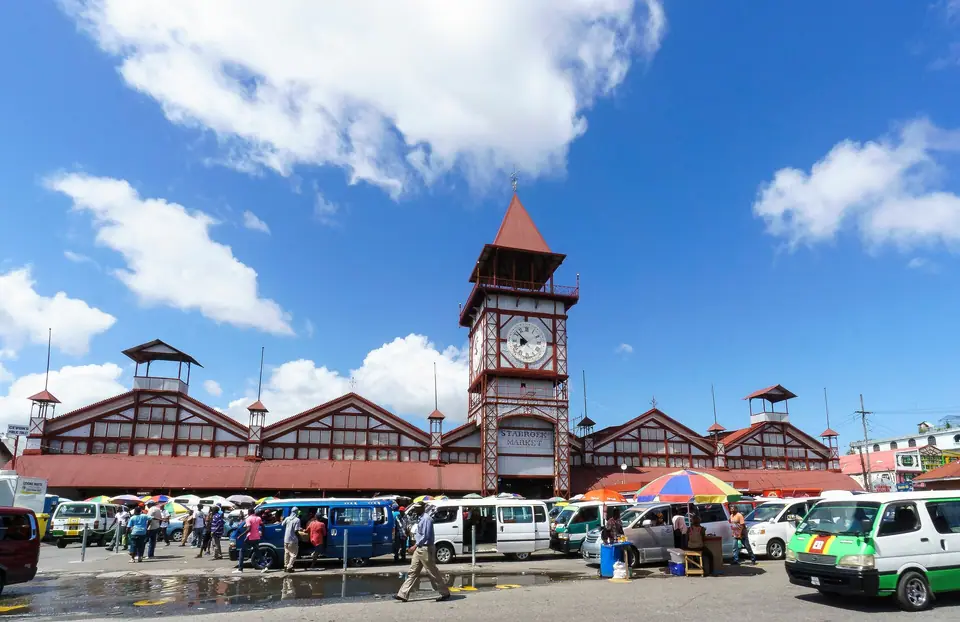
Stabroek Market, Bourda Market, and Water Street Trade
Commerce in Georgetown centres on its historic municipal markets. Overlooking the Demerara River on Water Street, Stabroek Market covers an expansive iron-and-steel pavilion assembled in 1881 by the Edgemoor Iron Company of Delaware. Its distinctive red-and-white clock tower dominates the city skyline. Behind the iron market hall, passenger speedboats depart from the ferry stelling, connecting commuters across the river estuary to West Demerara.
Further east in central Georgetown, Bourda Market provides an energetic open-air grocery experience. Wooden vendor stalls display regional agricultural produce, including soursop, sapodilla, ground provisions, and fiery wiri-wiri chillies. Local traders sell glass bottles of dark cassareep, an essential boiled cassava extract used to make traditional Guyanese pepperpot. Exploring the perimeter streets offers immediate insight into the culinary culture of the capital.
Georgetown Botanical Gardens and Urban Manatee Ponds
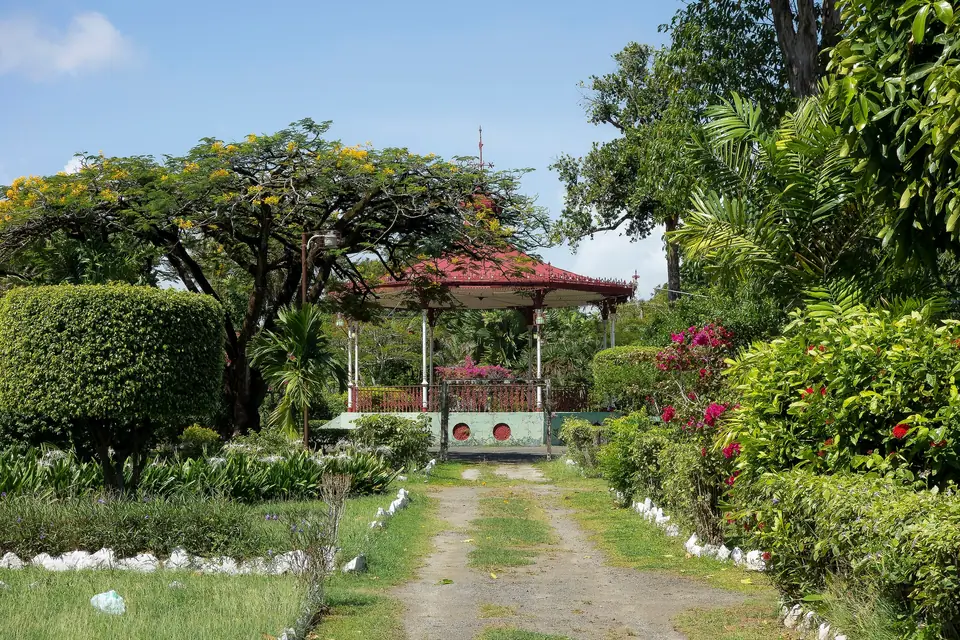
Established in 1879 on former plantation land, the Georgetown Botanical Gardens was designed by botanists John Frederick Waby and George Samuel Jenman. The grounds feature classical Victorian cast-iron Kissing Bridges crossing drainage lagoons filled with native Victoria amazonica water lilies. The tranquil park preserves extensive tropical trees and flowering shrubs that provide shelter for urban wildlife.
The freshwater ponds within the park are famous for their resident population of semi-wild West Indian manatees. Visitors frequently gather along the grassy banks to pluck handfuls of fresh grass, which the gentle aquatic mammals rise to eat directly from outstretched hands. Beyond the waterways, the grounds function as a prime birdwatching destination. More than 200 bird species live within the park borders, including the festive parrot and the endemic blood-coloured woodpecker.
Main Street Museums and Cultural Monuments
Main Street serves as the cultural avenue of the capital, shaded by towering cabbage palms and colonial brick walkways. The Walter Roth Museum of Anthropology, founded in 1974 inside a magnificent late-Victorian wooden residence, houses artifacts from Guyana's nine indigenous nations. Exhibits display ancient stone tools, feather headdresses, and woven cassava presses. A short walk south leads to the Guyana National Museum, founded in 1868, which documents natural history and colonial industrial relics.
Further east on Vlissengen Road stands Castellani House, designed between 1879 and 1882 by architect Cesar Castellani. This multi-storey greenheart mansion originally served as the official residence for the government botanist before becoming the National Gallery of Art. Adjacent to the building sits the bronze 1763 Monument, created by sculptor Philip Moore to honour the national hero Cuffy and the historic Berbice slave rebellion.
Rainforest Flights to Kaieteur Falls
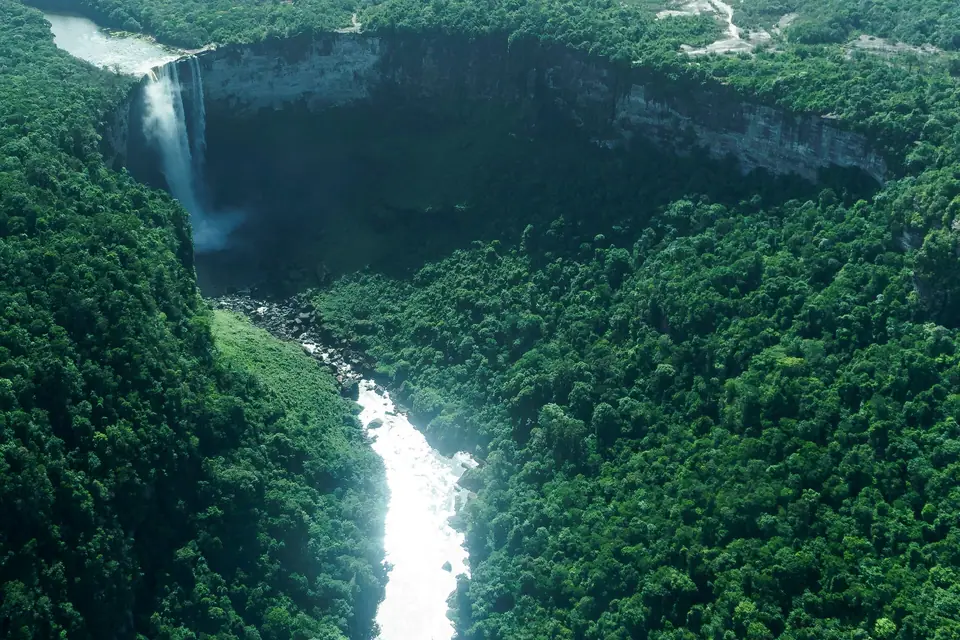
The premier natural day excursion from the capital is a flight to Kaieteur Falls. Small aircraft depart from Eugene F. Correia International Airport in Ogle, flying roughly 50 minutes southwest over unbroken Amazonian canopy before touching down on the remote airstrip in Kaieteur National Park. The Potaro River plunges 226 metres over an immense sandstone cliff, creating the world's tallest single-drop waterfall.
Guided walking trails wind through the moist cloud forest surrounding the gorge. The park protects unique microhabitats, including giant tank bromeliads that shelter endemic golden rocket frogs. Visitors also frequently spot the brilliant orange plumage of the Guianan cock-of-the-rock in the rocky undergrowth. Tour operators organise these aerial excursions as half-day return trips, offering an effortless contrast to the coastal city streets.
Georgetown Sights and Day Trips Summary
| Attraction | Primary Highlight | Key Setting |
|---|---|---|
| St. George's Cathedral | Historic 43.5-metre timber architecture | Church Street and Avenue of the Republic |
| Stabroek Market | 1881 iron clock tower and river stelling | Water Street along the Demerara River |
| Botanical Gardens | West Indian manatees and 200 bird species | Vlissengen Road and Regent Street |
| Walter Roth Museum | Indigenous Amerindian anthropological collections | Historic timber mansion on Main Street |
| Kaieteur Falls | 226-metre single-drop waterfall excursion | Potaro River in Kaieteur National Park |
Weather Planning and Tropical Seasons
Georgetown features a hot, humid tropical marine climate tempered by Atlantic trade winds. Open-Meteo climate data recorded between 2015 and 2024 shows warm conditions throughout the year. Daytime highs range from 28.8°C in January to 31.8°C in October. Nighttime lows remain steady between 23.3°C and 24.7°C across all twelve months.
Precipitation follows two distinct rainy seasons. The primary wet season begins in May, bringing 133 millimetres over 19 wet days. June follows with 161 millimetres across 23 wet days, and July records 147 millimetres across 21 wet days. A secondary wet spell occurs in December, producing 126 millimetres over 18 wet days, and January brings 112 millimetres across 16 wet days. The most reliable dry periods run from February to April and from September to November, when monthly rainfall drops to 63 millimetres across nine wet days. Plan walking tours in the early morning to avoid midday heat and sudden equatorial downpours.
Where it is
- 1Georgetown
- Eugene F. Correia International Airport (OGL) · about 5 km from Georgetown in a straight line
- Cheddi Jagan International Airport (GEO) · about 35 km from Georgetown in a straight line
- Directions in Google Maps
Stations and taxi ranks: OpenStreetMap. Airports: OurAirports. Distances are in a straight line.
Traveller tips
Real advice from people who have been to Georgetown. Every tip is read by our team before it goes live.
No tips yet. Been here? Yours could be the first.
Thank you! Your tip will appear here after a quick review.
More in Georgetown
Continue exploring Georgetown with related neighbourhood, food, and planning guides
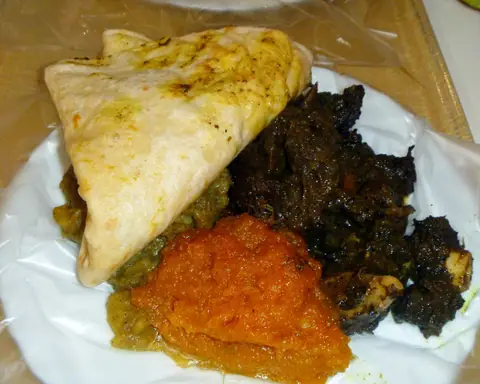
What to Eat in Georgetown: Pepperpot, Cook-Up Rice, Seven Curry and Demerara Rum
Georgetown, Guyana
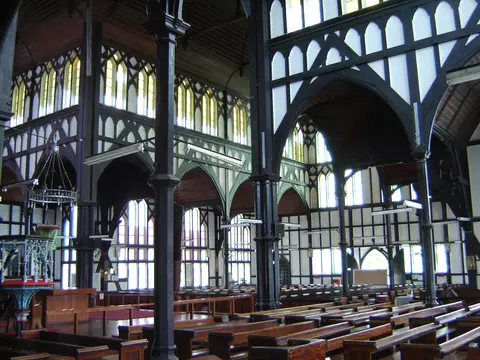
St. George's Cathedral, City Hall and Georgetown Wooden Heritage
Georgetown, Guyana
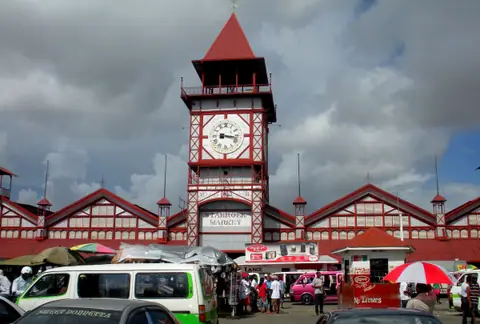
Stabroek Market, Bourda Market and Water Street Guide
Georgetown, Guyana
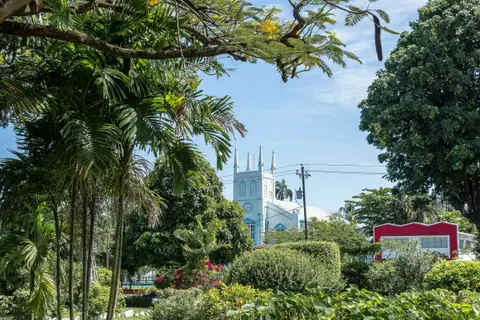
Georgetown Botanical Gardens, Manatees and Promenade Gardens Guide
Georgetown, Guyana
