How to Get to Prague and Navigate the City Transit Network
Navigate Prague with ease using our comprehensive guide to airport transfers via Trolleybus 59, international rail links, metro lines, and PID ticket validation rules.
Prague operates one of the most efficient, punctual, and walkable public transport systems in Central Europe. A unified transit authority coordinates the metro, trams, city buses, and specific river ferries, which means a single validated ticket lets you switch between modes without fuss. Most visitors rarely need a private taxi once they understand how the primary connections operate between Václav Havel Airport Prague (PRG), the central railway hubs, and the historic quarters.
Before you begin planning your daily route across the river, it helps to orient yourself with our wider Prague Travel Guide: What to Know Before You Go so you understand the urban layout.
Václav Havel Airport to Prague City Centre
Václav Havel Airport sits approximately 17 kilometres northwest of the historic centre. Because no direct heavy rail or underground line runs into the terminals yet, road-based public transit provides the primary link to the Prague Metro network.
Note that travellers occasionally confuse Prague Airport with regional airfields in neighbouring territories. Václav Havel Airport Prague (IATA code: PRG) is the only commercial international airport serving the capital of the Czech Republic.
- Trolleybus 59 to Metro Line A (Green): High-capacity articulated electric trolleybuses depart directly outside Terminal 1 and Terminal 2 every 4 to 5 minutes during peak daytime periods. The ride to Nádraží Veleslavín takes roughly 15 to 17 minutes. At Nádraží Veleslavín, escalators and lifts lead straight down to Metro Line A. From there, trains carry you to Malostranská below the castle, Staroměstská for the Old Town, or Můstek at Wenceslas Square in under 15 minutes. A standard 90-minute transit ticket covers the entire journey. Door-to-door transit time to central hotels is around 45 minutes.
- Bus 100 to Metro Line B (Yellow): This service runs from the airport terminals to Zličín station, the western terminus of Metro Line B, in approximately 18 minutes. It offers a convenient connection if your accommodation is located in Smíchov, Anděl, or southern districts. You can consult our curated area breakdown in Where to Stay in Prague: Neighbourhoods Compared to confirm which metro line matches your hotel address.
- Airport Express (AE Coach): This dedicated direct bus links both airport terminals to Praha hlavní nádraží (the main railway station on Metro Line C). The journey takes around 40 minutes depending on street traffic. Standard city transport tickets and multi-day passes are not valid on the Airport Express. Passengers must purchase a separate dedicated ticket directly from the driver or airport transit counters.
- Overnight Bus 910: When the daytime metro lines shut for the night, Bus 910 provides a direct link between the airport and central stops, including Karlovo náměstí and I. P. Pavlova.
Comparing Prague Airport Transfer Options
| Route Option | Connection & Terminus | Typical Travel Time | Ticket Type Required | Best For |
|---|---|---|---|---|
| Trolleybus 59 to Metro A | Nádraží Veleslavín (Line A) | 35 to 45 minutes total | Standard PID ticket or multi-day pass | Old Town, Malá Strana, Wenceslas Square |
| Bus 100 to Metro B | Zličín (Line B) | 40 to 50 minutes total | Standard PID ticket or multi-day pass | Smíchov, Anděl, southwestern districts |
| Airport Express (AE) | Praha hlavní nádraží (Line C) | Around 40 minutes | Dedicated AE fare only (no PID passes) | Direct rail transfers, heavy luggage |
| Night Bus 910 | I. P. Pavlova / Karlovo náměstí | 45 to 55 minutes | Standard PID ticket or multi-day pass | Late-night arrivals after midnight |
International Trains to Praha Hlavní Nádraží
Prague connects smoothly to neighbouring European capitals via České dráhy (Czech Railways) and international partner rail networks. Most cross-border trains pull directly into Praha hlavní nádraží, situated a short walk from Wenceslas Square and directly connected to Metro Line C.
- Arriving from Munich: Direct Alex and České dráhy regional express trains (known as the Západní expres) run every two hours. The rail journey cuts through western Bohemia and arrives in Prague in approximately 5.5 hours.
- Arriving from Berlin and Dresden: EuroCity services travel down the picturesque Elbe River valley, pulling into Prague in roughly 4.5 hours from Berlin or just over 2 hours from Dresden.
- Arriving from Vienna, Budapest, or Bratislava: Modern Railjet and EuroCity trains provide frequent daily connections across flat plains, taking roughly 4 hours from Vienna or under 2.5 hours from Bratislava.
- Arriving from London or Paris: No direct high-speed daytime passenger train exists between London or Paris and Prague. Travellers from London typically fly (roughly 2 hours flight time) or combine the Eurostar to Brussels with high-speed ICE connections through Frankfurt to Prague (a journey exceeding 12 hours). Passengers from Paris choose between direct commercial flights (around 1 hour 45 minutes) or overnight sleeper and daytime rail combinations routed through Germany.
- Long-Distance Coaches: International bus operators serve the Florenc central bus station, positioned at the interchange of Metro Lines B and C.
Understanding the Prague Metro and Tram System
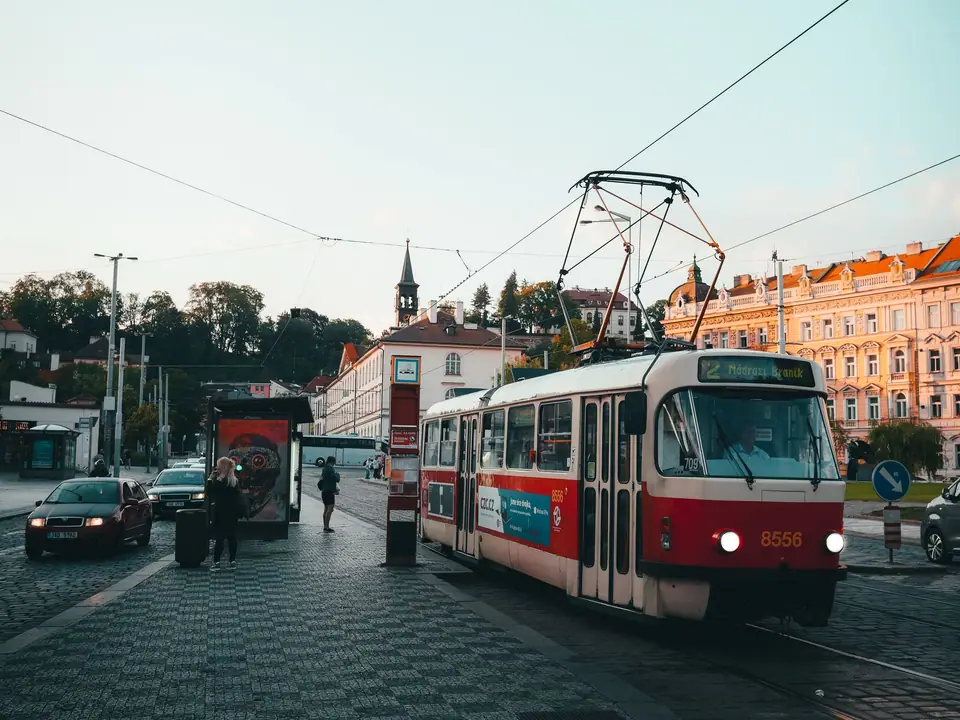
The urban transport network is structured around three underground metro lines and a dense web of street trams. Metro lines intersect in a central triangle: Můstek (Lines A and B), Muzeum (Lines A and C), and Florenc (Lines B and C).
Trams operate across the entire historic bowl. Tram 22 is famous among visitors because it threads past the National Theatre, crosses the Vltava River into Malá Strana, and climbs up to the northern gates of Prague Castle before continuing to Pohořelec. You can learn how to link this tram climb with a walking descent through historic courtyards by reading our companion guide to Prague Castle and Malá Strana: How to Visit. Tram 22 is exceptionally popular, so stay alert to your personal belongings during crowded boardings.
After midnight, standard trams and metro trains stop running. A dedicated night tram network takes over, with all night routes meeting at the central interchange stop at Lazarská at regular intervals.
Ticket Types and Validation Rules
Prague Integrated Transport (PID) operates on a time-based fare structure rather than charging per station. Standard single tickets allow unlimited transfers between metro, tram, and city bus lines within their validity window, which is typically set at 30 minutes or 90 minutes. Visitors staying for multiple days frequently choose 24-hour or 72-hour tourist passes.
You can purchase digital tickets using the official PID Lítačka mobile app. If you use the app, activate your ticket at least one full minute before entering the paid metro zone or boarding a vehicle, as the digital countdown must complete before your pass is legally valid. Physical paper tickets can be bought at station vending machines and newsagents. Yellow mechanical validation boxes sit at the top of all metro station escalators and inside every tram and bus. You must insert your paper ticket once into the slot to stamp the time and date. Never stamp a paper ticket a second time, which invalidates the pass.
Prague transport operates without mechanical barrier gates, but plain-clothes ticket inspectors conduct random checks across platforms and vehicles. Always keep your validated paper ticket or active app screen ready for inspection until you exit the station.
Where it is
- 1Prague
- Václav Havel Airport Prague (PRG) · about 13 km from Prague in a straight line
- Directions in Google Maps
Stations and taxi ranks: OpenStreetMap. Airports: OurAirports. Distances are in a straight line.
Traveller tips
Real advice from people who have been to Prague. Every tip is read by our team before it goes live.
No tips yet. Been here? Yours could be the first.
Thank you! Your tip will appear here after a quick review.
More in Prague
Continue exploring Prague with related neighbourhood, food, and planning guides