Quick Field Data
- UNESCO Inscription: 1981 · Cultural Criteria (ii), (iv)
- Scale & Footprint: 65 hectares (160 acres) of protected historic centre with eight Roman and Provençal Romanesque monument groups
- Access & Ticketing: In the walkable centre of Arles; municipal monument passes cover the Amphitheatre, Roman Theatre, Cryptoporticus, Thermes of Constantine, Alyscamps and Cloister of Saint-Trophime
- Arrival Logistics: Beside the Rhône in the Provence-Alpes-Côte d'Azur region of southern France, linked by regional rail and road to Mediterranean hubs led by Marseille
From Roman Colony on the River Rhône to Medieval Capital of Provence
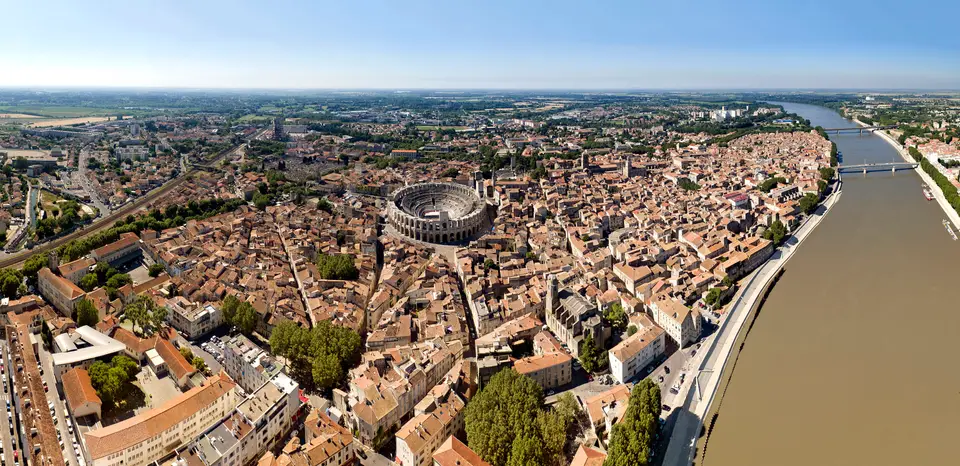
The 65-hectare (160-acre) historic core of Arles lies on the banks of the River Rhône in the Provence-Alpes-Côte d'Azur region of southern France. It was inscribed in 1981 as Arles, Roman and Romanesque Monuments (in French, Arles, monuments romains et romans), and you can find it in our UNESCO World Heritage Atlas. The site shows how an ancient Classical city adapted its street grid, public spaces and monuments to medieval European life. Medieval Arles did not grow on a new site outside the ancient walls. It grew directly out of the structures left by Antiquity, turning Roman arenas, baths and cemeteries into the civic and spiritual heart of a busy Mediterranean city.
Three great periods shaped the eight monument groups inside the 65-hectare area. The earliest buildings, the Arles Amphitheatre (arena), the Gallo-Roman theatre and the underground galleries of the Cryptoporticus beneath the Roman forum, date from the 1st century BC and the 1st century AD. In this period the Romans brought the full range of imperial city buildings to Gaul, on a site that already had earlier Greek foundations. In Late Antiquity, from the 4th to the 6th centuries, Arles rose to become a leading political and religious capital and enjoyed a second golden age. The riverside public baths known as the Thermes of Constantine (Baths of Constantine) and the marble sarcophagi of the Alyscamps cemetery date from this time.
In the early Middle Ages the city adapted to danger. The Roman amphitheatre became a walled fortress, and the Thermes of Constantine became a count's palace. In the 11th and 12th centuries Arles flowered a third time as one of the leading cities of the Mediterranean world. Inside the medieval walls and along the Alyscamps, masons and sculptors drew directly on the Roman ruins around them. They created major works of Provençal Romanesque art, above all the 12th-century Church of Saint-Honorat and the Church of Saint-Trophime, with its carved portal and canons' cloister.
The First-Century BC and First-Century AD Roman Monuments
The Arles Amphitheatre (arena) anchors the northern and central old town and forms an outstanding group with the nearby Roman Theatre and the Cryptoporticus. It was built in the late 1st century AD as a monumental oval arena for public shows. Its tiers of stone arcades and vaulted inner corridors still dominate the skyline. In the troubled centuries after the end of the Roman Empire, local people walled up the outer arches and turned the amphitheatre into a fortified citadel inside the city. Houses, lanes and defensive towers were built inside the oval seating bowl and the stone galleries. The arena became a self-contained walled quarter that sheltered townspeople for centuries, until modern conservation cleared the arcades. It is a clear example of the practical reuse of ancient building that marks Arles.
Just south-west of the arena stands the Gallo-Roman theatre (Roman theatre), from the 1st century BC. Much of its stone seating and stage wall was quarried away in the Middle Ages. The surviving semicircular tiers of the cavea and the standing marble columns still show the civic grandeur the Romans brought to Gaul. Around the historic core survive sections of the Ramparts of the Roman castrum, which protected the ancient river port on the Rhône.
West of the theatre, beneath the present City Hall and the neighbouring Chapel of the Jesuit College, lie the Cryptoporticus and the Roman forum. Built in the 1st century BCE, these cool underground stone galleries held up the level terrace of the Forum of Arles above. They may also have served as slave quarters or vaulted stores. Beside the forum, in the courtyard of the Museon Arlaten, stands the curved stone colonnade of the Roman exedra, which completes the 1st-century civic centre. Together, the Cryptoporticus, the Forum of Arles, the exedra, the Gallo-Roman theatre, the Amphitheatre and the Ramparts of the Roman castrum show how Roman planners built level public squares and great entertainment venues on the sloping ground beside the River Rhône.
4th-century Splendour: The Baths of Constantine and the Alyscamps
In the 4th century CE, when Arles entered its second golden age as an imperial capital of Late Antiquity, builders raised the Thermes of Constantine (French: Thermes de Constantin) on the bank of the River Rhône. Built of alternating bands of brick and limestone, this large public bath complex keeps its tall vaulted hot rooms and a semicircular apse. These were later built into a medieval count's palace before being uncovered and preserved as a historic monument.
South-east of the historic city walls lies the Alyscamps, the famous cemetery of ancient and medieval Arles. Its avenue is lined with stone sarcophagi from the Roman period and Late Antiquity (4th to 6th centuries), and it remained a prestigious Christian burial ground throughout the Middle Ages. Near the end of the walk stands the Church of Saint-Honorat, built in the 12th century in the Provençal Romanesque style over the ancient cemetery.
Provençal Romanesque Revival: Saint-Trophime and the 1178 Coronation
Inside the city walls, beside the City Hall and the Cryptoporticus, stand the Church of Saint-Trophime (Church of St. Trophime) and its cloister, among the finest Romanesque monuments in Provence. Built in the 11th and 12th centuries, the church shows the lasting influence of Classical Antiquity on medieval Provençal architecture and sculpture. In 1178 the German emperor Frederick Barbarossa was crowned King of Arles in this church, and its richly carved western portal belongs to the same late 12th-century flowering. Beside the nave, the Cloister of Saint-Trophime surrounds a quiet stone courtyard. Its carved piers and capitals link Roman decorative motifs with medieval Christian stories.
Walking the 65-Hectare Monument Circuit in Arles
The eight parts of the World Heritage site lie within easy walking distance of each other in the 65-hectare historic centre. The Roman street grid and squares still shape daily life in Arles, so you can follow two thousand years of Mediterranean city history in one continuous walk. You can study the Classical Corinthian capitals and carved scenes on the 12th-century portal of the Church of Saint-Trophime, where Emperor Frederick Barbarossa received the crown of the Kingdom of Arles in 1178. You can also walk past the Roman and 4th-century sarcophagi of the Alyscamps to the Romanesque Church of Saint-Honorat. Everywhere, Antiquity and the Middle Ages form one fabric of buildings.
- Entry and Route Across the Historic Centre: Start in the central square beside the City Hall, with the portal and carved cloister of the Church of Saint-Trophime, where the 1178 coronation took place. Then go down beneath the City Hall and the Jesuit College chapel into the galleries of the 1st-century BC Cryptoporticus, and see the nearby Roman exedra in the courtyard of the Museon Arlaten.
- Tickets and Viewpoints: Head east through the column ruins of the Gallo-Roman theatre and climb the upper tiers of the Arles Amphitheatre for views over the tiled roofs to the River Rhône. Next, visit the 4th-century Thermes of Constantine by the river, follow the Ramparts of the Roman castrum and walk the sarcophagus-lined Alyscamps to the 12th-century Church of Saint-Honorat. Check the official site for combined monument passes.
- Timing and Onward Connections: See the open-air theatre, amphitheatre and Alyscamps in morning or late afternoon light, and keep the shaded Cryptoporticus and Cloister of Saint-Trophime for midday. Link Arles with our regional guide to Marseille and our UNESCO World Heritage Atlas.
