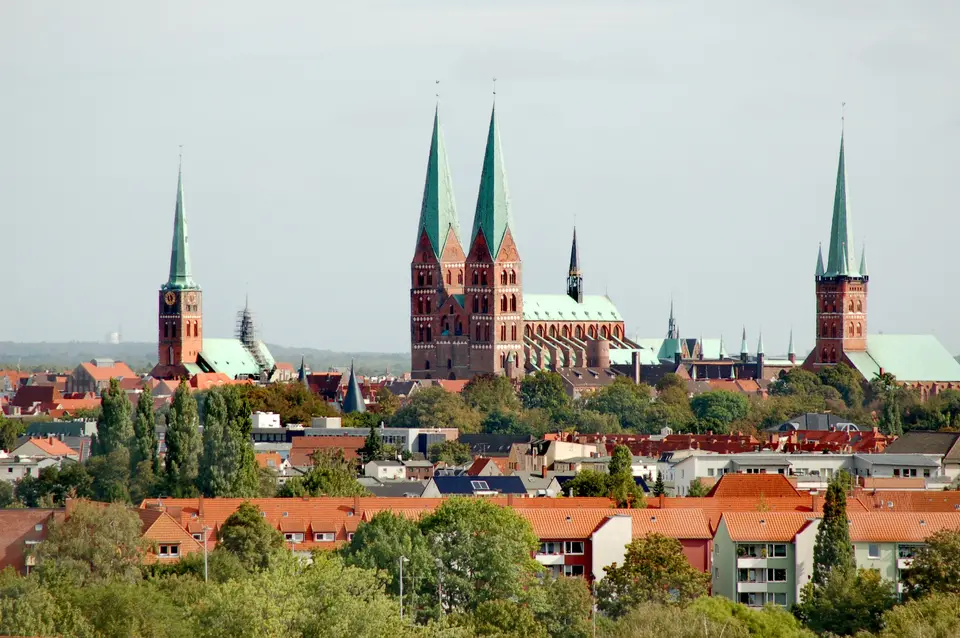
Quick Field Data
- UNESCO Inscription: 1987, as a historic city on the Baltic coast of northern Germany.
- Scale & Footprint: Three protected areas on the Old Town island, from the Burgkloster of 1227 in the north to the St Aegidien quarter in the south. They include the Holstentor gate, the salt warehouses, merchants' houses and the narrow courtyard alleys called Gänge.
- Access & Ticketing: The streets, Gänge and waterfronts are open all year. The Holstentor museum, the European Hansemuseum, the Burgkloster and the church towers charge entry, so check the official sites before you go.
- Arrival Logistics: In northern Germany near the Baltic coast and Hamburg, around 57 kilometres north-east of Hamburg by regional train and Baltic ferries.
Lübeck's Old Town sits on a long island ringed by the River Trave and its canals, near the Baltic coast and connected closely to Hamburg. For about three centuries, from around 1230 to 1535, it was the unofficial capital and "Queen" of the Hanseatic League, the great trading alliance of northern Europe. Count Adolf II of Schauenburg and Holstein founded the town in 1143. After a fire, Duke Henry the Lion of Saxony refounded it in 1159. Lübeck soon outgrew older Baltic trading centres such as Birka, Haithabu, Schleswig and Visby. In 1226 Emperor Frederick II made it a Free Imperial City, answering only to the emperor. After the Danish defeat at the Battle of Bornhöved in 1227, the citizens built the Dominican Burgkloster on the site of the old castle. Lübeck became the legal, diplomatic and maritime link between the North Sea and the Baltic. Listed in 1987 and featured in our UNESCO World Heritage Atlas, the Old Town keeps 15th- and 16th-century merchants' houses, great Brick Gothic churches, salt warehouses and the twin-towered Holstentor gate.
Two parallel streets run along the ridge of the island, and walking them is like reading a map of medieval trade. On the western slope, down towards the quays and salt warehouses, lived the wealthy long-distance merchants. They shipped salt from Lüneburg, later carried along the Stecknitz Canal of 1391 to 1398, to Scania in southern Sweden, where it was used to preserve herring. In return they brought furs, wax, timber, grain and flax from Novgorod, copper and iron from Sweden, dried fish from Bergen and cloth from Bruges and London. On the eastern slope lived small traders and craftsmen. Behind the merchants' houses, narrow brick passages called Gänge lead to hidden courtyards. There, small rented cottages, the Buden, housed craftsmen and sailors.
Lübeck Law, Brick Gothic Spires, and the 200-Town Hanseatic Network
From its alliance with Hamburg in 1241, Lübeck spread both its laws and its architecture across some 200 towns, from Estonia and Russia to the Netherlands. Many Baltic ports, such as Wismar, Rostock, Stralsund, Riga and Reval (Tallinn), adopted Lübeck Law. Lübeck's city council then served as their highest court of appeal. In the same way, Lübeck's tall red-brick churches, above all St Mary's and the Cathedral, set the model for Brick Gothic churches and town halls around the Baltic.
From the 14th century, envoys from the member towns met in Lübeck at the Hanseatic Diet, or Hansetag. There they passed binding decisions and set rules for trade and safety at sea. The league relied on fleets of broad cargo ships called cogs and later larger hulks and carracks. Lübeck's great warship Adler von Lübeck was launched in 1566. When needed, the league used blockades and boycotts against Novgorod, Norway and Flanders. Its power peaked in the war with Denmark of 1361 to 1370. In 1367 the towns formed the Confederation of Cologne, and in 1368 their forces sacked Copenhagen. The Treaty of Stralsund in 1370 gave the league control of fortresses on the Øresund for 15 years.
Walking the Three Protected Zones from the Burgkloster to the Holstentor
An Allied air raid in 1942 destroyed about a fifth of historic Lübeck. It badly damaged the Cathedral, St Peter's, St Mary's and the merchants' houses near the river. After the war, the great churches were rebuilt, while the medieval street plan and three intact areas survived to form the World Heritage Site. The main area runs from the Burgkloster in the north, now part of the European Hansemuseum, to the craftsmen's quarter of St Aegidien in the south. The second covers merchants' houses in the south-west of the island. The third takes in the western approach, with the Holstentor and the salt warehouses beside the river.
- Begin at the Holstentor and the riverside salt storehouses: Start at the 15th-century Holstentor and the gabled salt warehouses by the Trave. They show how salt and herring paid for Lübeck's rise. Check the official site for museum entry.
- Step through the narrow Gänge into the rear Buden courtyards: On the eastern and southern streets towards St Aegidien, duck through the low archways between house fronts. Behind them lie quiet medieval alleys and tiny cottages.
- Trace Hanseatic history from the Burgkloster to St Mary's: Visit the Burgkloster and the European Hansemuseum at the north end of the island, easy to reach by direct train from Hamburg. Then walk south past St Mary's, St Peter's and the Cathedral.
Rival Powers, the 1669 Last Diet, and Modern Hanseatic Identity
In the 15th and 16th centuries Lübeck struggled to hold the league together. It faced revolts by its own craftsmen and a war with King Eric of Pomerania, during which a Hanseatic fleet attacked Copenhagen in 1428. Dutch ships broke into the Baltic grain trade, and in 1494 Tsar Ivan III closed the Hanseatic office in Novgorod. Waterways still frame the island. In 1598 Queen Elizabeth I expelled the league from its London base, the Steelyard. After the Thirty Years' War, the last Hanseatic Diet met in 1669, and the medieval league quietly came to an end.
Lübeck, Hamburg and Bremen kept working together as Hanseatic cities into the 19th century and even sent a joint envoy to the United States. Lübeck stayed a self-governing city until 1937, when it was merged into the state of Prussia. In 1980 a new Hanseatic league of towns, "The Hansa", was founded in Zwolle in the Netherlands, with its headquarters in Lübeck. The city's seafaring past lives on in its brick-gabled lanes, salt warehouses and quiet courtyards.
