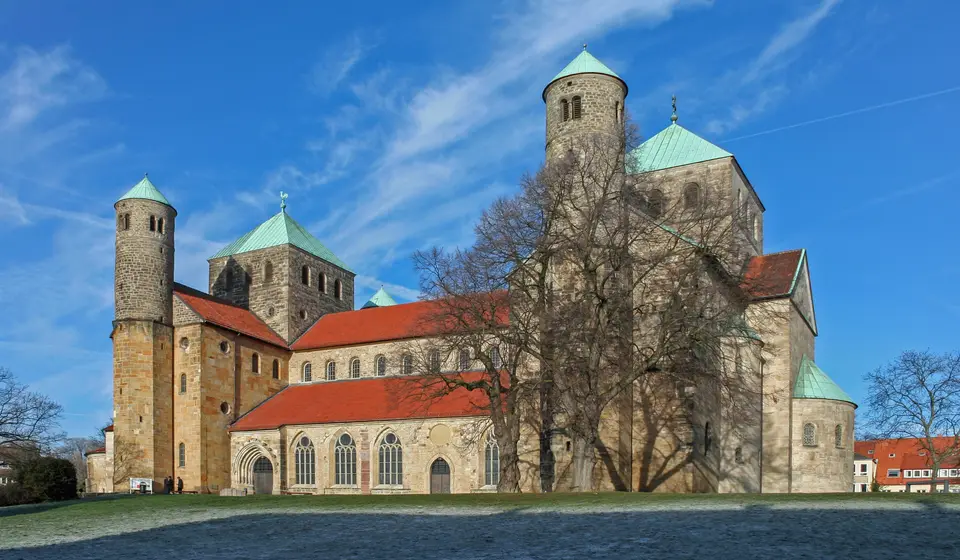
Quick Field Data
- UNESCO Inscription: 1985 (buffer zone extended in 2008), as outstanding examples of Ottonian Romanesque architecture and monumental bronze casting in the Holy Roman Empire.
- Scale & Footprint: An inscribed area of 0.58 hectares (inside a 157.68-hectare buffer zone) in Hildesheim; St Michael's Church is 74.75 metres long and 22.75 metres wide across the nave.
- Access & Ticketing: St Michael's Church (Lutheran nave, Catholic crypt) and St Mary's Cathedral with its museum are open daily outside services; check the official site for museum and crypt admission.
- Arrival Logistics: In the city of Hildesheim in Lower Saxony, northern Germany, linked by rail and road across Lower Saxony towards Dortmund.
St Mary's Cathedral and St Michael's Church stand on two low hills in the historic centre of Hildesheim, in Lower Saxony, northern Germany. Together they are the most complete group of buildings and art surviving from the Ottonian Renaissance of the Holy Roman Empire. Inscribed in 1985 and listed in our UNESCO World Heritage Atlas, the site covers 0.58 hectares inside a 157.68-hectare buffer zone. Both churches took shape around the year 1000 under Bishop Bernward of Hildesheim, who served as bishop from 993 to 1022. The balanced double-choir plan of St Michael's and the great lost-wax bronze castings of the Bernward Doors and the Bernward Column, now in St Mary's Cathedral, mark a turning point in medieval European art. Visitors coming from Dortmund and across northern Germany find two early eleventh-century monuments carefully rebuilt after wartime destruction. Six Romanesque towers stand out on the skyline.
Bishop Bernward, Emperor Otto III, and the Ottonian Renaissance
Hildesheim's eleventh-century flowering came from the vision of Bishop Bernward, a scholar, courtier and skilled craftsman. He was private tutor to the young Emperor Otto III before he became Bishop of Hildesheim in 993. Trained himself in painting, book illumination, architecture and bronze work, Bernward went with Otto III to Rome. There he studied the great timber-roofed basilicas of early Christianity and the spiral victory columns of imperial Rome. Back in Old Saxony, he set out to make his see a northern sacred centre worthy of the renewed Christian empire.
Half a kilometre north of the medieval city walls, on a rise above the River Innerste, Bernward founded a Benedictine monastery dedicated to the Archangel Michael. The rise is now called the Michaelishügel (St Michael's Hill), next to the Baroque Magdalenengarten park and the Gymnasium Andreanum. Work on the abbey church began in 1010. Bernward consecrated the unfinished church on the feast of Saint Michael, 29 September 1022, only weeks before he died. His successor, Bishop Godehard, finished the monastery buildings in the early 1030s, consecrated the church again and moved Bernward's remains into the western crypt under the choir.
Over the following centuries both churches survived fires, religious division and twentieth-century war. After a severe fire in 1046, St Mary's Cathedral was rebuilt over its original crypt, taking up the pattern of alternating columns and piers first used at St Michael's, in slimmer proportions. At St Michael's, a twelfth-century fire led to major rebuilding and a new consecration in 1186 by Bishop Adelog of Dorstedt, helped by Prince-Bishop Tammo of Verden. During the Reformation, around 1542, St Michael's became a simultaneum, a church shared by two faiths, which it still is today. The main upper church is Lutheran, while the western crypt where Bishop Bernward is buried remains Roman Catholic. On 22 March 1945 a British air raid badly damaged both churches. St Michael's was carefully rebuilt between 1950 and 1957, and St Mary's Cathedral was fully restored, bringing back their clean Ottonian Romanesque forms.
Double-Choir Symmetry, the Lower Saxon System, and the Tree of Jesse Ceiling
The architectural historian Nikolaus Pevsner praised St Michael's as the oldest surviving example of an Early Romanesque exterior and a masterpiece of geometric planning. It is 74.75 metres long with walls 1.63 metres thick. The plan is a balanced double-choir basilica with apses at both ends: three in the east, and a single raised apse in the west above a cross-vaulted ambulatory crypt 18.36 metres long. Two projecting three-part transepts each measure 40.01 by 11.38 metres. A massive square lantern tower rises over each crossing, balanced by four slender round stair turrets on the ends of the transepts.
The nave is 27.34 metres long between the crossings, 22.75 metres wide with its side aisles (8.60 metres without them) and 16.70 metres high. The square of the crossing is the basic unit for the whole building. The nave arcades show the famous Lower Saxon alternation of supports: between each pair of square piers stand two round columns with cubic capitals. This three-part rhythm became a hallmark of Ottonian and Romanesque churches across central Europe. The painted stucco choir screens and angel reliefs beside the western crypt entrance survive from the twelfth-century rebuilding.
Above the nave of St Michael's is its famous flat painted wooden ceiling, made around 1230 and restored in 2010. It is 27.6 metres long and 8.7 metres wide and is made of more than 1,300 oak planks, which were taken down and stored safely before the 1945 air raid. This huge panel painting shows the Tree of Jesse: the royal and prophetic family tree of Christ, growing from Jesse through Christ's royal ancestors and the prophets up to Christ enthroned.
The Bernward Doors and Christ Column at St Mary's Cathedral
About ten minutes' walk south of St Michael's Hill is St Mary's Cathedral, with its treasury and Bishop Bernward's two greatest bronzes, among the first monumental hollow-cast bronzes made in Europe since antiquity. The towering Bernward Doors were begun after 1008 and cast in 1015, each wing in a single piece, probably first for St Michael's. They carry 16 high-relief panels set in matching pairs. Reading down the left wing are eight scenes from the early chapters of Genesis and the fall of humanity. Reading up the right wing are eight matching scenes from the life, passion and resurrection of Christ, setting the fall against redemption.
Nearby in the cathedral stands the bronze Bernward Column (Christ Column), cast around 1020 as a great victory column modelled on Trajan's Column in Rome. Instead of battles, its spiral frieze winds upwards through scenes from the Gospels showing the public life and miracles of Jesus. With the eleventh-century wheel chandelier and the reliquaries of the Cathedral Museum, these two bronzes make Hildesheim a cradle of Romanesque sculpture. Walking between the cloister of St Mary's Cathedral and the double-choir nave of St Michael's, visitors can compare Bernward's great bronze casting with the painted wooden panels of the thirteenth-century nave ceiling, all in one compact old town.
- Start at St Michael's to experience the double-choir geometry and oak ceiling: Enter by the south door on the Michaelishügel and stand in the nave to see the 1,300-plank Tree of Jesse ceiling of about 1230 overhead. Count the alternating square piers and cubic-capital columns, then go down into the Catholic western crypt with Bishop Bernward's sarcophagus.
- Read the 16 bronze panels of the Bernward Doors in pairs at St Mary's Cathedral: Walk south through the centre to St Mary's Cathedral to inspect the 1015 bronze doors, comparing each Genesis relief on the left with its matching Gospel scene on the right. Then inspect the spiral narrative bands wrapping the 1020 Bernward Column.
- Stroll through the adjacent Magdalenengarten for a full view of the six towers: Step west from St Michael's cloister into the terraced Magdalenengarten above the River Innerste for the clearest exterior view. From here you can see how the two square crossing towers and four round stair turrets balance the 74.75-metre basilica.
