Quick Field Data
- UNESCO Inscription: 1979 (cultural serial property in the Dordogne department, Nouvelle-Aquitaine region, southwestern France)
- Scale & Footprint: 15 inscribed prehistoric sites, decorated caves and rock shelters, in a 30-by-40-kilometre stretch of the Vézère Valley that holds 147 to more than 150 Palaeolithic deposits and 25 to 30 decorated caves
- Access & Ticketing: Run by the Centre des monuments nationaux and departmental heritage bodies; check the official site for strict daily limits (under 100 visitors a day at Font-de-Gaume and Les Combarelles) and for Lascaux IV bookings
- Arrival Logistics: Centred on Les Eyzies-de-Tayac-Sireuil, the "Capital of Prehistory", and on upstream Montignac, Rouffignac, Marquay, Peyzac-le-Moustier and Tursac in the Dordogne
Four Hundred Millennia of Human Occupation and the Birth of Prehistoric Archaeology
The Vézère winds between steep Cretaceous limestone cliffs and wooded hills in the Dordogne department of Nouvelle-Aquitaine. In an area of only about 30 by 40 kilometres, its decorated caves and rock shelters hold the richest concentration of Palaeolithic living sites and cave art in Europe. The valley was inscribed on the World Heritage List in 1979 and appears in our UNESCO World Heritage Atlas. The listing protects 15 key caves and rock shelters, called abris in French. They cluster around the riverside village of Les Eyzies-de-Tayac-Sireuil and nearby communes such as Montignac, Rouffignac, Marquay, Peyzac-le-Moustier and Tursac. The wider valley holds 147 to over 150 known Palaeolithic sites and 25 to 30 decorated caves. Together they span from 400,000 (or 450,000) to 10,000 (or 8,000) years ago.
Ice-age hunter-gatherers returned again and again to the sheltered, south-facing limestone overhangs above the Vézère, a river rich in game. Their hearths, flint workshops, bone tools and burials built up in deep layers, one above another. These layers became the world reference for European prehistory. Digs in the Dordogne began in 1810, but scientific archaeology started here in 1863. Over five months the French palaeontologist Edouard Lartet and his English partner Henry Christy excavated Grotte Richard, the Gorge d'Enfer shelters, Laugerie-Basse, Laugerie-Haute, Le Moustier and La Madeleine. In 1864 at La Madeleine they found an ivory plate engraved with a woolly mammoth. It proved beyond doubt that early humans had lived beside extinct ice-age animals.
In 1872 the archaeologist Gabriel de Mortillet named the main cultural periods of the Palaeolithic after sites in the Vézère valley. The Micoquien is named after La Micoque, lived in from roughly 450,000 to 100,000 years ago, with 10 metres of layers where the Tayacian industry was also found. The Mousterian, linked with Neanderthals from 160,000 to 40,000 years ago, is named after Le Moustier. A 45,000-year-old Neanderthal skull was found there in 1908, and there are other Neanderthal burials in the area at La Ferrassie, Le Regourdou and Roc de Marsal. The Magdalenian, from 17,000 to 12,000 years ago, is named after the Abri de la Madeleine in Tursac. Just as important was a find of 1868 at the Abri de Cro-Magnon in Les Eyzies. Five Aurignacian skeletons, four adults and a baby, dated to around 28,000 years ago, gave the name "Cro-Magnon" to the first modern humans in Europe.
Settling the Cave Art Debate: From La Mouthe and Font-de-Gaume to Lascaux
The rock shelters fixed the timeline of Stone Age tools. The caves settled one of the fiercest scientific arguments of the 19th century, over whether Palaeolithic people could paint and engrave deep underground. Decorated caves had been found at Chabot in 1879, Altamira in 1880 and Pair-non-Pair in 1881. Sceptics still dismissed the paintings as recent fakes. Then in 1895 the archaeologist Émile Rivière studied the cave of La Mouthe in Les Eyzies, found in 1894. He uncovered animal engravings 90 metres inside, sealed under ancient layers of stalagmite, and a carved stone fat-burning lamp decorated with an ibex. Six years later, in September 1901, the local schoolteacher and archaeologist Denis Peyrony, working with Henri Breuil and Louis Capitan, made two discoveries. In the narrow corridor of Les Combarelles, 300 metres long and 1 metre wide, used 13,000 to 11,000 years ago, they found more than 600 Magdalenian engravings. A few days later, in nearby Font-de-Gaume, they found more than 200 polychrome bison, horses, mammoths and reindeer dated to 17,000 years ago. The leading critic, Émile Cartailhac, then published his famous confession of 1902 in L'Anthropologie, "Mea culpa d'un sceptique".
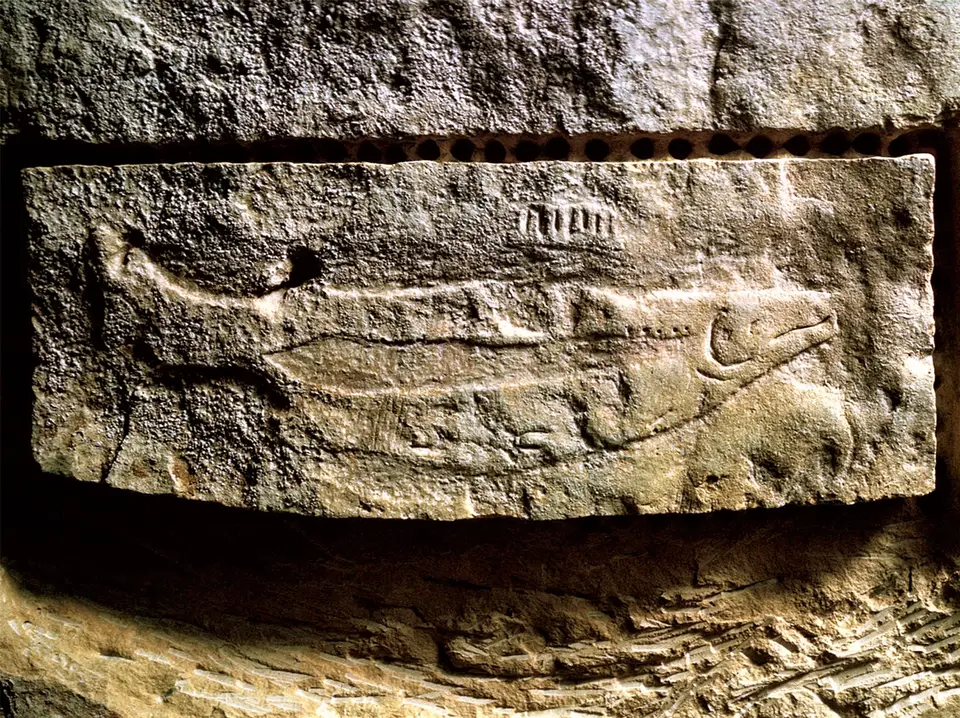
The greatest find came in September 1940: Lascaux Cave near Montignac. Its bright red, yellow and black mineral pigments preserve around 600 painted figures and hundreds of engravings. About 100 major animals, aurochs, horses, stags and bison, date to approximately 17,000 years ago and are famous for their life and sense of perspective. The 15 listed sites also include fine carved reliefs and small portable art. At the Abri du Poisson in the Gorge d'Enfer (found in 1892, fish carving recognised in 1912), a relief of a salmon 1 metre long dates to the Middle Gravettian, around 25,000 years ago. It is one of the oldest images of a fish in the world. The Cap Blanc shelter in Marquay is 15 metres long; it was found in 1908, and the skeleton of the Magdalenian Girl was found there in 1911. Its deep limestone frieze, 13 metres long and 2 metres high, shows 10 life-size horses and bison.
At Laugerie-Basse, lived in 14,000 years ago, Paul Hurault, 8th Marquis de Vibraye, found the ivory "Vénus impudique" in 1864. It lies next to the 200-metre Laugerie-Haute shelter, used from 24,000 to 15,000 years ago. At La Madeleine, Denis Peyrony's excavations of 1921 to 1922 found the 10,000-year-old burial of the Enfant de la Madeleine, wearing over 1,000 shell beads. The site also gave the carved reindeer-antler spear-thrower known as "Bison Licking Insect Bite". At Roc de Saint-Cirq (Grotte du Sorcier, found in 1952), the reliefs include the human "sorcerer". The huge Rouffignac Cave (Cro de Granville) was mentioned as early as 1575 and scientifically confirmed in 1956. Over 200 mammoth drawings and finger flutings lie up to 2 kilometres underground.
Visiting Lascaux IV, Font-de-Gaume, and the Les Eyzies Rock Shelters
Human breath, body heat and lighting quickly upset the climate inside caves. After 1948, crowds at the original Lascaux Cave caused green algae and fungus to grow, and France closed it to the public in 1963. La Mouthe and La Madeleine are also closed to general visitors. A visit to the Vézère Valley therefore combines high-quality replica centres, original caves with strict quotas and open-air cliff shelters.
- Lascaux IV in Montignac and the Rouffignac mammoth train: Start at the northern end of the valley in Montignac, at the International Centre for Cave Art, Lascaux IV. It opened in 2016 as the full successor to the Lascaux II replica of 1983. 3D laser scans accurate to under a millimetre and mineral pigments recreate the whole cave, with interactive galleries. Then drive west to Rouffignac Cave, where a small electric train takes visitors 2 kilometres into the dark limestone maze to see original Magdalenian mammoth engravings and paintings, 13,000 years old.
- Font-de-Gaume, Les Combarelles, and the Cap Blanc sculpted frieze: Stay in Les Eyzies-de-Tayac-Sireuil to book one of the strictly limited daily tickets (fewer than 100 visitors a day). Font-de-Gaume is the only cave in the valley with original polychrome prehistoric paintings that is still open to visitors, and nearby Les Combarelles is also open. From Les Eyzies, drive up the hill towards Marquay to see the deeply carved Magdalenian horse frieze in the original Cap Blanc rock shelter. On the way, stop near the Abri de Laussel and Bernifal.
- National Museum of Prehistory, Abri Pataud, and the Gorge d'Enfer shelters: In the centre of Les Eyzies, climb to the cliffside Château de Tayac for the National Museum of Prehistory, founded by Denis Peyrony in 1913, and the nearby International Pole of Prehistory. Then walk to the layered cliff excavations of Abri Pataud and the Abri de Cro-Magnon. A short way upstream along the Vézère are the stalactite cave of Le Grand Roc, found in 1924, the overhangs of Laugerie-Basse and Laugerie-Haute, and the salmon relief at Abri du Poisson in the Gorge d'Enfer. Further on are the great cliff ledges of Roque Saint-Christophe and Castel Merle near Peyzac-le-Moustier and Sergeac. Other caves and shelters lie in the valleys around. They include the engraved cave of Bara-Bahau at Le Bugue (found in 1951), the Muzardie cave and the Neanderthal child burial of Roc de Marsal at Campagne, and the underground horse carvings found in 1915 beneath the medieval ruins of Château de Commarque. There are also the Venus relief of the Abri de Laussel at Marquay, the painted cave of Bernifal at Meyrals, and the Neanderthal burials of La Ferrassie at Savignac-de-Miremont and Le Regourdou near Montignac. Together they show why the Vézère basin remains an endless archive for the study of Quaternary human evolution.
