London Museums Guide: British Museum, National Gallery, Tate, NHM & V&A
What to see in London's five great free national collections, quiet side entrances, and Friday late-night openings.
Since December 2001, government-funded national museums in London have offered 100 percent free admission to their permanent collections, charging only for major temporary exhibitions. That policy transforms how you plan a trip. Instead of marching through four exhausting hours to justify a pricey ticket, you can pop into the National Gallery for 45 minutes. See five masterpieces before dinner in Soho, or spend a wet afternoon inside the Victoria and Albert Museum's cast courts without spending a penny. Even so, "free entry" no longer means walking straight through the front door at midday in July. Several museums strongly recommend or require a free pre-booked timed entry ticket online to manage security queues. Knowing which side entrance to use saves up to 40 minutes in line.
Comparing London's Big Five free national museums
- The British Museum (Bloomsbury, WC1): Founded in 1753 from the collection of physician Sir Hans Sloane, the British Museum is the UK's most visited attraction. It spans two million years of human history around Sir Robert Smirke's 1823 Greek Revival quadrangle and Norman Foster's 2000 glass-and-steel Great Court. With two hours, focus on six anchor rooms. Start at the Rosetta Stone (196 BCE trilingual stele in Room 4, best seen right at morning opening) and the Parthenon Sculptures (Room 18). Continue to the Assyrian Lion Hunt reliefs from Nineveh (Rooms 6 to 10) and the seventh-century Anglo-Saxon Sutton Hoo helmet (Room 41). Finish upstairs with the twelfth-century walrus-ivory Lewis Chessmen (Room 40) and the Egyptian Mummies (Rooms 62 and 63). Queue-skipping tip: Book a free timed ticket online. When the main Great Russell Street gate has a long queue, use the quieter north entrance on Montague Place. Friday evening opening extends into the night, and the glass-roofed Great Court is far calmer during evening hours. All four major museum quarters connect directly to step-free Underground or bus routes, and cloakrooms accept small daypacks for a modest charge.
- The National Gallery (Trafalgar Square, WC2): Parliament established the National Gallery in 1824 by purchasing 38 paintings from banker John Julius Angerstein. Today it holds over 2,300 Western European canvases painted between 1250 and 1900. Reopened in May 2025 after a bicentenary redesign, the Sainsbury Wing leads chronologically into early Italian Renaissance panels. See Jan van Eyck's 1434 Arnolfini Portrait (Room 28), Leonardo's Virgin of the Rocks (Room 66), and Holbein's 1533 The Ambassadors (Room 12). In the later wings hang J.M.W. Turner's 1839 The Fighting Temeraire (Room 34), John Constable's The Hay Wain, and Vincent van Gogh's 1888 Sunflowers (Room 43). The gallery opens daily from morning to late afternoon, with extended late opening on Fridays.
- Tate Modern (Bankside, South Bank, SE1): Tate Modern opened in May 2000 inside Sir Giles Gilbert Scott's brick Bankside Power Station (1947 to 1963). In 2016 it expanded with Herzog & de Meuron's ten-storey brick Blavatnik Building. It holds the national collection of modern and contemporary art from 1900 to today. Walk down the western ramp into the 35-metre-high, 152-metre-long Turbine Hall. Afterwards, explore the free collection displays on Levels 2 and 4 of the Natalie Bell Building, featuring Picasso, Matisse, Dalí, Rothko, Pollock, and Kusama. Cross the Millennium Bridge from St Paul's to pair it with Day 2 of our London 3-day itinerary.
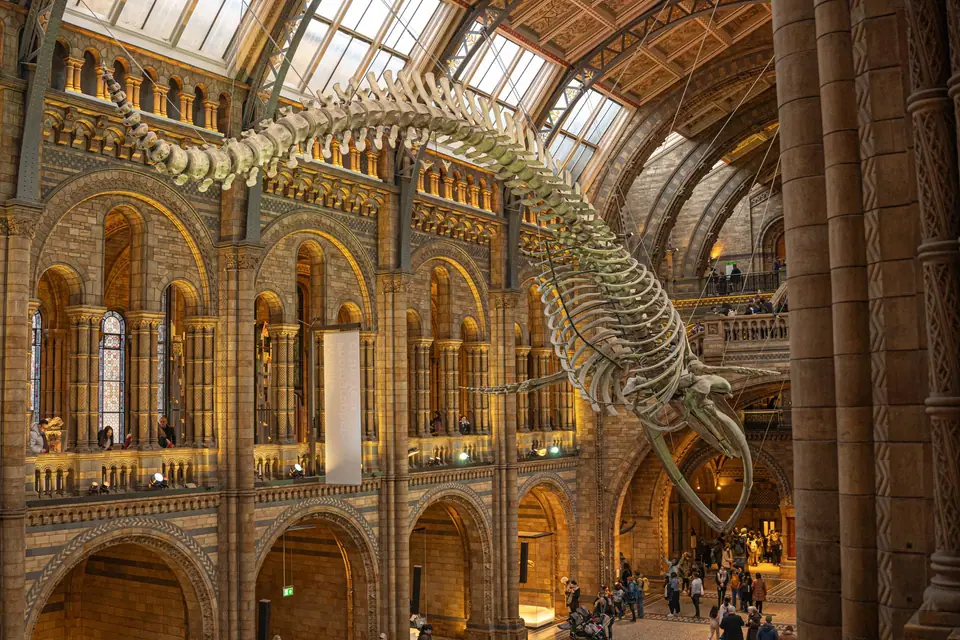
- The Natural History Museum (South Kensington, SW7): Alfred Waterhouse's 1881 Romanesque terracotta palace welcomes visitors beneath Hope. That 25.2-metre blue whale skeleton has hung from the vaulted ceiling of Hintze Hall since 2017. Divided into Red, Green, Blue, and Orange zones, the museum's top sights include the Dinosaurs Gallery (Blue Zone) and the Archaeopteryx fossil and Darwin's finches in the Treasures Cadogan Gallery. Children love the earthquake simulator in the Earth Hall and the five-acre Urban Nature Project gardens, opened in July 2024 with a bronze Diplodocus. Queue-skipping tip: Book a free timed slot online before school holidays, and enter via the Exhibition Road side entrance rather than the main Cromwell Road queue.
- The Victoria and Albert Museum (SW7 & V&A East, E20): Founded after the 1851 Great Exhibition for decorative arts, the V&A is calmer than its neighbour. Do not miss the monumental Cast Courts (Rooms 46a and 46b), which hold full-scale nineteenth-century plaster casts of Trajan's Column and Michelangelo's David. Explore the Raphael Cartoons (Room 48a), the British Galleries, and the Fashion Court. Have tea inside the world's oldest museum restaurant, the 1868 Gamble, Poynter, and Morris Refreshment Rooms, designed by William Morris, Philip Webb, and Edward Burne-Jones. In Queen Elizabeth Olympic Park (Stratford), the free V&A East Storehouse (May 2025) and V&A East Museum (April 2026) display open-access design archives.
Four intimate free museums without the crowds
When rain sends thousands of visitors toward Bloomsbury and South Kensington, these four smaller museums stay peaceful and free:
- The Wallace Collection (Marylebone, W1): An eighteenth-century aristocratic townhouse on Manchester Square. It displays Frans Hals's The Laughing Cavalier (1624), Jean-Honoré Fragonard's The Swing (1767), Sèvres porcelain, and princely Renaissance armour five minutes north of Bond Street station.
- Sir John Soane's Museum (Holborn, WC2): The skylit 1792 to 1824 house-museum of architect Sir John Soane at 13 Lincoln's Inn Fields. Preserved by an 1833 Act of Parliament, it holds the alabaster sarcophagus of Pharaoh Seti I in the crypt. Upstairs, attendants open hinged folding walls to reveal William Hogarth's A Rake's Progress (open Wednesday to Sunday).
- Tate Britain (Pimlico, SW1): The home of British art from 1500 to the present on Millbank. Inside hang John Everett Millais's Pre-Raphaelite Ophelia, Francis Bacon, David Hockney, and the Clore Gallery bequest of J.M.W. Turner paintings, a 15-minute riverside walk south of Westminster.
- Imperial War Museum (SE1) & London Museum (EC1): Inside the former Bethlem Royal Hospital, the Imperial War Museum hangs a Spitfire and V-2 rocket in its Atrium. Upstairs sit comprehensive Holocaust and First World War galleries. Across the river at Smithfield in the City, the new London Museum opens inside the Victorian Smithfield General Market buildings in late 2026. Its galleries trace the capital's social history from Roman Londinium to the present day.
Where it is
- 1London Museums
- London Heathrow Airport (LHR) · about 24 km from here in a straight line
- Directions in Google Maps
Stations and taxi ranks: OpenStreetMap. Airports: OurAirports. Distances are in a straight line.
Traveller tips
Real advice from people who have been to London. Every tip is read by our team before it goes live.
No tips yet. Been here? Yours could be the first.
Thank you! Your tip will appear here after a quick review.
More in London
Continue exploring London with related neighbourhood, food, and planning guides
What to Wear in London: Waterproof Layers, Tube Heat & Dress Codes
London, United Kingdom
Westminster Walking Guide: Big Ben, Westminster Abbey & Buckingham Palace
London, United Kingdom
Best Day Trips from London by Train: Windsor, Oxford, Bath & Cambridge
London, United Kingdom
Where to Stay in London: Best Neighbourhoods Compared by Tube & Budget
London, United Kingdom
