Westminster Walking Guide: Big Ben, Westminster Abbey & Buckingham Palace
A 3.2-kilometre step-by-step walk through royal and parliamentary London, with Changing of the Guard timings.
No other district in Britain packs a thousand years of royal coronations, parliamentary history, and wartime bunkers into such a compact area as the City of Westminster (SW1). Anglo-Saxon King Edward the Confessor built his palace and Benedictine abbey on Thorney Island during the 1050s. That location let the crown govern two miles upstream from the independent merchants of the Roman City of London. Westminster remains the political and ceremonial heart of the United Kingdom today. You can walk past the exterior of every landmark below in three hours over a flat 3.2-kilometre (2-mile) route. Booking timed entry inside Westminster Abbey and the Churchill War Rooms easily turns the walk into a full day.
Step-by-step Westminster walking route (3.2 km)
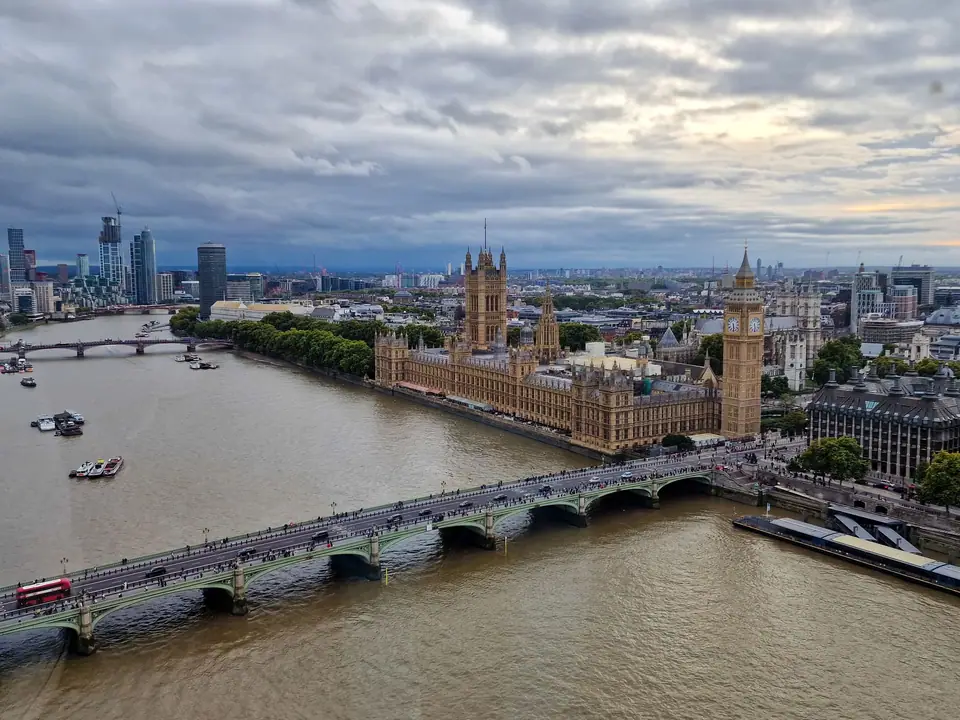
- Westminster Bridge and Big Ben (Start at 08:45): Exit Westminster Tube station (Jubilee, Circle, and District lines) onto seven-arch iron Westminster Bridge. Opened in 1862, the bridge is painted green to match the leather benches inside the House of Commons. Looking back toward the north bank gives you the finest morning light on the 300-metre neo-Gothic riverfront of the Palace of Westminster. Sir Charles Barry and Augustus Welby Pugin designed the building after the medieval palace burned on 16 October 1834. Only 1097 Westminster Hall and its fourteenth-century oak hammerbeam roof survived that blaze. At the northern corner rises the 96-metre (316-foot) Elizabeth Tower, restored between 2017 and 2022 to reveal its Prussian blue and gilt clock dials. Inside hangs the 13.7-tonne Great Bell cast at Whitechapel in 1858 and nicknamed Big Ben. Guided 90-minute climbs up the 334 spiral steps to the belfry are open to visitors aged 11 and over. Tickets release on the second Wednesday of each month at 10:00 UK time, three months ahead, on the UK Parliament website.
- Parliament Square Statues: Cross Bridge Street into Parliament Square, laid out as an open green in 1868. Twelve bronze statues ring the grass, led by Ivor Roberts-Jones's hunched 1973 figure of wartime Prime Minister Sir Winston Churchill facing Big Ben. Around the lawn stand statues of Abraham Lincoln, Mahatma Gandhi, and Nelson Mandela. On the northern side stands suffragist Millicent Fawcett, unveiled in 2018 as the first statue of a woman on the square.
- Westminster Abbey (09:30 Timed Entry): Directly south of the square rises the Collegiate Church of St Peter at Westminster. Consecrated under Edward the Confessor on 28 December 1065, the abbey was rebuilt in French-inspired Gothic style by King Henry III from 1245. Every monarch since William the Conqueror in 1066 (40 sovereigns up to King Charles III in 2023) was crowned beneath the 31-metre vaulting. Coronations take place on the 1268 Cosmati Pavement in front of the 1300 oak Coronation Chair. Inside rest 3,300 tombs and memorials, including Elizabeth I, Mary Queen of Scots, Isaac Newton, Charles Darwin, Stephen Hawking, and the Grave of the Unknown Warrior. In the south transept lies Poets' Corner, honouring Geoffrey Chaucer, William Shakespeare, Charles Dickens, and Jane Austen. Book the first 09:30 slot online and add the elevated Queen's Diamond Jubilee Galleries in the thirteenth-century triforium. On Sundays the abbey closes to paid sightseeing, but all services and daily 17:00 Choral Evensong are free without booking.
- Whitehall and 10 Downing Street: Walk north up Whitehall, once the site of Henry VIII's sprawling Palace of Whitehall. Only Inigo Jones's 1622 Palladian Banqueting House survived the 1698 palace fire. King Charles I stepped through one of its upper windows onto the execution scaffold on 30 January 1649. Turn left down King Charles Street for the underground Churchill War Rooms (allow 90 minutes, pre-booking essential). Back on Whitehall, pass Sir Edwin Lutyens's Portland stone Cenotaph war memorial (1920). Pause opposite at the iron security gates of 10 Downing Street, home to British Prime Ministers since Sir Robert Walpole in 1735.
- Horse Guards Parade: Halfway up Whitehall, two mounted troopers of the Household Cavalry stand sentry outside from 10:00 to 16:00 daily. They belong to the Life Guards (in red tunics and white plumes) or the Blues and Royals (in blue tunics and red plumes). Walk through the central stone archway onto the gravel expanse of Horse Guards Parade, formerly Henry VIII's jousting tiltyard.
- Trafalgar Square and Nelson's Column: Continue to the top of Whitehall where Charing Cross opens into Trafalgar Square. Sir Charles Barry laid out the square in the 1840s around the 51.6-metre granite shaft of Nelson's Column (1843). Sir Edwin Landseer's four bronze lions were added around the base in 1867. Along the northern terrace stand the free National Gallery and James Gibbs's 1726 church of St Martin-in-the-Fields.
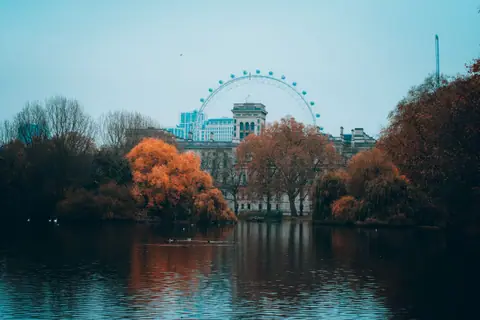
- Admiralty Arch and St James's Park: Pass under the triple arches of 1912 Admiralty Arch onto the red ceremonial avenue of The Mall. Step left into 23-hectare St James's Park, landscaped by John Nash in 1828. Pause on the Blue Bridge over the lake: looking east frames Whitehall and the London Eye, while looking west frames Buckingham Palace. Near Duck Island Cottage live the park's resident great white pelicans. Pelicans have lived here continuously since the Russian Ambassador gifted the first pair to King Charles II in 1664.
- Buckingham Palace (Finish around 12:30): Emerge at the gilded gates of Buckingham Palace. Originally built in 1703 as Buckingham House, the residence was bought by King George III in 1761 and expanded by John Nash in the 1820s. It became the monarch's official London palace upon Queen Victoria's accession in 1837, with Sir Aston Webb's east front completed in 1913. When the quartered Royal Standard flies overhead, the King is in residence; when the Union Flag flies, he is away.
How to watch the Changing of the Guard without the crush
The Changing of the Guard links three sites: Buckingham Palace, St James's Palace on Pall Mall, and Wellington Barracks on Birdcage Walk. Ceremonies normally take place on Monday, Wednesday, Friday, and Sunday mornings around 10:45 to 11:00. Heavy rain cancels the parade, so check the official Household Division schedule (`householddivision.org.uk`) the evening before:
- Skip the Palace Railings After 10:00: The Buckingham Palace forecourt fills six deep by 10:00. Stand instead at Friary Court outside St James's Palace on Marlborough Road at 10:25 to watch the Old Guard inspect arms before marching down the Mall at 10:43. You can also stand outside Wellington Barracks on Birdcage Walk at 10:40 as the New Guard and Regimental Band step off.
- The King's Life Guard at Horse Guards Parade: Mounted ceremonies take place at 11:00 Monday to Saturday and 10:00 on Sunday on Horse Guards Parade. Because no iron railings separate spectators from the troopers, it offers much clearer views and pairs directly with Day 1 of our London 3-day itinerary.
Where it is
- 1Westminster Walking
- London Heathrow Airport (LHR) · about 23 km from here in a straight line
- Directions in Google Maps
Stations and taxi ranks: OpenStreetMap. Airports: OurAirports. Distances are in a straight line.
Traveller tips
Real advice from people who have been to London. Every tip is read by our team before it goes live.
No tips yet. Been here? Yours could be the first.
Thank you! Your tip will appear here after a quick review.
More in London
Continue exploring London with related neighbourhood, food, and planning guides
Best Things to Do in London: Tower, Westminster, South Bank & Free Views
London, United Kingdom
How to Get to London: 6 Airports Compared, Eurostar & the Tube
London, United Kingdom
Best Time to Visit London: Month-by-Month Weather, Daylight & Events
London, United Kingdom
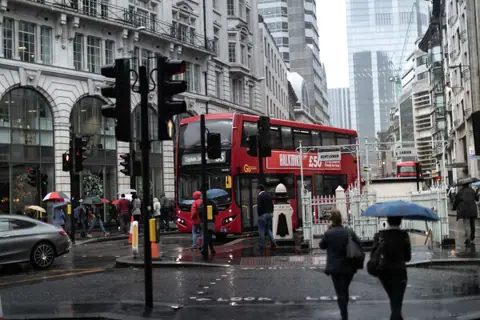
What to Wear in London: Waterproof Layers, Tube Heat & Dress Codes
London, United Kingdom
