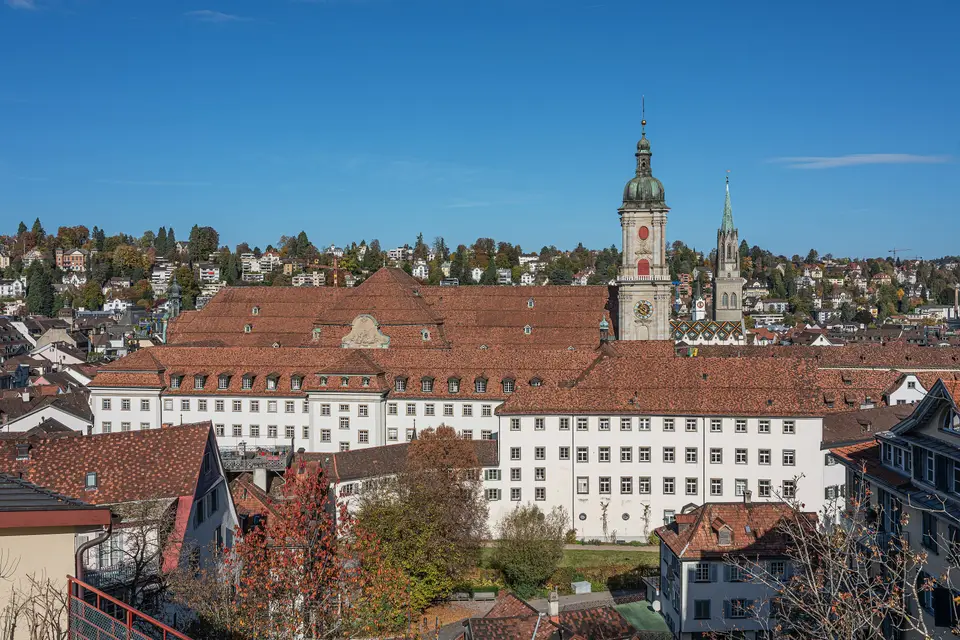
Quick Field Data
- UNESCO Inscription: 1983 (Cultural Criteria ii, iv)
- Scale & Footprint: The whole monastic complex in the town of St. Gallen, with the Baroque Cathedral, the Abbey Library, the Abbey Archives and the convent buildings
- Access & Ticketing: A working Catholic cathedral and public library museum in St. Gallen; check the official site for Stiftsbibliothek and exhibition entry rules
- Arrival Logistics: In the city of St. Gallen in north-eastern Switzerland, near Lake Constance and east of Zurich
Twelve Centuries of Monastic Learning Between the Alps and Lake Constance
The Abbey of St Gall (German: Abtei St. Gallen) stands in the city of St. Gallen in north-eastern Switzerland, near Lake Constance. It preserves the buildings and learning of one of Europe's leading Benedictine monasteries, active for 1,200 years from the 8th century until its dissolution in 1805. UNESCO listed it in 1983 under cultural criteria ii and iv; see our UNESCO World Heritage Atlas. The monastery forms the historic core of St. Gallen, east of Zurich. Its library and archives keep priceless early medieval manuscripts from the Carolingian period. The buildings, however, owe their unified look mainly to the late Baroque rebuilding of 1755 to 1768, in which the architect Peter Thumb played a leading part.
Tradition dates the monastery's origins to around 612 CE. Gallus (Saint Gall), an Irish missionary and companion of Saint Columbanus, then built a hermit's cell on the spot where the abbey later rose. Gallus lived in his woodland cell until his death around 646 CE. His followers stayed together at the cell under the rule of Saint Columbanus, combining prayer, manual work, reading and teaching under his successors Saint Magnus, the deacon Stephen and the priest Magulfe. Around 719 CE (other sources give 720 or 747), Waltraf (or Waltram), a nobleman and judge of Thurgau, asked Charles Martel to place the hermitage under the local Alemannic priest Otmar (Saint Othmar). Otmar became its founder and first abbot. With the support of Charles Martel and later his son Pepin, on the advice of Pepin's brother Carloman, Otmar replaced the rule of Columbanus with the Rule of Saint Benedict in 747. He founded the St. Gall School and expanded the abbey quickly. By the end of his rule, 53 names stood in the register of monks, and the monks Magnus of Füssen and Theodor had founded daughter houses at Kempten and Füssen in the Allgäu.
The Carolingian Golden Age and the 9th-Century Plan of St Gall
Noble families gave land across Thurgau, the Zürichgau and Alemannia as far as the Neckar. In 744, for instance, the noblewoman Beata sold property to pay for a journey to Rome. Abbot Waldo of Reichenau (740 to 814) organised the copying of manuscripts with Anglo-Saxon and Irish monks. At Charlemagne's request, Pope Adrian I sent leading singers from Rome to teach the monks Gregorian chant. A long dispute with the nearby Bishopric of Constance ended in the early 9th century, when Louis the Pious (ruled 814 to 840) confirmed the abbey's direct subjection to the emperor (Reichsunmittelbarkeit), making it an Imperial Abbey. King Louis the German confirmed its immunity and its right to elect its own abbots in 833, and in 854 he freed it from paying tithes to the Bishop of Constance. In the 9th and 10th centuries the monastery was home to famous scholars such as Notker the Stammerer, Notker of Liège, Tuotilo, Notker Labeo and Hartker. Hartker's antiphonary records early neume notation, from before music was written on five-line staves.
In this Carolingian golden age a larger church was built and the library grew. More than 400 of the manuscripts it acquired and copied survive there today:
- The 9th-Century Plan of St Gall: The Plan was drawn on parchment between 820 and 830 CE. It followed one of the reform synods held at Aachen under Emperor Louis the Pious between 814 and 817 and was dedicated to the abbot of St Gall. It is the oldest known architectural plan on parchment. It is also the only major architectural drawing to survive from the roughly 700 years between the fall of the Western Roman Empire and the 13th century. It was never built, but it shows the ideal of a well-planned, well-supplied Carolingian monastery.
- Old Irish and Pauline Manuscripts: The Stiftsbibliothek holds a copy of Priscian's Institutiones grammaticae with the Old Irish poem "Is acher in gaíth in-nocht". It also holds a late 9th-century copy of the letters of Saint Paul, with an ink drawing of Paul preaching to an agitated crowd of Gentiles and Jews.
- The Silver Age and Wiborada: Between 924 and 933, Magyar raids forced the monks to move their books to Reichenau for safety. On 26 April 937 a fire destroyed much of the abbey, though the library survived. The recluse Wiborada was killed during the raids in 926. In 1047 she became the first woman formally canonised by the Holy See, 54 years after Saint Udalric, Bishop of Augsburg, in 993. Between 954 and 971/974 Abbot Notker built a defensive wall around the monastery. In 1006 the monks recorded the most northerly sighting of that year's supernova. The abbey's cultural silver age ended with the death of Abbot Ulrich II on 9 December 1076.
Prince-Abbots, the Appenzell Wars and the Baroque Rebuilding
In 1207 King Philip of Germany made Abbot Ulrich von Sax a prince (Reichsfürst) of the Holy Roman Empire, turning the monastery into a princely abbey. Over the next three centuries the town of St. Gallen slowly freed itself from the abbot. It was ruled by the cloth-weavers' guilds from 1353, bought its liberty from King Sigismund in 1415 and became officially free of the abbey in 1457. Meanwhile the farmers of the abbot's Appenzell lands rose in the Appenzell Wars in 1401. They won the battle of Stoss in 1405 and allied with the Swiss Confederation in 1411. The abbot allied with Zürich, Lucerne, Schwyz and Glarus in 1451, and in 1454 the town became an associate of the Confederation. Abbot Ulrich Rösch bought the County of Toggenburg in 1468 and in 1487 began a new monastery at Rorschach on Lake Constance. On 28 July 1489 Mayor Ulrich Varnbüler and Hermann Schwendiner led armed men from St. Gallen and Appenzell to destroy the Rorschach buildings. The four cantons that protected the abbey invaded early in 1490, and Varnbüler and Schwendiner fled to King Maximilian.
In 1524 the town adopted the Protestant Reformation, while the monastery stayed Catholic. Reformed iconoclasts scattered some old books, until Abbot Diethelm began a restoration in 1530. Abbot Pius Reher (1630 to 1654) set up a printing press. In 1712, during the Toggenburg War (Second War of Villmergen), Swiss forces looted the abbey and carried manuscripts off to Zürich and Bern. Even so, the princely abbey went on to rule Switzerland's largest church state, with more than 77,000 inhabitants. Between 1755 and 1768 the medieval monastery was demolished and rebuilt in late Baroque and Rococo style, with the architect Peter Thumb (1681 to 1766) among its leading builders:
- The Baroque Cathedral of St Gall: Built between 1755 and 1768, it is one of the last great Baroque abbey churches in the West. The abbey became a separate see in 1846, and in 1848 its church was raised to the cathedral of the Diocese of St. Gallen.
- The Rococo Abbey Library (Stiftsbibliothek): Also designed by Peter Thumb, the library has a bright Rococo interior of polished carved wood, stucco and painted ceilings. In 2005 it held more than 160,000 books, including 2,100 handwritten codices. Nearly half of these date from the Middle Ages, and 400 are more than 1,000 years old. By December 2009, 355 documents had been digitised in the Codices Electronici Sangallenses project.
- The Northern Square and the Abbey Archives: On the north side of the square stand 19th-century buildings, including the old arsenal, the Guardian Angels Chapel and the former Catholic school. The Abbey Archives keep the records of the 73 ruling abbots. Henggeler compiled their biographies in 1929, and Beat Jakob Anton Hiltensperger printed their coats of arms in 1778. The records run until the last prince-abbot, Pankraz Vorster, was removed in 1798 and the abbey was dissolved in 1805.
Visiting the Cathedral, the Rococo Library and the Monastery
Today the whole monastic complex is part of the historic town of St. Gallen and is open to visitors all year:
- Entry and Route: St. Gallen is easy to reach by direct train from Zurich. A short walk through the pedestrian town centre leads to the abbey courtyard.
- Tickets and Viewpoints: The Stiftsbibliothek is open to the public and hosts changing manuscript exhibitions, concerts and cultural events beside the cathedral; check the official site for current library and exhibition entry.
- Timing and Onward Connections: Allow at least half a day to see the late Baroque cathedral, the medieval manuscripts and early musical notation in the Rococo library hall, and the streets of St. Gallen around them.
