Quick Field Data
- UNESCO Inscription: 1983 (Criterion iii; an early medieval Alpine monastery with Switzerland's finest series of figurative murals, painted around 800 AD, and 12th-century Romanesque frescoes and stucco).
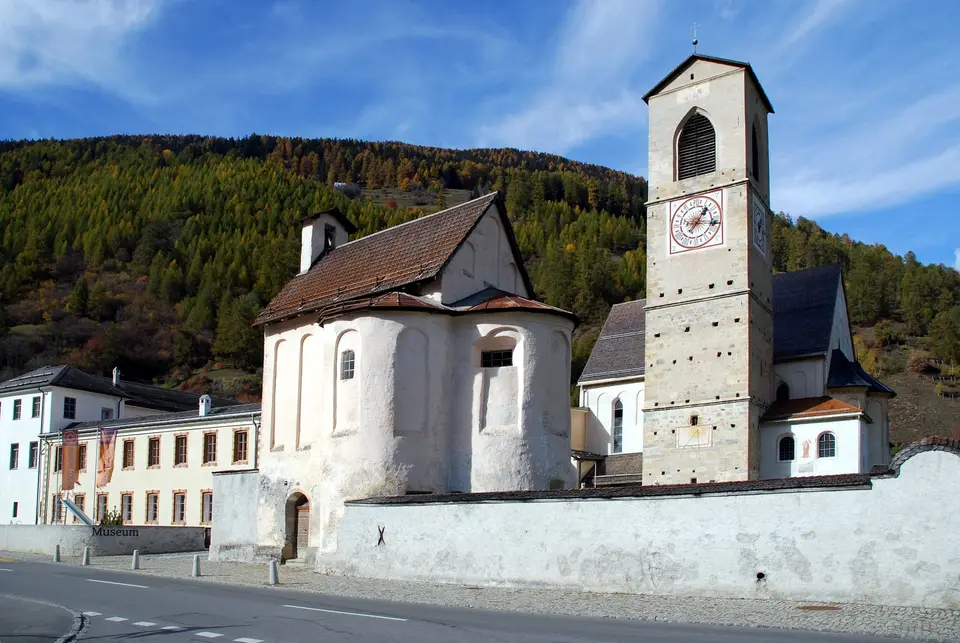
- Scale & Footprint: Located in Val Müstair, Canton of Graubünden, Switzerland, the complex comprises the Carolingian convent church, the Holy Cross Church, and the tower of Abbess von Planta. It also preserves the old residence of the Bishop of Chur with the two-storey chapel of St Ulrich and St Nicholas around two rectangular courtyards.
- Access & Ticketing: A working Benedictine priory of nuns, where religious life has continued for more than 1,200 years; the convent church and museum are open with a ticket, so check the official site.
- Arrival Logistics: In Santa Maria Val Müstair in the Grisons (Graubünden), in the far south-east of Switzerland south of the Alps, reached over the Alpine passes north of Milan.
Charlemagne's Alpine Pass Monastery and 12 Centuries of Monastic Life
The Benedictine Convent of St John stands in the Alpine valley of Val Müstair, in the Canton of Graubünden (the Grisons) in the far south-east of Switzerland. It lies south of the main Alpine ridge on the strategic pass route from Italy. In German it is the Benediktinerinnenkloster St. Johann, and in Romansh the Claustra benedictina da Son Jon. It was founded around 775 to 780 AD by a Bishop of Chur, almost certainly on the orders of the Frankish king Charlemagne, during the monastic revival of the Carolingian Renaissance. It was one of a wave of early medieval monasteries in the region, with Disentis, Pfäfers, Mistail and Cazis. Fortified to control the pass through Val Müstair, it was also a centre of Christian teaching, missionary training and manuscript painting. Carolingian painters, jewellers and goldsmiths worked here.
At the start of the 9th century it is recorded as a monastery of Benedictine monks. In 881 it passed fully to the Bishop of Chur. A church tower was added in the 10th century. In the 11th century the bishop's residence was enlarged, with a residential tower, a cloister and the two-storey chapel of St Ulrich and St Nicholas, richly decorated with stucco and frescoes. In the first half of the 12th century the monks were replaced by a community of Benedictine nuns. This is first recorded in 1167, and the first abbess known by name, Adelheid, appears between 1211 and 1233. Throughout the Middle Ages the Bishop of Chur, the Grey League and League of God's House, and the House of Habsburg competed for influence over the abbess and the lay steward (vogt) who ran the valley's worldly affairs.
This rivalry sparked the Swabian War right at the convent gates on 20 January 1499. Habsburg troops, seeking control of the Grisons and the Alpine passes, occupied the valley and looted the monastery. Forces of the Three Leagues drove them back at the Battle of Calven. The Treaty of Basel in September 1499 then gave the Old Swiss Confederacy virtual independence. Around 1500 the original single-nave Carolingian church was turned into a three-nave late Gothic church. The Ilanz Articles of 1524 and 1526, passed by the League of God's House, weakened the bishop's worldly power and cut the abbey's income. Reforms after the Council of Trent, between 1600 and 1614, regulated the sacraments, the breviary and the shared dormitories under the Benedictine Rule. Religious life has continued without a break to the present day, and the abbey became a priory in 1810.
Carolingian Mural Rows, Romanesque Apse Frescoes and the Convent Buildings
Today the convent reflects more than 1,200 years of building around two rectangular courtyards. The eastern part holds the Carolingian convent church, the Holy Cross Church, the tower of Abbess von Planta and the residence of the Bishop of Chur. The western courtyard is lined by the cloisters, two entrance towers and farm buildings. The convent church largely keeps its Carolingian form. It was first a single-nave church with five apses, planned from the start as one painted space. It holds the most important cycle of Carolingian frescoes preserved in place anywhere in Europe. They were painted around 800 AD and came to light again in the 20th century, when restorers carefully examined the later paint layers.
The painters used a small range of mineral colours, mainly ochre, red and brown, with quick, bright brushwork. They combined Roman ways of showing figures with Christian gospel subjects and Germanic geometric and animal motifs. The style is closely linked to the early medieval paintings of Santa Maria foris portas at Castelseprio in Lombardy. The murals run in five horizontal rows from the south wall across the west wall to the north wall. Since no one needed to read to follow painted walls, these balanced, symmetrical scenes made Christian stories clear to clergy and lay people alike. The top row shows scenes from the life of King David in the Hebrew Bible. The three middle rows show the childhood and Passion of Christ, and the bottom row shows the crucifixion of St Andreas. The west wall joins all five rows in a great early medieval Last Judgment, weighing the sins of humanity.
In the 12th century, including work of the 1160s, the east wall and the three horseshoe-shaped apses were repainted with Romanesque frescoes and stucco figures. These apse paintings show a range of biblical themes. They include Christ in Majesty, the feast of Herod Antipas, where the dance of Herodias's daughter leads to the beheading of John the Baptist, the abbey's patron saint, and the parable of the wise and foolish virgins, with the apostles and St Stephen. Together, the Carolingian rows in the nave and the Romanesque apses show how painters over four centuries adapted the scale of figures, their pigments and their framing while keeping the church interior unified.
Visiting the Abbey Church, the Residential Tower and Val Müstair
The convent is still a living Benedictine priory, where a community of nuns keeps up daily monastic life. Visitors follow a clearly marked route through the church and courtyards that respects the quiet of the western cloisters.
- The Five Carolingian Rows in the Abbey Church: Step inside the convent church, turned around 1500 into a three-nave late Gothic hall. Trace the five rows of Carolingian murals of around 800 AD as they wrap from the south wall across the Last Judgment on the west wall to the north wall. Find King David in the top row, the life and Passion of Christ in the three middle rows and St Andreas at the bottom. Notice how the ochre, red and brown colours organise each scene.
- The Romanesque Apses and Stucco: Walk towards the eastern choir to see the 12th-century Romanesque frescoes in the three apses and on the east wall. They include Christ in Majesty, the feast of Herod Antipas, the beheading of John the Baptist, the parable of the wise and foolish virgins, the apostles and St Stephen, with the medieval stucco work.
- The Courtyards, the Abbess's Tower and the Holy Cross Church: Explore the two courtyards with their western cloisters, entrance towers and farm buildings. Then visit the fortified residential tower of Abbess von Planta and the old residence of the Bishop of Chur, with its 11th-century two-storey chapel of St Ulrich and St Nicholas, and the Holy Cross Church beside it.
20th-Century Rediscovery and Alpine Conservation
The murals and stucco of Müstair came to light again under later paint in 20th-century restorations, and UNESCO inscribed the convent in 1983. They give an unrivalled view of how Christian imagery changed from the reign of Charlemagne to the Romanesque period. They also reflect the political, social and economic links of the Grisons across twelve centuries. Ongoing conservation watches over the fragile plaster and mineral colours inside the Alpine church. Travellers crossing the passes between Switzerland and northern Italy can combine Val Müstair with Milan and explore other early medieval monasteries in our UNESCO World Heritage Atlas.
