Quick Field Data
- UNESCO Inscription: 1984, as a pioneering masterpiece of early eighteenth-century German Rococo palace and garden design.
- Scale & Footprint: An 89-hectare landscaped park linking the U-shaped Augustusburg Palace with the Falkenlust hunting lodge roughly 1 mile to the south-east.
- Access & Ticketing: Augustusburg Palace is seen on a guided tour, Falkenlust can be visited at your own pace, and the park paths are open to walkers; both palaces close in winter, so check the official site for dates and tour times.
- Arrival Logistics: In the town of Brühl in North Rhine-Westphalia, between Bonn and Cologne, reached by regional train in minutes from Cologne.
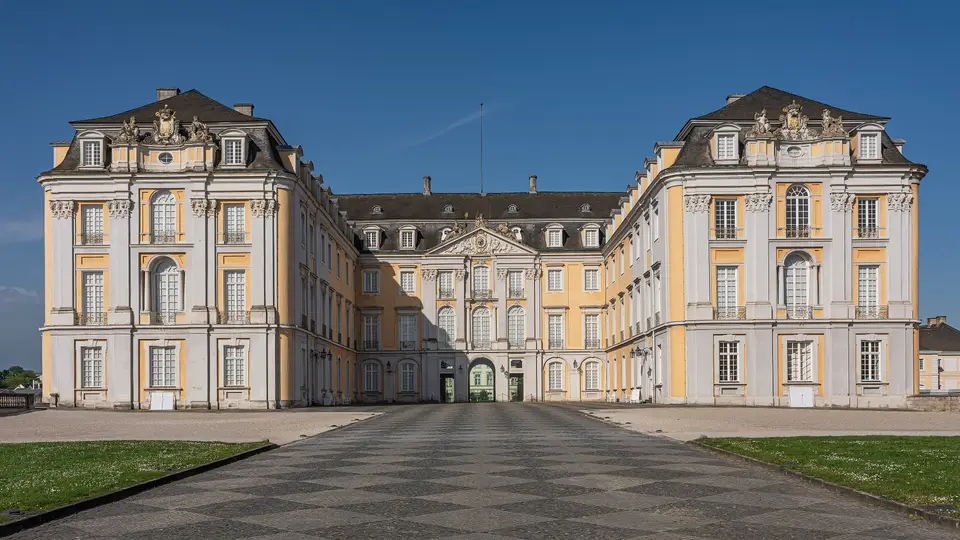
In the town of Brühl in North Rhine-Westphalia, the Castles of Augustusburg and Falkenlust stand in 89 hectares of neat parterres, mirror pools and woodland avenues. They are among the earliest and finest Rococo court buildings in eighteenth-century Germany. Inscribed in 1984 and listed in our UNESCO World Heritage Atlas, the pair was commissioned by Clemens August of Bavaria (1700 to 1761), Archbishop-Elector of Cologne and a member of the Wittelsbach family. He gathered court architects, stucco masters and fresco painters and turned the foundations of a ruined medieval moated castle into a lavish three-winged residence. The Schlosspark gardens link it to a small country lodge for falconry. Visitors visiting on a short regional train trip from Cologne find the palace grounds right next to Brühl town centre. Symmetrical fountains reflect the palace front.
Elector Clemens August, Schlaun, and Cuvilliés's Rococo Transformation
In 1725 the Prince-Elector and Archbishop Clemens August of Bavaria planned and paid for a grand new residence in Brühl on the foundations of an older medieval castle. The first architect was Johann Conrad Schlaun, who built a three-winged brick structure with roughcast render. The elector disliked the heavy, dull character of Schlaun's design. He soon brought in the court architect François de Cuvilliés to rework the residence in the new international Rococo style.
Cuvilliés shaped a U-shaped palace of three storeys and two attic levels, built of brick with roughcast plaster. Single-storey orangery wings run along the north and south sides. The southern wing holds an ornate court oratory and chapel, and the northern wing holds service rooms. Inside, the central block, the state wings and the elector's private apartments follow a careful order of space and decoration. It set a new standard for German princely courts of the eighteenth century.
Brühl lies close to Bonn, the federal capital of West Germany after the Second World War, so Augustusburg Palace gained a diplomatic role in modern times. Until 1994 the President of the Federal Republic of Germany held official state receptions for foreign guests there. The palace and park still host the well-known Brühl Palace Concerts.
Balthasar Neumann's Staircase, Dutch Faience, and the Falkenlust Lodge
The highlight of Augustusburg is the main staircase designed by Johann Balthasar Neumann. Often called a work of genius, the staircase hall rises in a lively sweep of marble, polished stucco, jasper columns and carved caryatids that hold up the upper balcony. Above it all is the striking illusionistic ceiling fresco by Carlo Carlone. Below the formal state rooms of the upper floor, the ground-floor summer apartments have a relaxed, charming mood (décor bon enfant). This was a deliberate contrast to the official court rooms, with cool walls lined in glazed faience tiles from the Low Countries.
Roughly 1 mile south-east of Augustusburg, in its own small park at the end of a diagonal woodland path, stands the Falkenlust hunting lodge. Cuvilliés designed it, and it was built from 1729 to 1737, with work going on until 1740. It was created from scratch so that Clemens August could pursue his passion for falconry. It is often compared with the Amalienburg pavilion at Nymphenburg Palace, which Cuvilliés designed a few years later. Falkenlust is a rendered brick country villa with symmetrical projecting bays. The two-storey main house stands between two low single-storey wings, where the elector's falcons were kept and where seasonal exhibitions are now held.
On the ground floor, a central oval salon shows the inventive charm and sense of free space that made Cuvilliés famous across Europe. In the lodge's small chapel, the artist Laporterie from Bordeaux created a sea grotto whose walls and vaults are covered entirely in shells and mineral crusts. Augustusburg and Falkenlust belonged to a wider network of homes and hunting lodges built for Clemens August of Bavaria. These include Clemenswerth Palace, the Electoral Palace and Poppelsdorf Palace in Bonn, and Schloss Herzogsfreude.
Dominique Girard's Parterre and Walking the Schlosspark
The wide gardens and old trees of the Schlosspark, first designed by the French garden architect Dominique Girard, link the two buildings. South of Augustusburg lies Girard's finely embroidered parterre, set around four fountains and a central mirror pool and framed by shady lime-tree avenues. In the nineteenth century the landscape architect Peter Joseph Lenné reshaped a southern part of the parterre and turned the outer grounds into a landscape garden. This created a smooth change from formal Baroque geometry near the palace to natural woodland walks towards Falkenlust.
The lasting harmony of Brühl comes from the dialogue between the formal court splendour of Augustusburg and the country intimacy of Falkenlust, with the Schlosspark between them. At Augustusburg, Neumann's marble and stucco staircase and Carlone's ceiling frescoes express the public power of the Archbishop-Elector of Cologne. The blue-and-white Dutch tiles of the summer apartments hint at the relaxed country mood waiting at the end of the woodland walk. At Falkenlust, Cuvilliés sized every room, from the oval salon to the shell grotto chapel and the falconry wings, for the private pleasure of the prince and his guests in the autumn hunting season.
In the 89-hectare park, Girard's symmetrical eighteenth-century parterre with its four fountains and mirror pool meets Lenné's nineteenth-century English landscape woodland. A single walk shows two eras of European garden design. From the Brühl Palace Concerts inside Augustusburg to a stroll along the lime-tree avenues to the lodge, visitors find an intact princely estate that joined French, Italian and German artistic traditions.
The route from the courtyard and great staircase of the main palace, through the formal parterre and shady woodland avenues to the oval salon of the falconry lodge, captures eighteenth-century court culture at its height. Every façade, fountain and tiled room reflects the close work between Clemens August and the European masters he gathered at Brühl. The walk also shows how the architects used water, tree-lined views and garden pavilions so that palace and park worked as one stage for court receptions and falconry outings. A guided tour of Augustusburg and a walk through the Schlosspark to Falkenlust give a full picture of life at the elector's court.
- Reserve the Augustusburg guided tour before walking to Falkenlust: Neumann's staircase and the tiled summer apartments can only be seen on a guided tour, so book your tour time at the Augustusburg ticket desk first.
- Walk the lime-tree alleys between the two palaces: Follow the diagonal path from Girard's southern mirror pool and parterre through the park trees to the courtyard of the Falkenlust hunting lodge.
- Inspect the shell grotto chapel inside Falkenlust: During your self-guided visit, take time over the oval ground-floor salon, the former falconry wings and the chapel covered in shells and mineral crusts by Laporterie.
