Quick Field Data
- UNESCO Inscription: 1991 (Cultural; town of Lorsch, Bergstraße district, Hesse, Germany)
- Scale & Footprint: 3.11-hectare core area with a 14.825-hectare buffer zone, covering the main abbey site on an Ice Age sand dune and the nearby Altenmünster site
- Access & Ticketing: Run by the Hesse state heritage authority; check official sources for tickets to the Königshalle, the museum centre, the herb garden and the Lauresham open-air laboratory
- Arrival Logistics: In Lorsch, on the Bergstraße in southern Hesse, about 10 kilometres east of Worms and easy to reach by regional train and motorway
Count Cancor, Saint Nazarius, and the Imperial Burial Ground of the Eastern Franks
The Abbey of Lorsch stands on a low sand dune from the Ice Age above the plain of the Weschnitz river in southern Hesse. It lies about 10 kilometres east of Worms, near the foot of the Bergstraße hills. The site is one of the rarest surviving witnesses to the Carolingian Empire in Europe. It appears in our UNESCO World Heritage Atlas as a site inscribed in 1991. The core area covers 3.11 hectares, with a buffer zone of nearly 15 hectares. The story began in 764, when the Frankish Count Cancor and his widowed mother Williswinda founded a church and monastery on their own land. It stood on a small island in the Weschnitz, at the place now called the Altenmünster, and was dedicated to Saints Peter and Paul.
Cancor and Williswinda handed the new foundation to their relative Chrodegang, Archbishop of Metz. He brought monks from the abbey of Gorze and obtained from Pope Paul I the relics of the Roman martyr Saint Nazarius. The relics arrived in 765, and so many pilgrims came that the community soon outgrew its first site. Chrodegang's brother Gundeland became abbot, and the monks moved a few hundred metres to the higher dune. After a property dispute with Cancor's son in 772, Gundeland placed the monastery under the protection of Charlemagne, which made Lorsch a royal abbey. Its new church, dedicated to Saints Peter, Paul and Nazarius, was consecrated in 774 by the Archbishop of Mainz, with Charlemagne and his court present.
Over the next century Lorsch became one of the leading religious, political and intellectual centres of the Carolingian world. Popes and rulers granted it huge estates. When King Louis the German died in 876, he was buried at Lorsch in a royal burial chapel. The abbey thus became a burial place for the Carolingian kings of the East Franks. His son Louis the Younger, who died in 882, was buried here too. Later, Queen Kunigunde, wife of King Conrad I, the first East Frankish king outside the Carolingian line, also found her resting place here. In the following centuries the abbey remained wealthy and powerful, with close ties to both popes and emperors.
The Königshalle Gatehouse, the Codex Aureus, and Monastic Decline
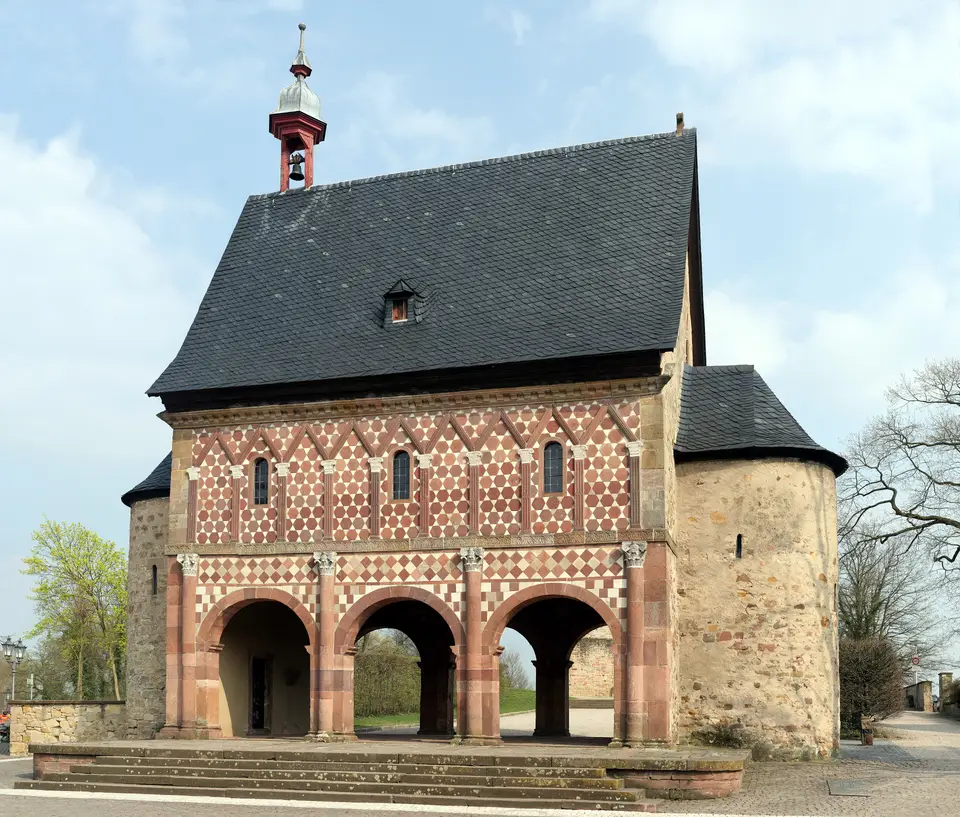
On the abbey lawn stands the famous Königshalle, or Torhalle, a gatehouse built in the 9th century, probably under Louis the German or his successors. It is one of the very few largely intact standing buildings from the Carolingian era in Germany. It joins the form of a Roman triumphal arch with local decorative craft. The two-storey free-standing hall has three open round arches on the ground floor, framed by four half-columns with carved capitals. Above this, the upper storey has fluted pilasters topped by small triangular gables instead of arches. The wall surfaces between them are covered in a pattern of red and white sandstone tiles, cut into squares, hexagons and diamonds. Two round stair towers lead to an upper hall decorated with wall paintings. A steep roof was added in the later Middle Ages.
The abbey's library and writing room were just as important. Surviving catalogues from the 9th century show one of the richest collections of classical and Christian manuscripts in medieval Europe. Around the year 800, monks here wrote the Lorsch Pharmacopoeia, one of the oldest surviving medical books from early medieval Europe. The famous Codex Aureus of Lorsch, a gospel book written in gold, was kept at the abbey for centuries. Today its pages are split between the Batthyaneum Library in Alba Iulia, Romania, and the Vatican Library. Its carved ivory covers are in the Vatican Museums and the Victoria and Albert Museum in London. In the late 12th century, monks compiled the Lorsch Codex, which records thousands of gifts of land across a wide area of Germany.
A severe fire in 1090 led to a Romanesque rebuilding of the church in the 12th century. Only a three-bay fragment of its nave survives today. Around 1230, the papacy removed the last Benedictine abbot, and in 1232 Emperor Frederick II gave Lorsch to the Archbishop of Mainz. Monks of other orders followed, first Cistercians and then, from 1248, Premonstratensian canons. In 1461 the abbey was pledged to the Electoral Palatinate. Elector Otto Heinrich brought in the Protestant Reformation and closed the monastery in the 1550s. Its manuscripts went to the Palatine Library in Heidelberg, and in 1623 much of that library was sent to Rome as a gift to the Pope. During the Thirty Years' War, Spanish troops sacked the abbey in 1621, and Lorsch returned to Mainz in 1623. French troops burned much of what was left in the late 17th century. In 1803 Lorsch passed to Hesse.
Exploring the Torhalle, Church Fragment, and Lauresham Open-Air Laboratory
Visitors coming south nearby from Heidelberg reach the quiet, grassy hill of Lorsch Abbey on the Bergstraße. Markings in the lawn trace the outline of the lost church and cloister. Stone walls mark the ancient foundations. A digital project led by Heidelberg University Library, the Bibliotheca Laureshamensis, brings together scans of the surviving Lorsch manuscripts. They are now scattered across many libraries in several countries. The standing gatehouse, the virtual library and the rebuilt farm of the Lauresham laboratory together give a full picture of the Carolingian world. Allow at least half a day to see all three parts of the site.
- The 9th-century Königshalle (Torhalle) and Romanesque church fragment: Walk up the gentle slope of the dune to study the red and white stone patterns, carved capitals and fluted pilasters of the Königshalle from all sides. East of the gatehouse, step inside the surviving three-bay fragment of the 12th-century church, once used to store tobacco. Then follow the low walls in the lawn that mark the length of the 774 church and the royal burial chapel.
- Altenmünster foundations and the monastic herb garden: Follow the path a few hundred metres across the Weschnitz meadow to the Altenmünster, where low stone outlines mark the first monastery of 764. Back on the abbey hill, stroll through the herb garden inspired by the Lorsch Pharmacopoeia.
- Lauresham Open-Air Laboratory and museum exhibition centre: Finish at the Lauresham open-air laboratory, a working reconstruction of a Carolingian manor farm with timber houses, workshops, barns and old livestock breeds. In the museum centre nearby, see Carolingian stone carvings, finds from the abbey and a copy of the Codex Aureus.
