Quick Field Data
- UNESCO Inscription: 1981 · Cultural Criterion (ii)
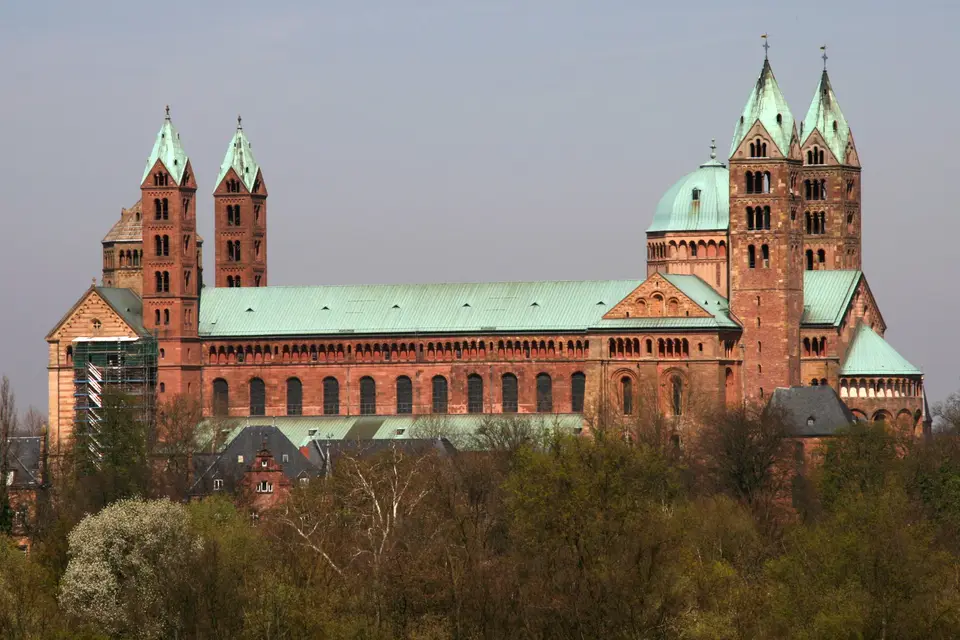
- Scale & Footprint: A vast vaulted Romanesque basilica with four towers and two domes on the left bank of the Rhine, in a city of 42.58 square kilometres and about 50,000 people
- Access & Ticketing: In the historic centre of Speyer; visitors can enter the nave and the imperial crypt and combine the visit with the nearby Judenhof, a World Heritage Site since 2021
- Arrival Logistics: On the Schifferstadt-Wörth railway in Rhineland-Palatinate, 21 kilometres south-west of Heidelberg and 25 kilometres south of Ludwigshafen and Mannheim, just 19 kilometres from Heidelberg
Salian Imperial Power and the First Consistently Vaulted Church in Europe
Speyer Cathedral stands on a river terrace 92 metres above sea level on the left bank of the Rhine in Rhineland-Palatinate (Rheinland-Pfalz). It lies 25 kilometres (16 miles) south of Mannheim and Ludwigshafen and 21 kilometres (13 miles) south-west of Heidelberg, in one of the oldest cities in Germany. It was inscribed in 1981 under cultural criterion (ii) and features in our UNESCO World Heritage Atlas. Emperor Conrad II (Konrad II) founded this Romanesque basilica, now crowned by four towers and two domes, in 1030, probably soon after his imperial coronation. It began as a basilica with a flat ceiling. For almost 300 years it was the burial place of the German emperors, and eight German kings and Holy Roman Emperors lie beneath its high altar.
In history, art and architecture, Speyer is the largest and most important Romanesque monument of the Holy Roman Empire. It was meant to display imperial power under the Salian dynasty (1024 to 1125) and was built in deliberate rivalry with the Abbey of Cluny, the architectural symbol of papal opposition. Speyer was the favourite town of Emperor Henry IV. After his famous journey from Speyer to Canossa in 1076 and his reconciliation with the Pope in 1077, he ordered major rebuilding and extensions at the end of the 11th century. His builders turned Conrad II's flat-ceilinged church into the earliest and largest church in Europe to be vaulted throughout in stone.
The cathedral took the general layout of St Michael of Hildesheim and perfected a plan that was then copied across the Rhineland. This Rhineland Romanesque plan balances massive east and west blocks and places four tall towers symmetrically around the nave and transept. Henry IV's late 11th-century rebuilding also introduced two firsts in architectural history. One was a monumental system of blind arcades strengthening the walls inside and out. The other was an open gallery running round the whole building just below the roof.
Two Millennia Along the Rhine: From Noviomagus to the ShUM Community
Speyer (historically Spires in English and Schbaija in Palatine German) has a history of more than two thousand years, and the city celebrated its 2000th anniversary in 1990. In the pre-Roman period it had the Celtic name Noviomagus ("new field"). In 10 BC it became a Roman military camp between the present town hall and the bishop's palace, guarding the north-eastern frontier of the Roman Empire against the Germanic tribes across the Rhine in Germania. The Greek geographer Ptolemy recorded it as Noviomagus on his world map in AD 150. In the 4th century the Peutinger Map called it Civitas Nemetum, after the Germanic Nemetes tribe, and by 346 a Western Christian bishop of the town was recorded for the first time. Civitas Nemetum was destroyed in the 5th century. The town was refounded in the 7th century as Spira, named after a nearby Frankish settlement and the Speyerbach, a tributary that joins the Rhine here.
When Conrad II began the cathedral in 1030, the town also built its first city wall. In 1084 the first Jewish community settled in Speyer. The city became one of the three ShUM cities, with Worms and Mainz, which formed the intellectual and spiritual centre of northern European Judaism in the Middle Ages. Its scholars included the 13th-century rabbi and tosafist Simha of Speyer, a signatory of the Takkanot Shum, as well as Samuel of Speyer and Judah ben Samuel of Regensburg. In 1096, during the First Crusade (People's Crusade), Count Emicho's army massacred Jewish communities across the Rhineland on its way to the Holy Land. In Speyer, Bishop John worked with the local leader Yekutiel ben Moses to shelter the Jewish residents in the bishop's palace and in stronger fortifications outside the town. He ruled that anyone who harmed a Jewish resident would have their hands cut off. The medieval community was later destroyed in the pogrom of 1349. Speyer's medieval Judenhof, with the remains of its synagogue and its intact underground ritual bath (mikve), was inscribed with Worms and Mainz as a UNESCO World Heritage Site in 2021 (ID 1636).
Free Imperial Town, the Protestation of 1529, and Modern Recovery
In 1294 the Roman Catholic bishop gave up most of his civic rights, and Speyer became a self-governing Free Imperial Town of the Holy Roman Empire. From 1527 to 1689 it was the seat of the Imperial Chamber Court. In the 16th-century Protestant Reformation the city was at the centre of European religious history. The first Diet of Speyer in 1526, under Holy Roman Emperor Charles V, granted temporary toleration of Lutheran teaching and worship. At the second Diet of Speyer, on 19 April 1529, Evangelical Lutheran states and princes issued the famous Protestation at Speyer against anti-Reformation resolutions. This gave rise to the terms "Protestantism" and "Protestants". The neo-Gothic Memorial Church (Gedächtniskirche) was built in Speyer between 1883 and 1904 to commemorate the 1529 Protestation.
Later centuries brought repeated war to the city and its cathedral. In 1635 Speyer was taken by Marshal of France Urbain de Maillé-Brézé and the duc de La Force (Marshal Jacques Nompar de Caumont), commanding the French Army of Germany. Royal French forces caused severe damage in 1689, and the Battle of Speyerbach was fought nearby in 1703 during the War of the Spanish Succession (1701 to 1714). From 1792 to 1814 the city was under French rule, in the First French Republic and then Napoleon Bonaparte's First French Empire (Emperor Napoleon I). After Napoleon's fall, from 1816 Speyer was the administrative capital of the Palatinate, the Rhine District of the Bavarian Kingdom (the Bavarian Palatinate). It kept that role for 129 years, until World War II ended in 1945. In 1861 the cathedral was the setting where Crown Princess Victoria introduced the future King Edward VII to his future wife Alexandra.
In 1947, under post-war Western Allied occupation, the city gained the State Academy of Administrative Science, now the German University of Administrative Sciences Speyer. Speyer twinned with the French cathedral city of Chartres in 1959 and with Ravenna in Italy in 1989. Over the centuries it has produced notable scholars, artists and writers. They include the 13th-century Franciscan choir master, composer and poet Julian of Speyer (before 1225 to around 1250), the scholastic philosopher Gabriel Biel (around 1415 to 1495) and the humanist author Dietrich Gresemund (1477 to 1512). Later came the physician and alchemist Johann Joachim Becher (1635 to 1682), the 19th-century painter Anselm Feuerbach (1829 to 1880) and the modernist painter Hans Purrmann (1880 to 1966). Today Speyer is an independent city (Kreisfreie Stadt) of four Stadtteile, with Speyer Airfield (Flugplatz Speyer) 4 kilometres south of the centre. It keeps its Salian basilica and its medieval Judenhof as two major monuments of European history.
- Entry and Route Through Historic Speyer: Walk east from the medieval Altpörtel (Old Town Gate) past the baroque Dreifaltigkeitskirche (Trinity Church) to Speyer Cathedral. Look for the balanced east and west blocks, the dwarf gallery running round the outside, the high groin vaults of Henry IV's nave and the Romanesque crypt with the royal and imperial tombs.
- Tickets and Viewpoints: Check the official site of Speyer Cathedral for crypt opening times and guided tours before you arrive. Combine the cathedral with the nearby Judenhof Speyer (synagogue ruins and medieval mikve), the Gedächtniskirche (Memorial Church), the Historical Museum of the Palatinate and the Technikmuseum Speyer.
- Timing and Onward Connections: Hourly trains on the Schifferstadt-Wörth railway link Speyer with Karlsruhe and the Rhine-Neckar cities of Heidelberg, Mannheim and Ludwigshafen. That makes it easy to pair a Rhine valley trip with our nearby city guide to Heidelberg and our UNESCO World Heritage Atlas.
