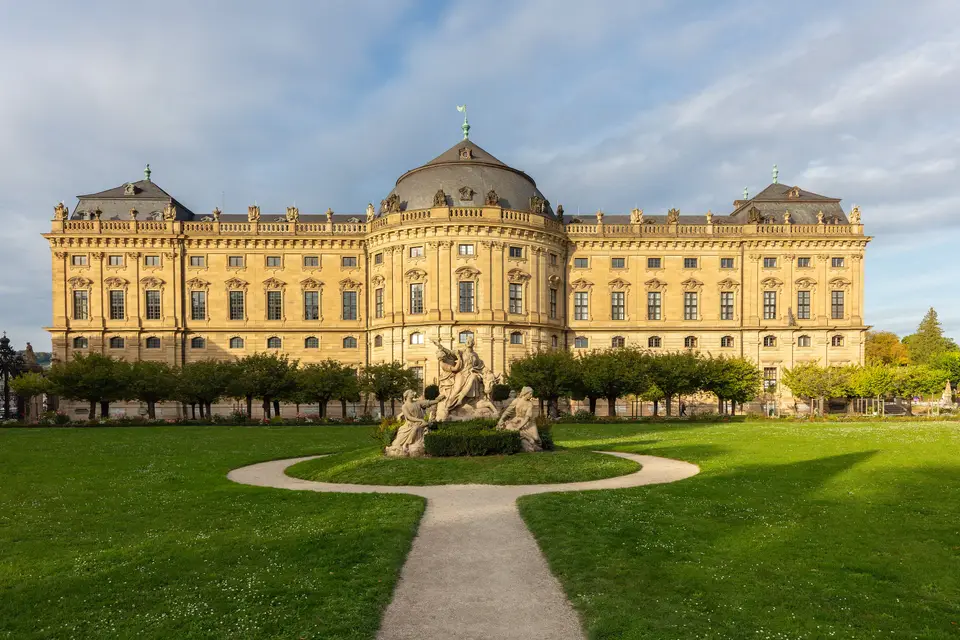
Quick Field Data
- UNESCO Inscription: 1981 (extended 2010) · Criteria (i), (iv)
- Scale & Footprint: 14.77 hectares (with a 25.0685-hectare buffer zone) at Residenzplatz 2 in Würzburg, Bavaria, Germany: the 92-by-167-metre palace of nearly 400 rooms, the 200-by-100-metre Residence Square and the Court Gardens (Hofgarten and Rosenbach Park)
- Access & Ticketing: Managed by the Bavarian state palace and garden administration, both the Residence Square and Court Gardens are free to enter on foot. A standard palace ticket covers the Staircase, White Hall, Imperial Hall, Imperial Apartments, Court Chapel, and the Martin von Wagner Museum.
- Arrival Logistics: In the centre of Würzburg on the Main River in Franconia, northern Bavaria, Germany, northwest of Munich
Balthasar Neumann and the International Workshop of the Schönborn Court
The Würzburg Residence (Würzburger Residenz) stands on a 92-by-167-metre footprint facing the 200-by-100-metre Residence Square (Residenzplatz 2) in the Franconian city of Würzburg. With its Court Gardens and square, it is one of the largest and most unified Baroque palaces in Europe. The shell was built between 22 May 1720 and December 1744, the interiors were decorated between 1740 and 1780, and the terraced Court Gardens were laid out between 1759 and 1780. The 14.77-hectare site was inscribed in 1981 under cultural criteria (i) and (iv), and a 2010 boundary change gave it a 25.0685-hectare buffer zone. It was commissioned by two ambitious Prince-Bishops of the Schönborn family, Johann Philipp Franz von Schönborn and his brother Friedrich Carl von Schönborn. Emperor Napoleon Bonaparte slept here three times between 1806 and 1813 and signed his declaration of war on Prussia here on 2 October 1806. He famously called the palace the largest parsonage in Europe.
Until the early 18th century the Prince-Bishops of Würzburg ruled from the medieval Marienberg Fortress, high on the hill west of the Main River. Johann Philipp Franz von Schönborn became Prince-Bishop in 1719 and reigned until 1724. He found the small town palace of 1701 to 1704 too modest for an absolute prince. In the year he took office he won a windfall of 600,000 florins in a court case, and he decided to build a residence to rival Versailles and Schönbrunn. He was backed by his uncle Lothar Franz von Schönborn, Archbishop and Elector of Mainz, who admitted to being possessed by a Bauwurm, or building bug, and by Friedrich Carl von Schönborn, Imperial Vice-Chancellor in Vienna from 1704 to 1734.
Instead of relying on one local workshop, the Schönborn patrons brought together leading architects from across Europe. The court artillery engineer and chief architect Balthasar Neumann coordinated plans from several masters. Maximilian von Welsch, architect to the Elector of Mainz, devised the four inner courts of the north and south wings. Johann Lukas von Hildebrandt, master of the Austrian Baroque in Vienna, shaped the garden front and central block from 1735. The Parisian architects Robert de Cotte and Germain Boffrand introduced the French Cour d'honneur layout.
Work began on 22 May 1720 with the north block, finished in 1729 under Christoph Franz von Hutten. It resumed in 1730 under Friedrich Carl von Schönborn. The 55-metre Cour d'honneur front was finished in 1732 to 33, Neumann's staircase rose in 1737 and the garden front followed in 1740. The hall vaults and the consecrated Court Chapel came in 1742 and 1743, and the shell was complete in December 1744. After Anselm Franz von Ingelheim (1746 to 1749), Karl Philipp von Greifenclau (1749 to 1754) commissioned Tiepolo's frescoes, and Neumann died in 1753. Adam Friedrich von Seinsheim (1755 to 1779) completed the northern rooms, the Green Lacquered Room, the Fürstensaal and the Ingelheimer Räume (1776 to 1781). The total cost was over 1.5 million guilders, at a time when a labourer earned one guilder a week.
Neumann's Unsupported Vault, Tiepolo's 580-Square-Metre Fresco, and the Kaiserzimmer
The four-storey palace has almost 400 rooms on its ground and upper floors and two mezzanines. Inside, a series of state rooms moves from French Baroque through German Rococo to Neoclassical design. From the ground-floor Vestibule and the Garden Hall, with stucco by Antonio Giuseppe Bossi from 1749, visitors reach Balthasar Neumann's masterpiece, the ceremonial Staircase (Treppenhaus). A single lower flight divides at a blank wall into two return flights. Above, a single trough vault of light volcanic stone spans 18 by 32 metres (59 by 105 feet), up to 23 metres (75 feet) high, without a single supporting pillar. Critics warned that the unsupported vault would fall. Yet it survived the British air raid of 16 March 1945, when the burning timber roof crashed onto it, a feat recalled on the last 50 Deutsche Mark banknote.
Across the 580-square-metre vault spreads one of the largest continuous ceiling frescoes in the world. The Venetian master Giovanni Battista Tiepolo painted it between 1752 and 1753 with his son Giovanni Domenico Tiepolo. The merchant Lorenz Jakob Mehling had brought him to Würzburg in 1750, after Giuseppe Visconti failed. Above, on Olympus, Apollo sets off with his sun horses and Mercury approaches the portrait medallion of Prince-Bishop Karl Philipp von Greifenclau. Around the edges Tiepolo painted vast allegories of the four continents. America has feather-crowned natives and a crocodile. Asia has an elephant, a tiger and the crosses of Golgotha. Africa has a camel and a caravan of turbaned Magi. Europe has a bull, a sceptre and the courtly arts, with self-portraits of Tiepolo in the southwest corner and Balthasar Neumann leaning on a cannon on the southern cornice.
At the top of the stairs, the Weisser Saal (White Hall) gives the eye a deliberate rest. Antonio Bossi's white Rococo ornament and military trophies of 1744 to 45 sit on a pale grey ground. Next comes the dazzling Kaisersaal (Imperial Hall). It was created between 1749 and 1751 at the centre of the garden front to receive future Emperors travelling to Frankfurt and back to Vienna. The oval hall has three-quarter columns of red, white and yellow stucco marble and Bossi's figures of Poseidon, Juno, Flora and Apollo. Domenico Tiepolo's canvases show Justinian publishing the Corpus Juris Civilis, Constantine the Great ordering the execution of Gallus and Ambrose barring Theodosius. Giovanni Battista Tiepolo's frescoes show the marriage of Emperor Frederick Barbarossa to Beatrix of Burgundy in 1156, Frederick Barbarossa naming the Bishop Duke of Franconia, and Apollo's chariot bringing Beatrix.
On either side of the Imperial Hall, along a 150-metre run of rooms on the garden front, are the Southern and Northern Imperial Apartments (Kaiserzimmer). They were decorated between 1740 and 1745 by the carver Ferdinand Hundt, the sculptor Johann Wolfgang van der Auvera, Antonio Bossi and the painter Johann Rudolf Byss, and between 1769 and 1772 by Materno and Ludovico Bossi. The southern Toskanaräume were added in Empire style under Grand Duke Ferdinand of Tuscany between 1806 and 1814, and a Neoclassical double bed was installed in 1812 for Napoleon and Marie Louise. The southern suite ends in the restored Spiegelkabinett (Mirror Cabinet), whose glass panels are painted and engraved from behind on gold leaf with Chinese and oriental scenes. The northern suite has the metallic green and gold Green Lacquered Room.
Hidden in the southwestern wing is the two-storey Hofkirche (Court Chapel). Three interlocking oval domes, painted by Byss with Högler and Thalhofer in 1735 to 1736, show the martyrdom of the Franconian apostles Kilian, Totnan and Kolonat. Below are agate-coloured marble columns, white Genoese marble statues and two side altarpieces by Tiepolo from 1752, the Assumption of Mary and the War in Heaven.
Touring the Reconstructed Apartments, Hofkirche and Court Gardens
On 16 March 1945 a British air raid burned out the wooden wings of the Residence. Only Neumann's stone-vaulted central block survived, with the Vestibule, the Garden Hall, the Staircase, the White Hall and the Imperial Hall. In June 1945 U.S. Army Major John Davis Skilton arrived and had the soaked vaults roofed. Because the panelling had been moved to safety beforehand, reconstruction from 1945 to 1987 restored the historic rooms. The outer wings now house the Martin von Wagner Museum (since 1963) and University of Würzburg institutes.
Plan your Würzburg visit around the Residence Square, the palace interior and the terraced gardens on the old bastions.
- Cross Residence Square past the 1894 Frankoniabrunnen to the Staircase: Begin in the 200-by-100-metre Residence Square. Johann Georg Oegg's wrought-iron gates were removed from here in 1821, after Würzburg joined Bavaria in 1814. Ferdinand von Miller the Younger's Frankoniabrunnen fountain of 1894 honours Prince Regent Luitpold, born in the palace in 1821, and Queen Victoria and Prince Albert stayed here in August 1845. Enter the Vestibule and climb Neumann's 18-by-32-metre Staircase slowly, so that Tiepolo's 580-square-metre Four Continents fresco unfolds above you.
- Walk the 150-metre Imperial Enfilade and the Mirror Cabinet: Step from Antonio Bossi's White Hall into the oval Kaisersaal to see Tiepolo's Barbarossa frescoes. Then tour the Southern and Northern Imperial Apartments, with the painted-glass Mirror Cabinet, the Green Lacquered Room, the Tuscany Rooms and the 1945 memorial room honouring Major John Davis Skilton. Before you leave, visit the Hofkirche in the southwest wing for its agate-marble columns and Tiepolo altarpieces of 1752.
- Stroll the terraced Hofgarten built into the city bastions: Pass through Johann Georg Oegg's wrought-iron garden gates into the Court Gardens, laid out between 1759 and 1780 on two stepped bastions of the city walls. Admire Johann Peter Alexander Wagner's sandstone putti and his groups of the Rape of Europa and the Abduction of Proserpina on the way to the Orangery. Then link your Franconian trip with our closest city guide in Frankfurt and our UNESCO World Heritage Atlas.
