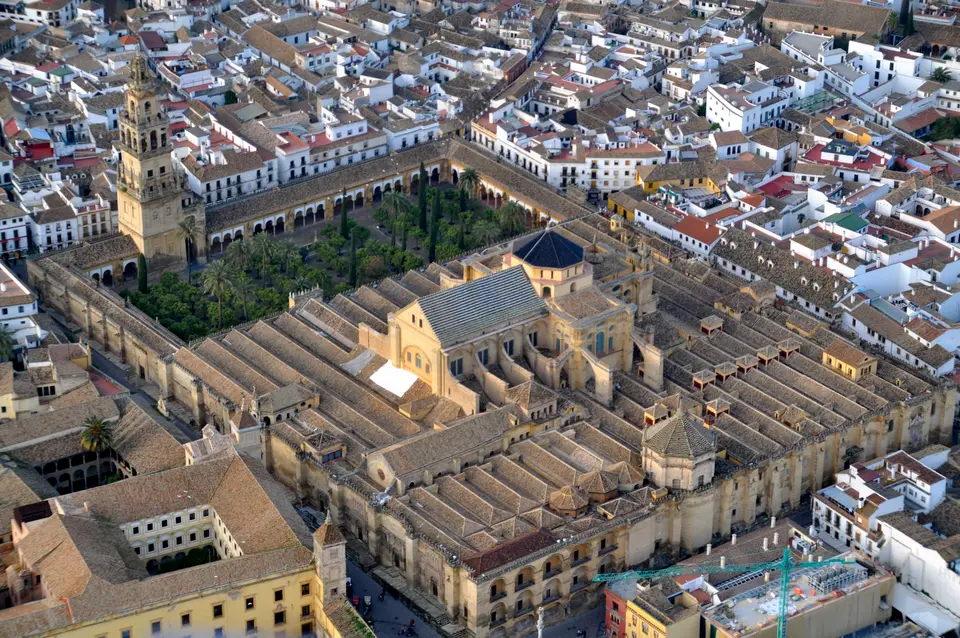
Quick Field Data
- UNESCO Inscription: 1984 (first for the Mosque-Cathedral, extended in 1994 to the old town), for its Roman, Visigothic, Islamic, Jewish and Christian monuments.
- Scale & Footprint: Winding streets and historic blocks surround the Mosque-Cathedral, bounded by Calle San Fernando to the east and the modern commercial centre to the north. To the south the zone crosses the River Guadalquivir via the 16-span Roman Bridge to the Calahorra Tower, and reaches west to the Alcázar de los Reyes Cristianos and San Basilio.
- Access & Ticketing: The historic streets, the Roman Bridge and the lanes of La Judería are open to walkers, while the Mosque-Cathedral, the Alcázar, the Caliphal Baths and the Synagogue need tickets; check the official site for times.
- Arrival Logistics: On the banks of the Guadalquivir River in Andalusia, Spain, linked by rail and road to Seville.
The Historic Centre of Cordoba (Córdoba) spreads along the north bank of the River Guadalquivir in Andalusia and is one of the largest and richest historic town centres in Europe. It was first added to the World Heritage List in 1984 for the Great Mosque-Cathedral, then extended in 1994 to much of the old town, and it is listed in our UNESCO World Heritage Atlas. Thousands of years of Roman, Visigothic, Islamic, Jewish and Christian life have each left a lasting mark here. With its river port, Córdoba was the main gateway between southern Andalusia and the central Spanish meseta, shipping farm produce and copper from the mines of the nearby Sierra Morena. It reached its greatest glory between the eighth and tenth centuries as the leading city and cultural centre of the western world. Visitors coming up the Guadalquivir valley from Seville walk into a maze of narrow lanes, great fortifications and courtyard houses. Whitewashed walls shade the cobbled streets.
From Roman Corduba to the Caliphate of 929 and Ferdinand III
The Romans founded the city in the second century BC, after Roman forces took the Carthaginian town in 206 BC, near an older Tartessian settlement called Corduba. It was first capital of Hispania Ulterior and rose to great importance under Emperor Augustus as capital of the Roman province of Baetica. After Roman power collapsed, the city came under Visigothic rule in the sixth century and stayed so until the early eighth century, when Moorish armies took it.
In 716 Córdoba became a provincial capital answering to Damascus, and in 756 it became the seat of the Muslim emirate of al-Andalus. In 929 Abderraman III made it the capital of an independent Caliphate. In the tenth century, Caliphal Córdoba was among the most advanced cities in the world. It was famous for its learning, its huge library and its religious tolerance, and it held more than 300 mosques and countless palaces and public buildings built to rival Constantinople, Damascus and Baghdad. Córdoba was also a centre of Jewish life in Andalusia for centuries and the birthplace of the great medieval rabbi and philosopher Maimonides (the Rambam).
In 1236, during the Christian conquest, King Ferdinand III (the Saint) took the city, built new defences and turned the Great Mosque into a Christian cathedral. A Christian city of palaces, churches, hospitals and fortresses grew up around it. The Moorish castle became a residence for the Christian kings in the fourteenth century. The Almohad tower guarding the bridge was heavily rebuilt under King Henry II in 1369, and King Philip II added the Royal Stables in 1570.
The Mosque-Cathedral, the 16-Span Roman Bridge, and La Judería
The heart of the site is the Great Mosque-Cathedral of Córdoba, set among old blocks of houses and narrow winding streets. To the south, the protected area crosses the River Guadalquivir to include the 16-span Roman Bridge and the Torre Fortaleza de la Calahorra (Calahorra Tower) on the far bank. On the north bank the bridge ends at the sixteenth-century Puerta del Puente gate. Other Roman remains include the tall columns of the Roman temple, the Roman walls of Córdoba and the mosaics shown inside the Alcázar.
West of the Mosque-Cathedral stands the Alcázar de los Reyes Cristianos. Its terraced gardens and the nearby Caliphal Baths reflect the Moorish design of the city's water and palace spaces. Close by are the Episcopal Palace of Córdoba, built over the foundations of the earlier Visigothic palace and now home to the Diocesan Fine Arts Museum, and the walled San Basilio district. On the western edge, the Moorish gate of the Puerta de Almodóvar leads into the old Jewish Quarter (La Judería). Here stand the medieval Córdoba Synagogue, built in 1314 and used by the Jewish community until 1492, and the small Gothic-Mudéjar Chapel of San Bartolomé, finished in 1410.
The quarters stretching east to Calle San Fernando and north to the shopping centre hold major religious and civic buildings from the fourteenth to the eighteenth centuries. Minarets from the Islamic period survive in the churches of Santiago, San Lorenzo and San Juan and in the Santa Clara Hermitage. The churches of San Nicolás and San Francisco are also here. Sixteenth-century landmarks include the former San Sebastián Hospital, finished in 1516 in a mix of Gothic, Mudéjar and Renaissance styles and now the Congress Centre. There are also the San Pelagio Seminary and the noble house of the Marqués de la Fuensanta del Valle, planned by the architect Hernán Ruiz. The eighteenth-century Hospital del Cardenal Salazar is known for its Baroque façade.
Courtyard Houses and Walking from the Guadalquivir to San Basilio
Beyond its great churches and defences, the old town is defined by its patio houses. Modest and grand homes alike turn plain walls to the narrow streets and open inwards onto cool courtyards full of plants, in the San Basilio quarter and around the cathedral.
What makes Córdoba so striking is how Roman engineering, Umayyad splendour, medieval Jewish heritage and Christian Gothic, Mudéjar, Renaissance and Baroque buildings sit side by side in a living town. The 16 arches of the Roman Bridge and the Calahorra Tower, the arches of the Great Mosque-Cathedral, the water gardens of the Alcázar and the 1314 synagogue in La Judería all stand close together. Each era built on the foundations of the last while keeping the intimate courtyard scale of the whitewashed quarters.
Moving from the riverbank into the winding lanes towards Calle San Fernando and San Basilio, visitors see public stone monuments and private flower-filled patios at every corner. Old minarets now serve as church bell towers over parish squares, Roman mosaics hang in royal halls, and Hernán Ruiz designed sixteenth-century hospitals and palaces. Together they show why Córdoba was for centuries a crossroads between the Guadalquivir valley and the Spanish meseta.
A single walking loop from the south bank through La Judería and into the western quarters links all five of Córdoba's historic cultures.
- Start at the Calahorra Tower and cross the 16-span Roman Bridge: Begin on the south bank of the Guadalquivir for views of the Mosque-Cathedral and Episcopal Palace rising above the river. From there, walk across all 16 arches of the Roman Bridge and enter through the sixteenth-century Puerta del Puente.
- Visit the 1314 Synagogue and 1410 Chapel of San Bartolomé in La Judería: Enter through the Puerta de Almodóvar into the narrow lanes of the Jewish Quarter to visit the medieval Córdoba Synagogue (active until 1492). Just steps away stands the Gothic-Mudéjar Chapel of San Bartolomé beside the Baroque Hospital del Cardenal Salazar.
- Tour the Alcázar gardens and Caliphal Baths and the San Basilio quarter: Spend the afternoon in the western quarter exploring the Roman mosaics and Moorish water gardens of the Alcázar de los Reyes Cristianos. Nearby you can visit the Royal Stables of 1570, the Caliphal Baths, and the flower-filled courtyard houses of San Basilio.
