Quick Field Data
- UNESCO Inscription: 1986, with a buffer zone extension in 2016 (Criteria iii, iv; a fortified medieval town combining Roman foundations with Islamic, northern Gothic and Italian Renaissance architecture).
- Scale & Footprint: A 9-hectare walled core, enclosed by an Almohad wall with some 30 towers from the Muslim period, and a 60.63-hectare buffer zone in Cáceres, Extremadura, Spain.
- Access & Ticketing: The walled streets and squares of the Ciudad Monumental are open public spaces. Museums, churches and palace courtyards set their own entry rules, so check before visiting.
- Arrival Logistics: In the Autonomous Community of Extremadura, south-western Spain, reached by regional rail and road from Seville to the south.
From Norba Caesarina and Almohad Towers to the Fortified Houses of the Nobility
The Old Town of Cáceres, known in Spanish as the Ciudad Monumental or Parte Antigua, stands on a rise in Extremadura that has drawn settlers since prehistoric times. Palaeolithic paintings in the nearby caves of Maltravieso and El Conejar record the earliest inhabitants. In the late first century BC the Romans founded the colony of Norba Caesarina here. Muslims, Jews and Christians followed. The hill became a trading and political centre, and wars between Muslim and Christian rulers left a layered architectural record. Every stone wall reflects that frontier history.
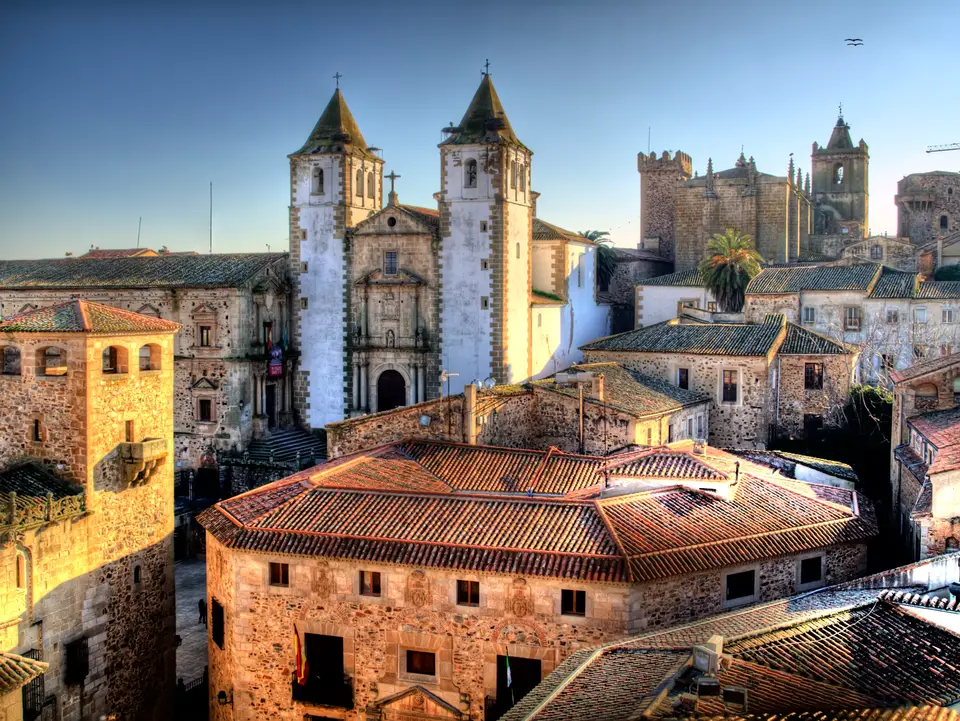
In the Islamic period, builders enclosed the 9-hectare town with an Almohad wall guarded by some 30 towers, many raised on reused Roman blocks. The Christian kingdom of León captured the city briefly in the 1170s and for good in 1229. Noble families then settled inside the walls and competed for power between the fourteenth and sixteenth centuries. Their rivalry shaped the walled town. Its narrow streets filled with austere fortified houses, town palaces and family towers in northern Gothic, Mudéjar and Italian Renaissance styles.
Isabella I of Castile and Ferdinand II of Aragon, the Catholic Monarchs, strengthened royal power after the war of succession against Juana la Beltraneja. They ordered the nobles who had supported her rival claim to cut down their towers. In 1480 only the loyal Diego de Cáceres y Ovando was allowed to build a full battlemented tower, at what is now the Palace of the Storks. In 1477 Isabella swore to respect the town's privileges, first granted by Alfonso IX, at the main gate, and Ferdinand followed in 1478. In the sixteenth century, men returning rich from the conquest of Peru paid for new Renaissance mansions. One was Francisco de Godoy Aldana, who commissioned his palace in 1548.
Almohad Cisterns, Truncated Noble Towers, and the Four Historic Parishes
Since the Middle Ages the wall has divided Cáceres into two zones. Inside the walls lies the Monumental City, with the parishes of Santa María and San Mateo. Outside lies the area around the Plaza Mayor, with the parishes of Santiago and San Juan. Overlooking the Plaza Mayor rises the twelfth-century Torre de Bujaco, the emblem of the city and the most famous of its Islamic towers. It stands on reused Roman blocks, and tradition links its name with the Almohad caliph Abu Yaqub Yusuf. Nearby stand the Tower of the Pulpits and the Yerba Tower. The Torre Mochada is another well-preserved tower of the circuit, comparable with the Almohad towers of Badajoz and the Torre del Oro in Seville. On the eastern side, the Arco del Cristo is a Roman gate surviving from Norba Caesarina. Close by are the Round Tower, the River Tower and the Baluarte de los Pozos, which guarded access to water.
In the parish of Santa María, two squares are dominated by the Gothic Co-Cathedral of Santa María and the Episcopal Palace with its Renaissance front. Around the square stand the fifteenth-century Carvajal Palace, with its round tower, now home to the provincial council's tourist office. Others include the Palace of Hernando de Ovando, the Mayoralgo Palace and the Lower Golfines Palace. The Lower Golfines Palace joins a fifteenth-century fortified house with sixteenth-century Renaissance decoration and bears the arms of the Catholic Monarchs. On the Plaza del Conde de Canilleros stands the Toledo-Moctezuma Palace, now the Provincial Historical Archive. Its owners descended, through Isabel de Moctezuma and her husband Juan Cano de Saavedra, from the Aztec ruler Moctezuma II.
At the centre of the walled town, the sloping Plaza de San Jorge is dominated by the Baroque Jesuit Church of San Francisco Javier, built between 1698 and 1755. Beside it stand the Jesuit college and the Gothic House of the Becerra, now a foundation. Higher up, in the San Mateo quarter, the Gothic Church of San Mateo stands on the site of the former mosque. Nearby are the Convent of San Pablo and the Upper Golfines Palace, where General Franco set up his headquarters in 1936. Close by are the Casa del Sol, with the sun emblem of the Solís family, and the Tower of Sande. The Palace of the Storks keeps the only tower that was never cut down. On the Plaza de las Veletas, the Museum of Cáceres occupies the Veletas Palace and the Casa de los Caballos. Beneath it lies the Almohad cistern of the old fortress, an underground rainwater tank with five naves. Sixteen horseshoe arches rest on 12 columns, some of Roman origin.
Walking the Extramuros Plaza Mayor, Intramuros Squares, and Jewish Quarters
The 9-hectare Monumental City keeps its medieval street plan with little sign of modern traffic, and it served as a filming location for the seventh season of Game of Thrones. The whole area is easy to explore on foot along cobbled slopes and lanes beside the walls.
- Entering from the Plaza Mayor through the Arco de la Estrella: Start in the arcaded Plaza Mayor outside the walls, near the Town Hall and the Ermita de la Paz. Look up at the Torre de Bujaco, then walk through the eighteenth-century Arco de la Estrella into the Plaza de Santa María. There you can see the Co-Cathedral, the Carvajal Palace, the Lower Golfines Palace and the Toledo-Moctezuma Palace.
- Climbing through Plaza de San Jorge to San Mateo and Las Veletas: Climb the steps to the Church of San Francisco Javier and the House of the Becerra in the Plaza de San Jorge. Continue to the upper squares of San Mateo and San Pablo to see the tower of the Palace of the Storks, the Casa del Sol and the Upper Golfines Palace. The Palace of the Marquis of Torreorgaz now houses the Parador of Cáceres. Then visit the Veletas Palace to see the Almohad cistern.
- Tracing the Adarves and the Old Jewish Quarter to the Arco del Cristo: Follow the cobbled lanes beside the walls, known as adarves, past the Arco de Santa Ana and the Palacio de la Generala. Pass the Gothic and Mudéjar Casa de Aldana and the Casa del Mono, which holds a library. Then wind through the old Jewish quarter of San Antonio, past the Ermita de San Antonio, said to stand on the site of the synagogue. The Cuesta del Marqués leads down to the Roman Arco del Cristo.
Multidisciplinary Conservation and the Extremadura Heritage Landscape
Cáceres was declared a Spanish Historic Ensemble in 1949 and listed by UNESCO in 1986, with a buffer zone of 60.63 hectares added in 2016. Outside the walls, the parishes of Santiago and San Juan have notable buildings of their own. They include the Gothic Church of San Juan Bautista, the sixteenth-century Convent of Santo Domingo and the Godoy Palace of 1548. The Church of Santiago de los Caballeros was rebuilt in the sixteenth century by the master builder Rodrigo Gil de Hontañón. Travellers coming north from Seville can compare Cáceres with other fortified Iberian towns in our UNESCO World Heritage Atlas.
