Quick Field Data
- UNESCO Inscription: 1988, covering the historic university quarter and monumental centre in Castile and León, Spain.
- Scale & Footprint: A municipality of 39.56 square kilometres at about 802 metres above sea level, on three hills above the right bank of the Tormes.
- Access & Ticketing: Streets and squares are open all year; check the official cathedral, cloister and university websites for entry rules.
- Arrival Logistics: Linked to Madrid by fast trains and motorways, with Salamanca Airport at Matacán, 14 kilometres to the east.
Salamanca spreads across three low hills on the right bank of the Tormes, at about 802 metres. It keeps one of Europe's most complete historic university towns. UNESCO added the old city to its list in 1988, and it appears in the UNESCO World Heritage Atlas. Its core brings together a Roman bridge, Romanesque churches of the 12th century, Gothic vaults, ornate Plateresque university fronts and the great Baroque Plaza Mayor. Almost everything is built of the same warm sandstone.
Celtic Hillforts, the Roman Bridge, and Medieval Repopulation
People first settled on these river bluffs early in the 1st millennium BC, on the hill of Cerro de San Vicente. By the 4th century BC the settlement had moved to the hill where the cathedrals now stand. Ancient writers called it Helmantike, Hermandica or Salmantica. In 220 BC Hannibal besieged and took the town during his campaign in Iberia.
After the Second Punic War, Rome made Salmantica part of the province of Lusitania. Three Roman works shaped the town for good: the Vía de la Plata road, an early wall around the cathedral hill, and the stone bridge over the Tormes. The northern arches of the bridge are Roman, while the southern half was rebuilt in the 17th century after a great flood in 1626.
Visigothic and then Muslim rule followed, and border wars left the area thinly settled for long periods. Lasting resettlement came after Alfonso VI of León took Toledo in 1085. In 1102 his son-in-law, Raymond of Burgundy, brought in settlers from many backgrounds, including Franks, Castilians, Mozarabs, Portuguese, Galicians and Jews. The diocese was restored, and work began on the Old Cathedral.
The 1218 University and the 16th-Century School of Salamanca
Learning shapes both the identity and the layout of the city. In 1218 King Alfonso IX of León founded a general school here. Alfonso X of Castile gave it the title of university in 1254, and in 1255 Pope Alexander IV recognised its degrees across Christendom. This placed Salamanca beside Paris and Bologna among Europe's leading universities.
Its golden age came in the 16th century, when several thousand students enrolled each year. In the university and the Dominican convent of San Esteban, scholars led by Francisco de Vitoria formed the School of Salamanca. Drawing on reports from the Americas, they rethought natural law, economics and the law of nations. They argued for the dignity and property rights of the peoples of the Americas.
Other milestones are linked to the city. Antonio de Nebrija, who taught here, published the first grammar of the Castilian language in 1492. Tradition holds that Columbus discussed his plans with scholars at San Esteban. Later, Salamanca mathematicians also contributed proposals for the calendar reform of Pope Gregory XIII.
- Patio de Escuelas and Hospital del Estudio: The square is framed by the Escuelas Mayores, the Escuelas Menores and the former Hospital del Estudio, now the rector's office. Nearby are the Gothic and Renaissance house that holds the Museum of Salamanca and the house-museum of the writer Unamuno.
- Convento de San Esteban and Convento de las Dueñas: The 16th-century Dominican convent of San Esteban has a Plateresque front shaped like a triumphal arch and a Baroque altarpiece by José Benito de Churriguera. Nearby, the Convento de las Dueñas has an irregular two-storey cloister carved with grotesques and monsters.
- Historic Colleges and Palaces: They include the 16th-century Colegio del Arzobispo Fonseca and the Colegio de San Ambrosio, now home to Spain's archive of the Civil War. Palaces such as Anaya, Monterrey and La Salina stand nearby. The late 15th-century Casa de las Conchas is covered with carved scallop shells, symbols of the Order of Santiago.
- Towers and Noble Houses of the War of the Bandos: In the 15th century, two noble factions fought for control of the city until Saint John of Sahagún helped make peace. This period left the Casa de doña María la Brava on the Plaza de los Bandos and the eight-sided Torre del Clavero.
Twin Cathedrals, La Clerecía, and the Baroque Plaza Mayor
Salamanca kept both its cathedrals, standing side by side. The Old Cathedral was begun in the 12th century in Romanesque style. The much larger New Cathedral was started in the 16th century in late Gothic style and finished in the 18th century. The Lisbon earthquake of 1755 left visible damage in the New Cathedral's bell tower.
Other notable churches include the round Romanesque church of San Marcos and the 12th-century church of Santo Tomás Cantuariense, dedicated to Thomas Becket. The convent of Las Úrsulas holds the tomb of Archbishop Fonseca by Diego de Siloé. The Baroque La Clerecía, begun for the Jesuits in 1617, has twin towers and is now home to the Pontifical University.
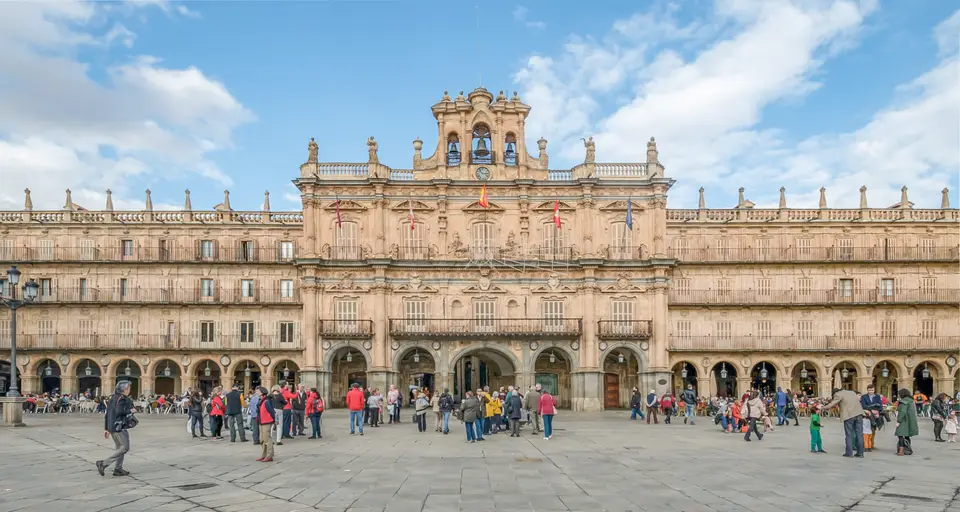
In the heart of the old town lies the Baroque Plaza Mayor, built between 1729 and 1755 to designs by Alberto and Nicolás Churriguera. During the Peninsular War, French troops demolished several colleges. Wellington's victory at the Battle of Arapiles, close to the city, followed in 1812. The old city recovered and in 2002 shared the title of European Capital of Culture with Bruges.
Salamanca Route Planning and Practical Logistics
Start at the Roman Bridge and climb to the Huerto de Calixto y Melibea garden and the Art Nouveau Casa Lis, built in 1905. Then pass the cathedrals, walk up Rúa Mayor past La Clerecía and the Casa de las Conchas, and come out at the Plaza Mayor. You can trace this south-to-north route on the Atlas.
Trains link the city with Madrid, Valladolid and Ávila, and motorways connect it with the rest of Spain. Winters are cold and frosty, while summers are dry and warm. In spring, Holy Week brings many processions, and local food includes hornazo, a pie filled with meats.
