Quick Field Data
- UNESCO Inscription: 1986 (Criteria i, ii, iii, iv). The city holds some 2,000 years of Roman, Visigothic, Islamic, Jewish and Christian history on a rocky promontory above the Tagus.
- Scale & Footprint: A historic core of about 260 hectares, with a buffer zone of about 7,669 hectares, at 529 metres above sea level in the province of Toledo, Castilla-La Mancha.
- Access & Ticketing: The walled streets, the Tagus bridges and Zocodover square are open public spaces. The Cathedral, the Alcázar, the synagogues and the former mosques charge entry, so check the official sites before you go.
- Arrival Logistics: Toledo lies 70 kilometres south of Madrid. High-speed trains, running since 15 November 2005, reach the 1919 Neo-Mudéjar station in about 30 minutes. The A-42 and AP-41 motorways also link the two cities.
From Roman Toletum and the Visigothic Capital to the School of Translators
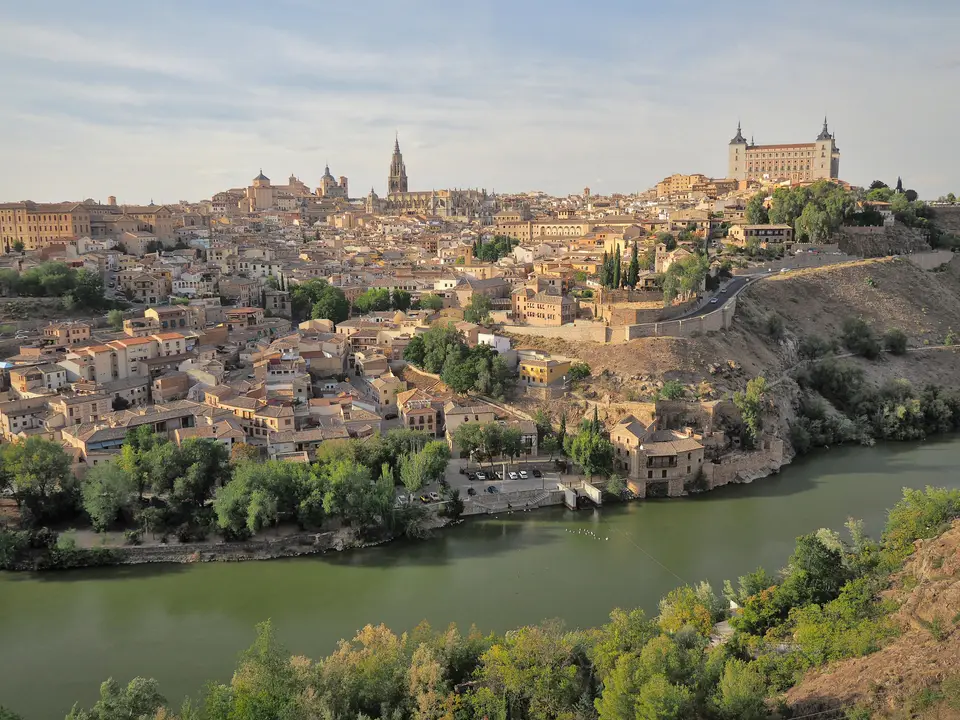
Toledo sits at 529 metres on a steep granite promontory, with the Tagus River curling round three sides, 70 kilometres south of Madrid. Romans called it Toletum and Arabic writers Tulaytulah. The Roman historian Livy described the Carpetani town as small but well fortified, and Rome took it in 193 BC. Toletum gained walls, baths, an aqueduct and a large circus, and its steel blades became famous across the ancient world.
Church councils met here from the year 400, and by the mid-6th century Toledo was the capital of the Visigothic kingdom. About thirty Councils of Toledo followed. At the Third Council in 589, King Reccared renounced Arianism for Catholicism. The Fourth Council in 633 standardised the liturgy and passed harsh decrees against Jews. In 681 a council confirmed the Archbishop of Toledo's primacy over the Spanish church. The gold Treasure of Guarrazar, found at nearby Guadamur in 1858, shows the wealth of this Visigothic age. Muslim forces under Tariq ibn Ziyad and Musa ibn Nusayr took the city in 711 or 712. Toledo often rebelled against the emirs of Córdoba, and in the 11th century it became the capital of an independent taifa kingdom under the Dhu l-Nunid dynasty.
King Alfonso VI of León and Castile captured Toledo on 25 May 1085. The city became known as the City of the Three Cultures, where Christians, Jews and Muslims lived under separate laws. That coexistence was broken by riots and persecutions, and it ended with the expulsion of the Jews in 1492 and of the Muslims in 1502. The Toledo School of Translators worked under Archbishop Raymond in the 12th century and King Alfonso X the Wise in the 13th. It turned Arabic and Hebrew works of science and philosophy into Latin and Castilian. That work carried classical learning across Europe. Emperor Charles V often held court here, but in 1561 his son Philip II settled the court in Madrid. Toledo's growth slowed, and its skyline has changed little since.
Umayyad Oratories, Mudéjar Synagogues, and the Gothic Cathedral
Inside the old walls, mosques, synagogues, churches and Renaissance hospitals stand along steep, winding lanes. Two bridges cross the Tagus gorge. The Alcántara Bridge on the east has Roman origins and is watched over by the medieval Castle of San Servando. The medieval San Martín Bridge guards the west. On the landward north side stand several gates. They include the 10th-century Bab al-Mardum, the old Bisagra Gate and the 14th-century Puerta del Sol. The 16th century added the Cambrón Gate and Alonso de Covarrubias's New Bisagra Gate. Islamic remains include bath houses and the 11th-century Tornerías Mosque. The best known is the Mosque of Cristo de la Luz, a small brick oratory finished in 999 and later given a Mudéjar apse.
The Jewish Quarter in the west keeps two Mudéjar synagogues that became churches after 1492. Santa María la Blanca, often called the oldest synagogue building still standing in Europe, has rows of white octagonal piers and horseshoe arches. The 14th-century Synagogue of El Tránsito houses the Sephardic Museum under a carved cedar ceiling and Hebrew stucco inscriptions. Above the western bend of the river stands San Juan de los Reyes, a Franciscan monastery built between 1477 and 1504. It mixes Isabelline Gothic with Mudéjar decoration. Nearby, the Church of Santo Tomé holds El Greco's painting The Burial of the Count of Orgaz, and the El Greco Museum is a short walk away.
At the centre of the city stands the Gothic Primate Cathedral of Saint Mary, built between 1226 and 1493 with French models and Mudéjar details. It contains the Mozarabic Chapel, where the ancient Mozarabic Rite is still celebrated. Narciso Tomé's Baroque altarpiece, El Transparente, is made of marble, stucco and bronze. Daylight falls on it through an opening cut in the vault. The 16th-century Alcázar crowns the highest point above Zocodover square. In 1936 Nationalist forces under Colonel José Moscardó held it through a siege from 21 July to late September, until relief troops arrived. Since 2010 it has housed the Army Museum. Near it stand the Renaissance Hospital de Santa Cruz and, outside the walls, the Hospital de Tavera. Downstream lies the Royal Arms Factory, founded by Charles III in 1761 and extended by Sabatini in 1777. It now hosts a campus of the University of Castilla-La Mancha.
Field Route from the Bisagra Gates through the Cathedral to the Jewish Quarter
Toledo was declared a historic and artistic site in 1940 and joined the UNESCO list in 1986. The easiest walk runs from the northern gates over the central ridge to the western cliffs above the Tagus.
- Ascending from the Northern Gates to Cristo de la Luz and the Alcázar: Enter through the New Bisagra Gate and pass the old Bisagra Gate and the Puerta del Sol. Stop at the Bab al-Mardum gate to look at the brickwork of Cristo de la Luz. Then climb through Zocodover square to the Hospital de Santa Cruz and the Alcázar, with views over the Tagus and the Alcántara Bridge.
- Exploring the Primate Cathedral and Visigothic San Román: Walk to the Cathedral to see the Mozarabic Chapel and the light falling on El Transparente. Continue west to the Mudéjar Church of San Román, home to the Museum of the Councils and Visigothic Culture.
- Traversing Santo Tomé and the Jewish Quarter to San Martín Bridge: See The Burial of the Count of Orgaz in Santo Tomé and visit the El Greco Museum. Then explore El Tránsito, Santa María la Blanca and the cloister of San Juan de los Reyes, before walking down to the San Martín Bridge.
Living Traditions, Steel Craftsmanship, and Tagus Conservation
Toledo keeps old crafts and customs as well as monuments. Its marzipan (mazapán de Toledo) has protected geographical status, and swordsmiths still work in the city. The Corpus Christi procession, declared of International Tourist Interest in 1980, follows streets shaded by woven awnings. With fast trains from Madrid, Toledo is an easy day trip, and you can compare it with other Spanish cities in our UNESCO World Heritage Atlas.
