Quick Field Data
- UNESCO Inscription: 1985 (extended in 2007), for its complete medieval defences, Gothic cathedral and Romanesque churches and convents outside the walls.
- Scale & Footprint: An irregular four-sided area of 31 hectares (77 acres) inside walls 2,516 metres round, on average 3 metres thick and 12 metres high.
- Access & Ticketing: The historic streets and gate squares are free to walk, while the wall-walk, the Gothic cathedral and the churches outside the walls each have their own ticket desks; check the official site for times.
- Arrival Logistics: In Castile and León in central Spain, linked by rail and road to Madrid.
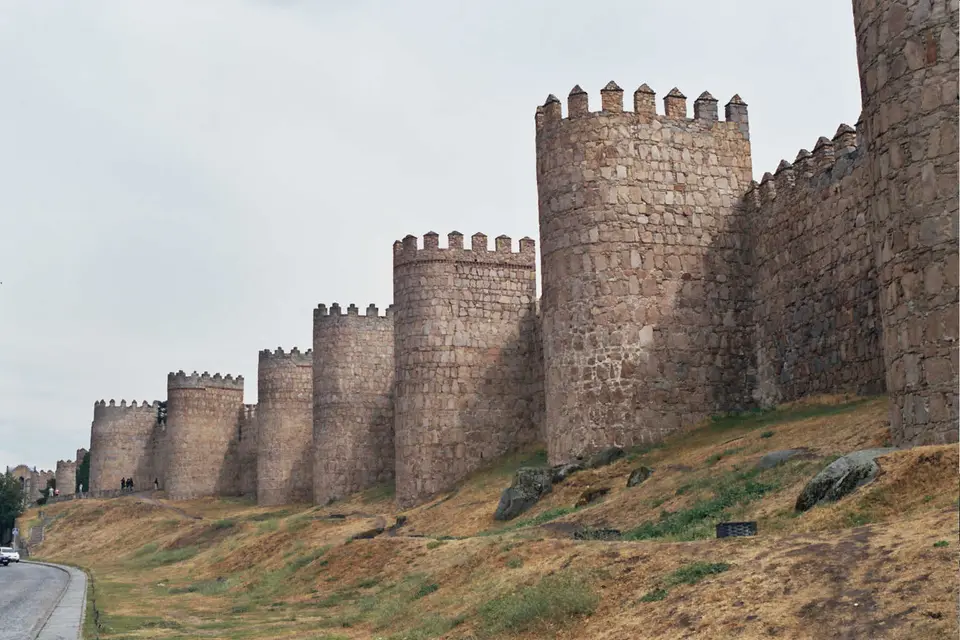
The walled city of Ávila stands on a high rocky ridge in Castile and León, central Spain. With its churches outside the walls, it keeps the most complete medieval town defences in Spain. Inscribed in 1985 and listed in our UNESCO World Heritage Atlas, the site was extended in 2007 to more churches and Renaissance convents outside the walls. Ávila has long been called the City of Saints and Stones. It was resettled in the eleventh century, when Christians repopulated the central Spanish plateau to defend the frontier against the Moors. It is famous as the birthplace of the sixteenth-century mystic Saint Teresa and as the burial place of the Grand Inquisitor Torquemada. Visitors from Madrid see an unbroken granite wall broken by round towers and great arched gateways. Granite towers guard the high plateau.
Alfonso VI's Repopulation Policy and the Medieval Defensive Circuit
Ávila's medieval revival came from the military and settlement plan launched after King Alfonso VI took Toledo in 1085. To strengthen the exposed southern frontier of Castile, between the central mountains and the southern river basin, the crown began a large repopulation policy (repoblaciones). It moved Christian settlers from northern Spain into fortified frontier towns. With nearby Segovia and Salamanca, Ávila became a key military and church stronghold on this frontier during the Middle Ages.
Many other Castilian frontier towns later pulled down parts of their walls to make room for growth, but Ávila kept its whole circuit. Records date the start of the walls to 1090, although the study of the building shows that most of the surviving masonry was rebuilt in the twelfth century, with work going on between the eleventh and fourteenth centuries. The Spanish state listed the Walls of Ávila (Las Murallas de Ávila) as a National Monument on 24 March 1884, a century before UNESCO inscription in 1985.
The walls enclose an irregular rectangle of 31 hectares (77 acres) shaped to fit the ridge, with a continuous circuit of 2,516 metres (8,255 feet). Partly built with dressed stones reused from Roman and other older buildings, they are on average 3 metres (9.8 feet) thick and 12 metres (39 feet) high. Depending on whether corner and gate towers are counted, surveys by historians and UNESCO list between 82 and 88 round towers set at regular intervals around the walls.
Nine Monumental Gates, the Cathedral Apse Bastion, and Extra-Muros Sanctuaries
Nine gates, built and altered in different periods, link the walled town with the countryside. The two largest and oldest are on the exposed eastern side, where the ground is flattest: the Puerta de San Vicente (Gate of Saint Vincent) and the Puerta del Alcázar (Gate of the Fortress). Both are flanked by twin round towers 20 metres (66 feet) high, joined high above the road by a semicircular stone arch and topped with battlements.
Between these two gates, the eastern wall takes in the fortified round apse of Ávila Cathedral itself. Known locally as the cimorro, this massive granite apse projects from the wall as one of the city's defensive towers. It joins the hard lines of a frontier fortress with the sacred architecture of what is often called Spain's first Gothic cathedral. Inside the walls, narrow cobbled lanes link Romanesque and Gothic parish churches with fortified noble palaces built to guard the gates.
The churches outside the walls (extra-muros), where medieval stonemasons and sixteenth-century monastic patrons had more room to build, are just as important to the listing. The first inscription in 1985 included four masterpieces of Castilian Romanesque just beyond the walls: the Basilica of San Vicente, the Church of San Pedro, the Church of San Andrés and the hermitage of San Segundo by the river. In 2007 the site was extended to three more Romanesque parish churches, San Martín, San Nicolás and Santa María de la Cabeza. It also took in three famous fifteenth- and sixteenth-century convents and monasteries of Ávila's Golden Age. These are the Convent of La Encarnación, the Convent of San José (the first house Saint Teresa founded in her reform of the order) and the Real Monasterio de Santo Tomás, a summer palace of the Spanish monarchs where Torquemada was buried.
Together, the walled town and its ring of Romanesque churches and Renaissance convents show how Ávila grew from an eleventh-century military outpost into a leading spiritual centre of sixteenth-century Spain. Walking both the wall-walk and the outer road, visitors see the contrast between the rough granite reused in the ramparts of 1090 and the twelfth century and the finely carved Romanesque doorways of San Vicente and San Pedro. Plain monastic cloisters stand outside the gates. This dialogue between defensive stonework and religious devotion shapes every square and viewpoint in Ávila.
Walking the Parapet Path and Exploring the Extramural Ring
Today visitors can walk along the battlements for a large part of the 2,516-metre circuit. Some stretches stay closed where the wall joins the cathedral apse and neighbouring palaces. The restored wall-walk gives wide views over the tiled roofs of the old town and the plateau beyond.
All around the plateau, the walls and the historic buildings inside and outside the gates form one unbroken view. The builders used heavy blocks of local grey granite and reused stones, so the 2,516-metre circuit seems to grow out of the rocky ridge above the Castilian plain. From the Romanesque churches of San Pedro and San Vicente on the eastern plateau or from the western viewpoint near San Segundo, the round towers and battlements form one of the best-preserved medieval townscapes in Europe.
A full-day walking loop that combines the wall-walk with the churches and convents outside shows both the twelfth-century frontier town and its sixteenth-century monastic flowering. Walking the open stretches of wall and passing through the nine gates shows how the granite towers and the fortified cathedral apse anchored the town, while the churches and convents outside complete the circuit.
- Compare the twin eastern gates and the cathedral apse from outside the walls: Start in the eastern square outside the ramparts to view the 20-metre twin drum towers of the Puerta del Alcázar and Puerta de San Vicente. Between those two gateways rises the projecting granite apse of the Gothic cathedral.
- Walk the elevated parapet path along the northern and western ramparts: Climb the public stairs onto the 3-metre-thick walls to follow the round towers from above, looking out to the Romanesque shrine of San Segundo and the open countryside.
- Follow the extramural route from San Vicente to Santo Tomás: Spend the afternoon outside the nine gates, visiting the Romanesque churches of San Vicente, San Andrés and San Pedro, the sixteenth-century Convent of San José and the royal monastery of Santo Tomás.
