Madrid Museums Guide: Prado, Reina Sofía, Thyssen & Paseo del Arte
How to tackle the Prado, Reina Sofía and Thyssen-Bornemisza without museum fatigue, including passes and free entry rules.
Along a shaded one-kilometre stretch of the tree-lined Paseo del Prado stand three world-famous art museums. Inscribed by UNESCO in 2021 as part of the Landscape of Light, they form the Golden Triangle of Art (Triángulo del Arte). These are the Museo Nacional del Prado, the Museo Nacional Centro de Arte Reina Sofía, and the Museo Nacional Thyssen-Bornemisza (pronounced TEE-sen bor-neh-MEE-sah). Between them, they trace Western painting from thirteenth-century Italian devotionals through the Spanish Habsburgs and Bourbons to Pablo Picasso's twentieth-century avant-garde. The single biggest mistake first-time visitors make is attempting to visit two or all three museums on the same day. Each collection demands fresh eyes. Schedule one per morning across our 3-day itinerary, followed by a long lunch in the adjacent Barrio de las Letras.
Museo Nacional del Prado: The Spanish Royal Collection
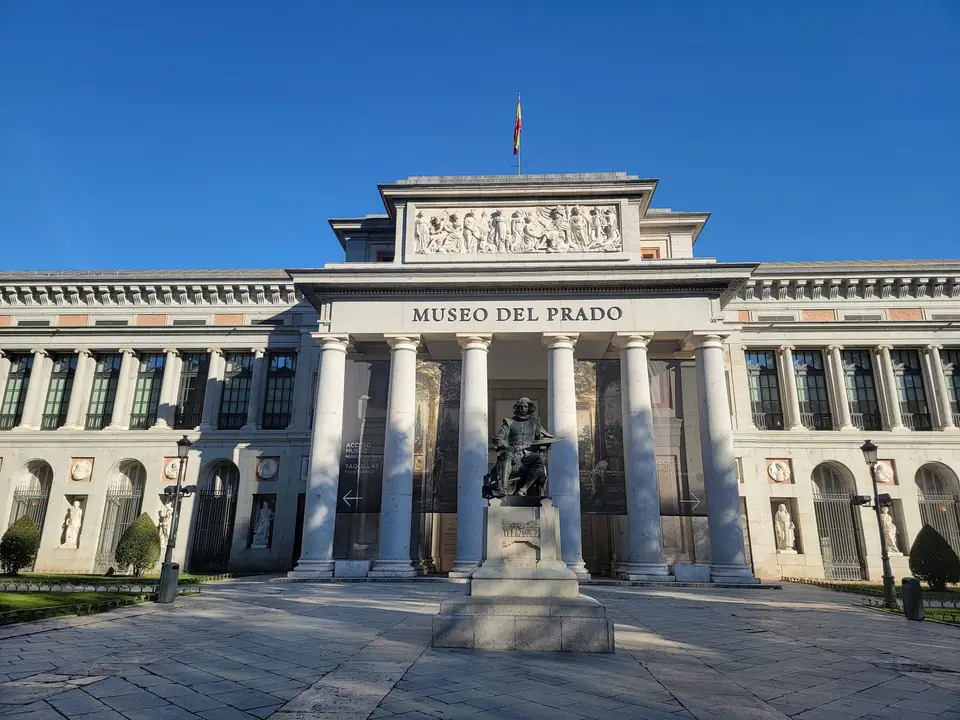
Enlightenment architect Juan de Villanueva designed this neoclassical building in 1785 as a Natural History Cabinet for King Charles III. It opened to the public as the Royal Museum of Paintings in 1819 and was expanded in 2007 by Rafael Moneo behind the Jerónimos Cloister. Today the Prado holds over 8,000 paintings, of which roughly 1,700 are on display. Because Spanish monarchs ruled Flanders, large parts of Italy and the Americas in the sixteenth and seventeenth centuries, the collection is unmatched for five masters. With a three-hour morning ticket, focus on these core rooms:
- Diego Velázquez (First Floor, Central Gallery Rooms 12 to 15). Room 12 anchors the entire museum with Las Meninas (1656). Velázquez paints himself standing behind a towering easel as five-year-old Infanta Margaret Theresa, her attendants and a mastiff look out toward the viewer. In the rear mirror glow the reflections of King Philip IV and Queen Mariana. Around it hang The Surrender of Breda (Las Lanzas), The Spinners (Las Hilanderas) and Vulcan's Forge.
- Francisco de Goya (Ground, First and Second Floors). Follow Goya's remarkable arc from his bright royal cartoon designs on the second floor to the unflinching royal group portrait The Family of Charles IV (1800). Nearby hang the Napoleonic War masterpieces The Second of May 1808 and The Third of May 1808 (1814). Finish on the ground floor in Rooms 64 to 67 before the fourteen dark Black Paintings (Pinturas Negras). Goya painted Saturn Devouring His Son and The Dog onto the plaster walls of his house (Quinta del Sordo) from 1819 to 1823.
- Hieronymus Bosch & Early Netherlandish Painting (Ground Floor Rooms 56 to 58). Philip II was an obsessive collector of Bosch. Arrive straight at opening to stand close to the three hinged oak panels of The Garden of Earthly Delights (c. 1490 to 1500), The Haywain Triptych, and Rogier van der Weyden's luminous 1435 Descent from the Cross.
- El Greco (First Floor Rooms 8B to 10B). Admire The Nobleman with his Hand on his Chest (c. 1580) and the towering Toledo altarpieces painted after Domenikos Theotokopoulos settled in Spain in 1577.
- Titian, Albrecht Dürer and Peter Paul Rubens. See Titian's equestrian portrait Emperor Charles V at Mühlberg (1548), Dürer's 1498 Self-Portrait, and Rubens's late celebratory The Three Graces (1635).
Prado Entrance Strategy: Pre-booked ticket holders enter via the Puerta de los Jerónimos behind the church or the lower Puerta de Goya. The central Puerta de Velázquez on the Paseo del Prado is reserved for pass holders and priority access.
Museo Reina Sofía: Picasso's Guernica, Dalí and Miró
Located at the southern end of the Paseo del Prado opposite Atocha station, the Reina Sofía occupies the vast eighteenth-century General Hospital created by Francesco Sabatini. You will recognise it by Ian Ritchie's three exterior glass-and-steel lift towers added in 1990 and Jean Nouvel's glossy red 2005 auditorium wing. Spain's national museum of twentieth-century and contemporary art takes over chronologically in 1881, the year of Pablo Picasso's birth.
Head first to the second floor of the Sabatini building to Room 206, home to Pablo Picasso's Guernica (1937). Picasso painted this stark black, white and grey oil on a monumental 3.49-by-7.77-metre canvas for the Spanish Republican Pavilion at the 1937 Paris International Exposition. It responds to the bombing of the Basque market town of Gernika by Nazi German and Fascist Italian aircraft on 26 April 1937. The painting spent decades at MoMA in New York at Picasso's insistence until democracy returned to Spain, arriving in Madrid in 1981. Surrounding rooms display Picasso's preparatory drawings and Dora Maar's photographs of the canvas in progress. Neighbouring galleries showcase Joan Miró and Salvador Dalí's 1929 The Great Masturbator and Girl at the Window.
Museo Nacional Thyssen-Bornemisza: Filling the Historical Gaps
Across the Plaza de Neptuno inside the early-nineteenth-century Palacio de Villahermosa sits the private collection assembled by Baron Heinrich Thyssen-Bornemisza and his son Baron Hans Heinrich. The Spanish state acquired the 775-work collection in 1993. Organised chronologically from the second floor down to the ground floor, the Thyssen fills every period underrepresented in the Prado and Reina Sofía. The second floor opens with fourteenth-century Italian primitives (Duccio), Jan van Eyck's diptych, and Hans Holbein the Younger's Portrait of Henry VIII. Further rooms hold Caravaggio's Saint Catherine of Alexandria and Canaletto. The first and ground floors trace French Impressionists (Monet, Degas, Renoir), Van Gogh and German Expressionists. The final rooms highlight North American painting led by Edward Hopper's 1931 Hotel Room. You can see its highlights comfortably in two hours.
Tickets, Paseo del Arte Pass & Why "Free Evening Entry" Needs Care
- The Paseo del Arte Pass (Abono Paseo del Arte). Valid for one full year from purchase, this combined pass covers the permanent collections of the Prado, the Reina Sofía and the Thyssen-Bornemisza. It saves roughly 20 percent over buying three individual tickets and lets you skip the ticket office. For the Prado and Reina Sofía, you still select a timed entry date and hour online.
- Weekly Closing Days & Free Evening Windows. The Prado opens daily. Free hours run Monday to Saturday (6:00 pm to 8:00 pm) and Sunday (5:00 pm to 7:00 pm). The Reina Sofía closes every Tuesday; its free slots run Monday and Wednesday to Saturday (7:00 pm to 9:00 pm) and Sunday (12:30 pm to 2:15 pm), booked online. The Thyssen-Bornemisza opens 7 days a week; free entry runs every Monday (12:00 pm to 4:00 pm) and Saturday nights (9:00 pm to 11:00 pm).
- Why Paying for a Morning Slot Beats the Free Queue at the Prado. For the Prado's evening free window, you must still stand in the physical line outside the Goya ticket office for a free pass. Queues begin 45 to 60 minutes before 6:00 pm, leaving barely ninety minutes inside crowded galleries. Buy a paid 10:00 am ticket instead.
- Beyond the Big Three (Sorolla Closure & Archaeological Gems). The beloved Museo Sorolla in Chamberí closed in October 2024 for an architectural expansion and remains under renovation into 2026; check its website before going. Instead, visit the Galería de las Colecciones Reales or the Museo Arqueológico Nacional (MAN) on Calle Serrano for the Iberian bust of the Lady of Elche.
Where it is
- 1Madrid Museums
- Adolfo Suárez Madrid–Barajas Airport (MAD) · about 13 km from here in a straight line
- Directions in Google Maps
Stations and taxi ranks: OpenStreetMap. Airports: OurAirports. Distances are in a straight line.
Traveller tips
Real advice from people who have been to Madrid. Every tip is read by our team before it goes live.
No tips yet. Been here? Yours could be the first.
Thank you! Your tip will appear here after a quick review.
More in Madrid
Continue exploring Madrid with related neighbourhood, food, and planning guides