Where to Stay in Madrid: 7 Best Neighbourhoods Compared
Which central Madrid barrio fits your trip style, sleep habits and arrival station, plus the room types to request.
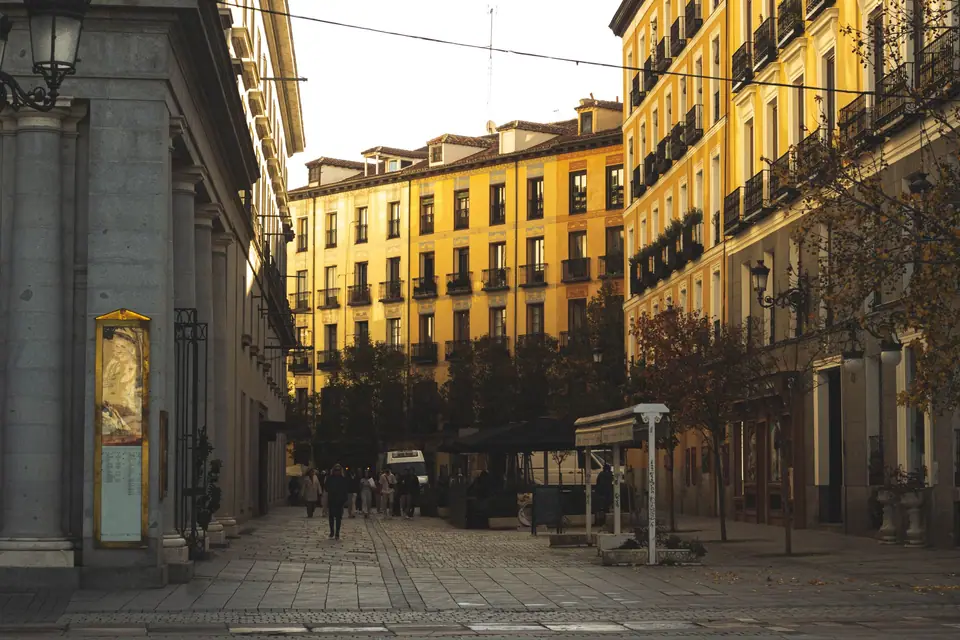
Choosing the right base in Madrid comes down to a simple trade-off between doorstep atmosphere and night-time quiet. The historic centre between the Royal Palace on the western ridge and the Paseo del Prado museums in the eastern valley measures only 2.5 kilometres across. Staying anywhere inside or immediately bordering the central Centro district allows you to walk to almost every major sight. At the same time, Madrid has the latest street life in Europe. Bars around Plaza de Santa Ana, Malasaña and Cava Baja stay lively until 2:00 am even on Tuesday and Wednesday nights. Two practical booking tips solve this before you arrive. First, if you are a light sleeper booking in a lively central barrio, request an interior courtyard room (habitación interior). Otherwise, ask for a high floor with double-glazed acoustic balconies (ventanas climalit). Second, if you travel between late May and September, verify that your accommodation has proper air conditioning rather than ceiling fans.
7 Best Madrid Neighbourhoods Compared Side by Side
- 1. Barrio de las Letras / Cortes (Our #1 Choice for First-Time Visitors). Stretching down the gentle slope between Puerta del Sol and the Paseo del Prado, the Literary Quarter is where Golden Age writers lived. Miguel de Cervantes, Lope de Vega, Francisco de Quevedo and Tirso de Molina all resided in these narrow seventeenth-century streets. Brass literary verses set into the granite pavement of pedestrianised Calle de las Huertas commemorate their works today. You can walk to the Prado and Thyssen-Bornemisza in five minutes, to the Reina Sofía and Atocha station in ten, and to Plaza Mayor in eight. Aim for quieter side streets such as Calle de Cervantes, Calle del Prado, or Calle de Lope de Vega near the 1610 Casa-Museo Lope de Vega. Avoid rooms directly above the late-night terraces of Plaza de Santa Ana if you go to bed early.
- 2. Puerta del Sol & Madrid de los Austrias (Best for Short Stays & Historic Grandeur). Staying between Sol, Plaza Mayor and Plaza de Oriente puts you at the exact geographic and transport centre of Madrid. Metro Lines 1, 2 and 3 plus Cercanías commuter trains intersect directly beneath Puerta del Sol. Choose the calmer western streets around Ópera, Plaza de Oriente and Plaza de la Villa. Those royal squares feel much more peaceful than the commercial arteries of Calle Preciados, Calle del Carmen and Calle de la Montera, which stay crowded late.
- 3. La Latina & Lavapiés (Best for Traditional Tapas & Sunday Market Culture). Just south of Plaza Mayor along the medieval Christian ramparts, La Latina feels like an old Castilian village of crooked lanes and terracotta roofs. Shaded squares such as Plaza de la Paja and Plaza de San Andrés lead into Calle de la Cava Baja. Along that single narrow street, over forty traditional tavernas pour draught vermouth and Rioja. It is unbeatable for food lovers, though Sunday afternoons around El Rastro are noisy and crowded. Directly east down the slope lies Lavapiés, Madrid's steepest and most multicultural quarter. Its streets pack in South Asian, West African and contemporary Spanish bistros near the street art of La Tabacalera and independent theatres.
- 4. Malasaña & Conde Duque (Best for Vintage Shops, Cafés & Night Owls). Immediately north of Gran Vía around the historic Plaza del Dos de Mayo, where Madrileños rose against Napoleon's troops on 2 May 1808, sits Malasaña. In the late 1970s and 1980s, this neighbourhood was the epicentre of the Movida Madrileña countercultural movement celebrated by filmmaker Pedro Almodóvar. Today its narrow streets hold specialty coffee roasters, record stores, vintage boutiques and late-night cocktail bars. For the same village charm with significantly quieter nights, book five minutes west around the eighteenth-century red-brick barracks of Conde Duque and Plaza de las Comendadoras.
- 5. Chueca & Salesas (Best for Boutique Hotels, LGBTQ+ Energy & Stylish Dining). East of Calle de Fuencarral and north of Gran Vía, Chueca is the heart of LGBTQ+ Madrid. The quarter centres on Plaza de Chueca, Plaza de Pedro Zerolo and the rooftop terrace of the three-level Mercado de San Antón. Its eastern edge, Las Salesas (around Plaza de las Salesas, Calle Barquillo and Calle Fernando VI), is one of Madrid's most refined corners. Here nineteenth-century French-style apartment facades, independent bakeries and small design hotels sit within a fifteen-minute walk of the Thyssen and Prado.
- 6. Salamanca & Jerónimos / Retiro (Best for Families, Luxury & Quiet Nights). The Marquis of Salamanca laid out this orthogonal grid of aristocratic boulevards northeast of Retiro Park in the 1860s. Calle de Serrano, Calle de Velázquez and Calle de Claudio Coello form the luxury shopping axis known as the Milla de Oro (Golden Mile). Across Barrio de Salamanca, visitors enjoy wide tree-lined pavements, Mercado de la Paz and peaceful nights. Directly south, Los Jerónimos (between the Prado and the western gates of Retiro Park) is Madrid's most distinguished residential enclave.
- 7. Chamberí, Almagro & Trafalgar (Best for Living Like a Local). North of Alonso Martínez and Bilbao Metro stations, Chamberí (pronounced chahm-beh-REE) rarely sees tour groups. The district centres on leafy tree-shaded Plaza de Olavide, a circular car-free square ringed by neighbourhood sun terraces. Nearby stand the aristocratic mansions of Almagro and the famous tapas strip of Calle Ponzano. Do not miss the preserved 1919 Ghost Metro Station of Andén 0 (Estación de Chamberí) designed by Antonio Palacios. Chamberí gives repeat visitors an authentic residential base connected to Sol in ten minutes on Metro Lines 1, 4 and 10.
Matching Your Hotel to Your Arrival Station or Airport Link
Your arrival terminal can help break a tie between neighbourhoods. If you arrive on an early or late high-speed AVE train at Puerta de Atocha, book in the Barrio de las Letras, Paseo del Prado or Retiro. Those same areas sit beside the Atocha terminus of the 24-hour yellow Express Bus 203 from Barajas Airport. You can walk from the train platform or bus stop to your hotel door in under ten minutes. Travellers landing at Terminal 4 can take Cercanías C1 or C10 directly to Recoletos (for Salamanca, Salesas and Cibeles) or Sol (for Centro and Austrias). Check every route in our getting there guide and plan your daily walks with our Madrid travel guide.
Where it is
- 1Madrid
- Adolfo Suárez Madrid–Barajas Airport (MAD) · about 14 km from Madrid in a straight line
- Directions in Google Maps
Stations and taxi ranks: OpenStreetMap. Airports: OurAirports. Distances are in a straight line.
Traveller tips
Real advice from people who have been to Madrid. Every tip is read by our team before it goes live.
No tips yet. Been here? Yours could be the first.
Thank you! Your tip will appear here after a quick review.
More in Madrid
Continue exploring Madrid with related neighbourhood, food, and planning guides
Madrid Orientation: 657m Altitude, Austrias vs Bourbon Axis & Tips
Madrid, Spain
12 Best Things to Do in Madrid: Museums, Palaces, Parks & Tapas
Madrid, Spain
How to Get to Madrid: Barajas Airport, Atocha vs Chamartín & Metro
Madrid, Spain
Best Time to Visit Madrid: 657m Plateau Weather, Crowds & Festivals
Madrid, Spain
