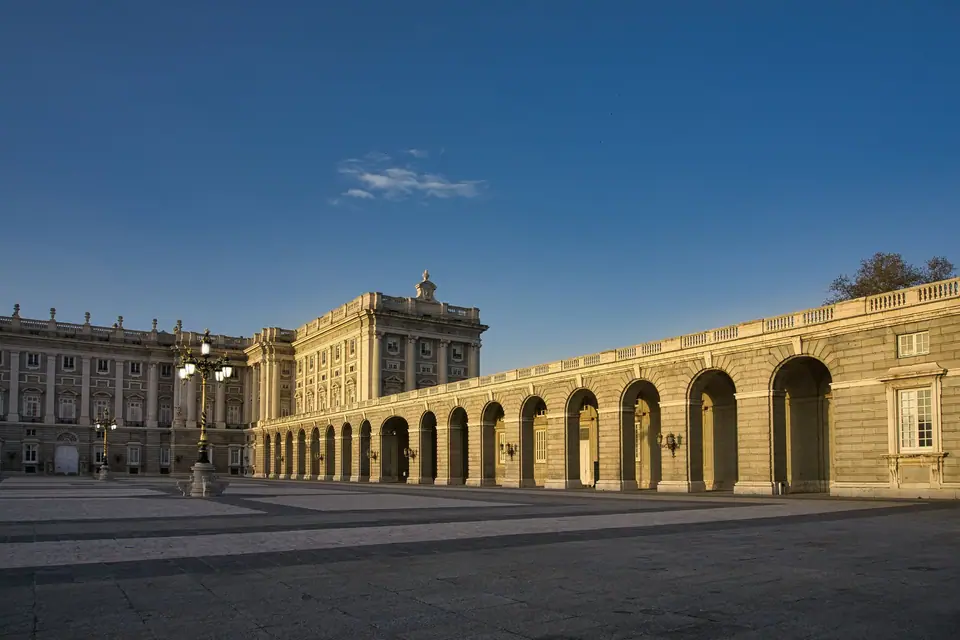
Royal Palace of Madrid & Habsburg Old Town Self-Guided Walk
Which state rooms to see inside Western Europe's largest royal palace, plus a 2.5-kilometre walk through Habsburg Madrid.
Madrid began on the steep western bluff above the Manzanares River ravine. In the late ninth century, Umayyad Emir Muhammad I of Córdoba built the military citadel (alcázar) of Mayrit on this strategic limestone ridge. The fortress guarded the northern approaches to Toledo. King Alfonso VI of León and Castile captured the citadel in 1085, and Philip II made Madrid Spain's permanent capital in 1561. The Habsburg monarchs expanded the medieval castle into the Royal Alcázar and laid out the surrounding courts still known as Madrid de los Austrias (Habsburg Madrid). Pair a morning inside the Bourbon palace with an afternoon downhill stroll to Plaza Mayor and La Latina. That route forms the opening day of our 3-day itinerary without needing a single train.
Visiting the Royal Palace of Madrid (Palacio Real)
On Christmas Eve, 24 December 1734, a catastrophic fire raged for four days through the old Habsburg Alcázar and destroyed the building. Court officials managed to throw Velázquez's Las Meninas and dozens of royal canvases out of the windows, saving the core of today's Prado Museum. Spain's first Bourbon monarch, King Philip V, commissioned Italian architects Filippo Juvarra and Giovanni Battista Sacchetti to erect a fireproof palace. They built it entirely of white Colmenar limestone and grey Guadarrama granite so no timber frame could burn again. Constructed between 1738 and 1764 and first occupied by King Charles III, the Palacio Real de Madrid spans 135,000 square metres and contains 3,418 rooms. That floor area is nearly double Buckingham Palace or Versailles, making it the largest functioning royal palace in Western Europe.
King Felipe VI and the royal family reside at the smaller Zarzuela Palace outside the city. Even so, the Palacio Real remains the official seat of state ceremonies, credential presentations and royal banquets. Book a timed entry slot online via the official Patrimonio Nacional portal and allow two hours for the self-guided route across these five main spaces:
- The Grand Staircase (Escalera Principal) and Halberdiers' Hall. Francesco Sabatini designed this single monumental flight of San Agustín marble steps guarded by two carved stone lions. Above shines Corrado Giaquinto's ceiling fresco Religion Protected by Spain.
- The Throne Room (Salón del Trono). This grand salon retains its original 1772 Rococo decorative scheme with crimson Genoese velvet wall hangings and Venetian rock-crystal chandeliers. Four gilt-bronze lions cast for Philip IV from the old Alcázar guard the dais beneath Giovanni Battista Tiepolo's 1764 ceiling fresco The Glory of Spain.
- The Gasparini Room and Porcelain Cabinet. King Charles III's private robing chamber was designed by Mattia Gasparini with Chinoiserie silk wall embroideries worked in silver thread and a swirling marble mosaic floor. Next door sits a room lined floor-to-ceiling in green-and-white garlands from the Royal Porcelain Factory of the Buen Retiro.
- The Gala Banquet Hall and the Royal Stradivarius Palatinos. Formed in 1879 by uniting three queen's apartments into a 400-square-metre dining hall set for 144 guests, this wing leads to the music room. Inside rests the Stradivarius Palatinos, the world's only complete decorated string quartet crafted by Antonio Stradivari in Cremona in 1696.
- The Royal Armoury (Real Armería) and Royal Kitchen. Across the open southern courtyard of the Plaza de la Armería sits one of the world's foremost Renaissance armouries. It displays the actual tournament and battlefield steel armour worn by Emperor Charles V (including his 1547 Battle of Mühlberg suit) and Philip II. A separate ticket upgrade lets you descend into the 1861 brick-vaulted Royal Kitchen (Cocina Real).
Next Door: The Galería de las Colecciones Reales (Opened 2023)
Carved into the granite cliff below the Plaza de la Armería between the palace and Almudena Cathedral stands the 40,000-square-metre Royal Collections Gallery. Designed by architects Emilio Tuñón and Luis Moreno Mansilla, the museum opened in June 2023. You enter at the top level and walk down wide ramps through three floors. Level -1 showcases Habsburg treasures including Flemish woven hangings, Bosch, Titian, El Greco and four monumental salomonic columns by Gian Lorenzo Bernini. Level -2 covers the Bourbons with Goya, Mengs, Velázquez's White Horse and gilded state carriages. Level -3 reveals the archaeological remains of Madrid's ninth-century Umayyad stone wall and gate towers unearthed during excavation.
Free Palace Entry & Changing of the Guard: Citizens of the EU and Latin America with passport or ID can enter both venues free from Monday to Thursday. The free window covers the last two hours of opening (4:00 pm to 6:00 pm in winter, 5:00 pm to 7:00 pm in summer). A small Changing of the Royal Guard takes place at the Puerta del Príncipe on Wednesdays and Saturdays from 11:00 am to 2:00 pm. The full 400-person, 100-horse Solemn Relief of the Guard (Relevo Solemne) fills the Plaza de la Armería at 12:00 noon. It runs on the first Wednesday of every month except January, August and September.
Self-Guided Walk Through Habsburg Madrid (2.5 km, 2 to 3 Hours)
- Almudena Cathedral & the 9th-Century Arab Wall (Muralla Árabe). Step across the Plaza de la Armería into Santa María la Real de la Almudena, consecrated by Pope John Paul II in 1993. Then walk 150 metres down Cuesta de la Vega to see the longest surviving outdoor stretch of Emir Muhammad I's flint-and-limestone ninth-century fortress wall.
- Calle del Factor Viewpoint & Plaza de Oriente. Loop back through the 1840s boxwood parterres of Plaza de Oriente, lined with royal statues surrounding Pietro Tacca's 1640 equestrian bronze of Philip IV. Galileo Galilei helped calculate the balance so the rearing horse stands entirely on its two hind legs, facing the 1850 Teatro Real opera house.
- Plaza de la Villa & Mercado de San Miguel. Walk east along Calle Mayor to the quiet medieval square of Plaza de la Villa. Three historic buildings frame the cobbles: the fifteenth-century Torre de los Lujanes, the sixteenth-century Casa de Cisneros and the seventeenth-century Casa de la Villa. Continue past the 1916 cast-iron glass pavilion of Mercado de San Miguel.
- Plaza Mayor & Chocolatería San Ginés. Enter the 1619 Plaza Mayor around the bronze equestrian statue of Philip III and the frescoed facade of the Casa de la Panadería. Duck two blocks northeast to Pasadizo de San Ginés 5 for fresh churros, or descend the steep stone steps of the Arco de Cuchilleros.
- Plaza de la Paja, San Francisco el Grande & Calle de la Cava Baja. Follow the curve of the medieval Christian wall down into La Latina. Pass the terraced gardens of the Príncipe de Anglona and the sloping square of Plaza de la Paja. Visit the 33-metre frescoed dome of the 1784 Real Basílica de San Francisco el Grande. Finish your walk with an early evening draught vermouth or tapas crawl along Calle de la Cava Baja. More highlights are in our things to do guide.
Where it is
- 1Royal Palace of Madrid & Habsburg Old Town Self-Guided Walk
- Adolfo Suárez Madrid–Barajas Airport (MAD) · about 15 km from here in a straight line
- Directions in Google Maps
Stations and taxi ranks: OpenStreetMap. Airports: OurAirports. Distances are in a straight line.
Traveller tips
Real advice from people who have been to Madrid. Every tip is read by our team before it goes live.
No tips yet. Been here? Yours could be the first.
Thank you! Your tip will appear here after a quick review.
More in Madrid
Continue exploring Madrid with related neighbourhood, food, and planning guides
Madrid 3-Day Itinerary: Royal West, Paseo del Arte & Day Trips
Madrid, Spain
Madrid Orientation: 657m Altitude, Austrias vs Bourbon Axis & Tips
Madrid, Spain
12 Best Things to Do in Madrid: Museums, Palaces, Parks & Tapas
Madrid, Spain
How to Get to Madrid: Barajas Airport, Atocha vs Chamartín & Metro
Madrid, Spain
