Madrid Orientation: 657m Altitude, Austrias vs Bourbon Axis & Tips
How the 657-metre plateau capital is laid out, when Madrid eats, and the practical rules to know before landing.
Understanding Madrid starts with two facts that shape every hour of your visit: its altitude and its clock. Sitting at 657 metres (2,155 feet) above sea level on the central Castilian plateau (Meseta Central), Madrid is the highest major capital in Europe. In 1561, King Philip II moved the royal court here from Toledo because the town stood at the exact geographical centre of the Iberian Peninsula. The city rises below the 2,428-metre peaks of the Sierra de Guadarrama. That elevation gives the capital over 2,800 hours of annual sunshine and low humidity. It also produces hot summer afternoons, icy winter mornings and rapid evening temperature drops. Just as striking is the daily rhythm of a Madrileño (mah-dree-LEN-yoh). Spain has used Central European Time since 1940 despite sitting on the same longitude as London and Lisbon. Consequently, solar noon arrives past 1:30 pm. Lunch begins between 2:00 pm and 3:30 pm, while dinner rarely starts before 9:00 pm or 10:00 pm.
How the Habsburg West and Bourbon East Fit Together
Almost everything you will visit on a first trip sits inside a compact, walkable rectangle measuring 2.5 kilometres from west to east. Rather than sprawling along a wide navigable river like Paris or London, central Madrid grew across two distinct historical terraces. Both sides meet at Puerta del Sol. Outside the eighteenth-century Real Casa de Correos, a bronze pavement plaque marks Kilometre Zero (Kilómetro Cero) of Spain's six national radial highways:
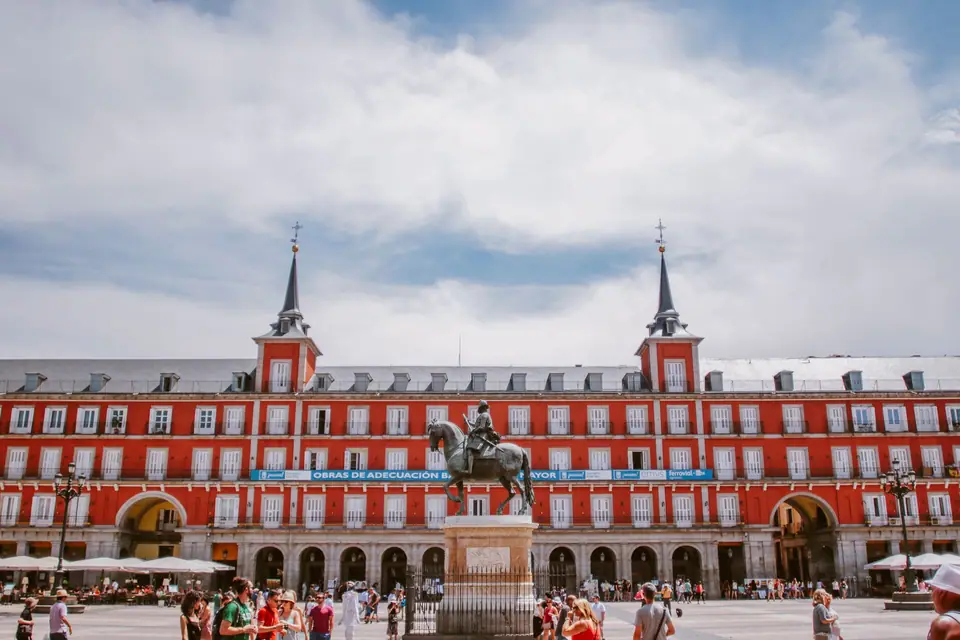
- The Western Ridge (Madrid de los Austrias and the Royal Palace). West of Puerta del Sol, the ground rises toward the steep ravine of the Manzanares River. Emir Muhammad I of Córdoba built the ninth-century Moorish fortress (alcázar) of Mayrit on this cliff edge. In the sixteenth and seventeenth centuries, the Habsburg monarchs laid out the arcaded Plaza Mayor, completed in 1619 under Philip III. Nearby sit the medieval civic buildings of Plaza de la Villa and the steeply sloping lanes of La Latina. When the Christmas Eve fire of 1734 destroyed the old fortress, the Bourbons erected the 3,418-room Royal Palace of Madrid and Royal Collections Gallery on the bluff.
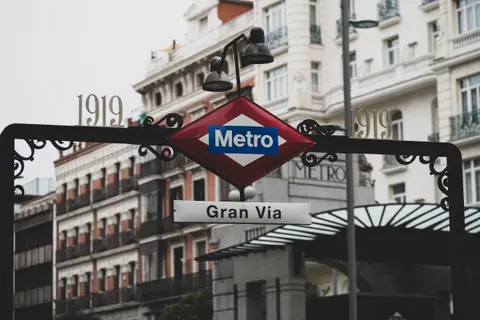
- The Central Spine (Puerta del Sol, Barrio de las Letras and Gran Vía). East of Sol, the cobbled pedestrian streets of the Barrio de las Letras (Literary Quarter) slope gently downhill toward the museums. Miguel de Cervantes and Lope de Vega lived in these narrow lanes during the Spanish Golden Age. Cutting across the northern edge of the old centre from Calle de Alcalá to Plaza de España is the 1.3-kilometre Gran Vía. Built between 1910 and 1929, the avenue is crowned by the winged Victoria dome of the 1911 Metropolis Building and the 1928 Art Deco Telefónica skyscraper. North of Gran Vía lie the bars and boutiques of Malasaña, Chueca and residential Chamberí (chahm-beh-REE).
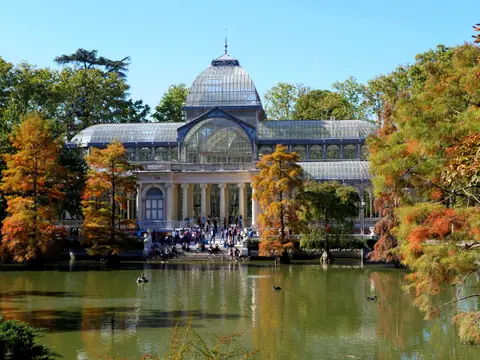
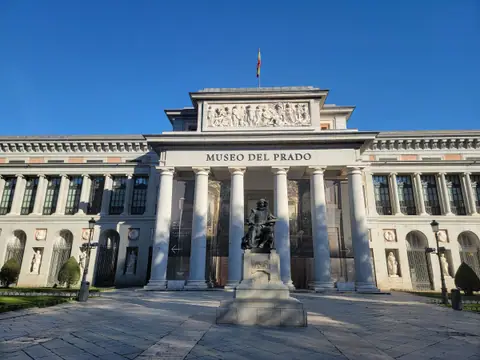
- The Eastern Valley (The Bourbon Paseo del Prado and Retiro Park). At the bottom of the eastern slope runs the tree-lined boulevard of the Paseo del Prado. In the late eighteenth century, Bourbon King Charles III transformed this valley into an Enlightenment showcase of natural science and public art. Today the boulevard and the 125-hectare Buen Retiro Park form a 200-hectare UNESCO World Heritage site. UNESCO inscribed this zone in 2021 as the Landscape of Light (Paisaje de la Luz). Along this single avenue stand the Prado Museum, the Reina Sofía and the Thyssen-Bornemisza (TEE-sen bor-neh-MEE-sah), covered in our Madrid museums guide.
Decoding Madrid's Meal Clock and Tapas Etiquette
Fighting Madrid's schedule means eating alone in empty tourist restaurants in the early evening while kitchens are still preparing for night service. Align your days with the five-stage local food rhythm and the city reveals itself effortlessly:
- Morning breakfast and mid-morning snacks (Desayuno and Almuerzo). Start with a café con leche and tostada con tomate, which is toasted bread rubbed with grated ripe tomato and olive oil. Many locals add a wedge of runny-centred tortilla española (potato omelette). You can also dip fresh churros and thick porras into hot chocolate at Chocolatería San Ginés, founded in 1894 near Sol.
- Midday aperitif hour (La Hora del Vermú). Before lunch, neighbours gather at tiled taverns for sweet red vermouth poured straight from the tap (vermú de grifo). Bartenders serve it over ice with an olive and a slice of orange. Each glass arrives with a small complimentary tapa of crisps, pickled anchovies (boquerones en vinagre) or olives.
- Early afternoon lunch service (La Comida). Lunch is the main meal of the day. From Monday to Friday, almost every neighbourhood restaurant offers a fixed-price menú del día. This three-course lunch includes a starter, main course, bread, drink and dessert or coffee. It provides exceptional value compared to evening à la carte selections.
- Late afternoon refreshment (La Merienda). Late afternoon is ideal for strolling Retiro Park or visiting the Temple of Debod towards sunset. Many locals also stop at a traditional pastry shop such as La Mallorquina on Puerta del Sol.
- Late evening dinner and tapas crawl (El Tapeo and La Cena). Skip sitting down for a heavy formal meal every night. Instead, do a standing bar crawl (ir de tapas) along Calle de la Cava Baja in La Latina or Calle Ponzano in Chamberí. Order a cold draught beer (caña) at each stop and share larger plates (raciones) or half-portions (medias raciones).
Metro Fares, Entry Rules, Money and What to Book Ahead
Getting around is straightforward once you know the fare options. Since June 2026, you can tap a contactless Visa, Mastercard or phone wallet directly at Metro turnstiles and aboard blue EMT city buses for single journeys. If you plan to ride the Metro frequently or share journeys with a companion, buy a red rechargeable Tarjeta Multi card from any station machine. Load it with a 10-journey Metrobús pack (Zone A). Because the card is non-personal, it can be tapped consecutively for multiple travellers in your group. Details on airport supplements and rail terminals are in our getting there guide.
Spain is a Schengen member state using the Euro (EUR). Non-EU travellers register fingerprints and a facial scan at automated border kiosks under the EU Entry/Exit System (EES), which became fully operational in April 2026. Check the official European Union portal for updates on ETIAS before departure. Contactless cards are accepted almost everywhere, service is included on bills, and tipping is modest. Round up small bar tabs or leave 5 percent after a sit-down meal. Madrid's tap water comes from the granite reservoirs of the Sierra de Guadarrama via Canal de Isabel II. It tastes crisp, soft and completely safe to drink. Electrical sockets use European two-pin Type C and Type F plugs at 230V and 50Hz. Book timed tickets online several days ahead for the Prado, the Reina Sofía and the Royal Palace. Reserve weekend high-speed Avant trains to Toledo and Segovia early, then follow our 3-day itinerary to link each district on foot.
Where it is
- 1Madrid
- Adolfo Suárez Madrid–Barajas Airport (MAD) · about 14 km from Madrid in a straight line
- Directions in Google Maps
Stations and taxi ranks: OpenStreetMap. Airports: OurAirports. Distances are in a straight line.
Traveller tips
Real advice from people who have been to Madrid. Every tip is read by our team before it goes live.
No tips yet. Been here? Yours could be the first.
Thank you! Your tip will appear here after a quick review.
More in Madrid
Continue exploring Madrid with related neighbourhood, food, and planning guides
How to Get to Madrid: Barajas Airport, Atocha vs Chamartín & Metro
Madrid, Spain
Best Time to Visit Madrid: 657m Plateau Weather, Crowds & Festivals
Madrid, Spain
What to Wear in Madrid: Altitude Layering, Cobbles & Evening Style
Madrid, Spain
Madrid Museums Guide: Prado, Reina Sofía, Thyssen & Paseo del Arte
Madrid, Spain
