Quick Field Data
- UNESCO Inscription: 1982 (Royal Saltworks at Arc-et-Senans) · Extended 2009 (Great Saltworks of Salins-les-Bains) · Criteria (i), (ii), (iv).
- Scale & Footprint: A serial industrial property in Franche-Comté, linking the 13th-century underground gallery at Salins-les-Bains (Jura) with Ledoux's semicircular factory of 1775 at Arc-et-Senans (Doubs), 21 km away
- Access & Ticketing: Both sites are public heritage museums; guided underground tours pass the 19th-century pump gallery at Salins-les-Bains, while the Institut Claude-Nicolas Ledoux runs exhibitions and gardens at Arc-et-Senans
- Arrival Logistics: Near Besançon in eastern France, in the Val d'Amour (Arc-et-Senans lies at 47.033 N, 5.778 E, 21 km north-west of Salins-les-Bains), reached by regional rail and road west of Geneva
1,200 Years of White Gold at Salins-les-Bains and the 21-Kilometre Brine Pipeline
This serial site links two industrial sites 21 kilometres apart near Besançon, in the Franche-Comté region of eastern France, around 46.9854 N, 5.8270 E. The Great Saltworks of Salins-les-Bains and the Royal Saltworks (Saline Royale) at Arc-et-Senans together record more than 1,200 years of open-pan salt making. UNESCO first listed the Saline Royale in 1982, at its 6th session. On 29 June 2009 the listing was extended to Salins-les-Bains, under criteria (i), (ii) and (iv). The pair joins a medieval brine works with a major early work of Enlightenment industrial architecture.
Rock salt (halite) lies beneath the valleys of Franche-Comté, and natural salt springs were worked at Salins-les-Bains, as at Montmorot and Lons-le-Saunier, from early times. At Salins production ran for at least 1,200 years until it stopped in 1962, though the spa still operates. Beneath the surface buildings runs a vaulted stone gallery from the 13th century, where workers tapped deep salt springs. A water-driven pump installed in the 19th century still works there. It lifted brine to the boiling house, where saltworkers laboured in great heat over open iron pans to crystallise the "white gold".
In 18th-century France salt was vital for preserving meat and fish. It was also a major source of royal income through the unpopular salt tax, the gabelle. Private tax farmers, the Ferme générale, collected it under six-year contracts, and subjects over the age of eight had to buy a fixed yearly quota. After centuries of boiling brine over wood fires, the hills around Salins had been stripped of timber. Fuel had to come from ever further away. As the springs grew weaker, the narrow valley left no room for the long graduation buildings used to concentrate brine by wind.
The King's Council halted a proposal in April 1773 to tap minor springs. The tax farmers then chose a bold solution. Instead of hauling timber up into the valley, they would pipe the brine 21 kilometres downhill to a new factory in the Val d'Amour at Arc-et-Senans. There the great Forest of Chaux would supply firewood for boiling. From 1780 to 1895 the brine flowed through 21 kilometres of wooden pipes from Salins-les-Bains to Arc-et-Senans.
Claude-Nicolas Ledoux's Semicircular Utopia at Arc-et-Senans
The factory was designed by Claude-Nicolas Ledoux (1736 to 1806). On 20 September 1771 Louis XV appointed him inspector of the saltworks of Lorraine and Franche-Comté. With the support of Madame du Barry, he entered the Royal Academy of Architecture in 1773 as royal architect. After the king's edict of 29 April 1773, Ledoux presented a first plan in April 1774. It was a rigid square, linked by covered arcades with 144 Doric columns, around a central court for firewood. The king rejected it. He objected that so many columns suited only palaces and churches, that a chapel in a corner was improper, and that a closed square risked fire and poor hygiene.
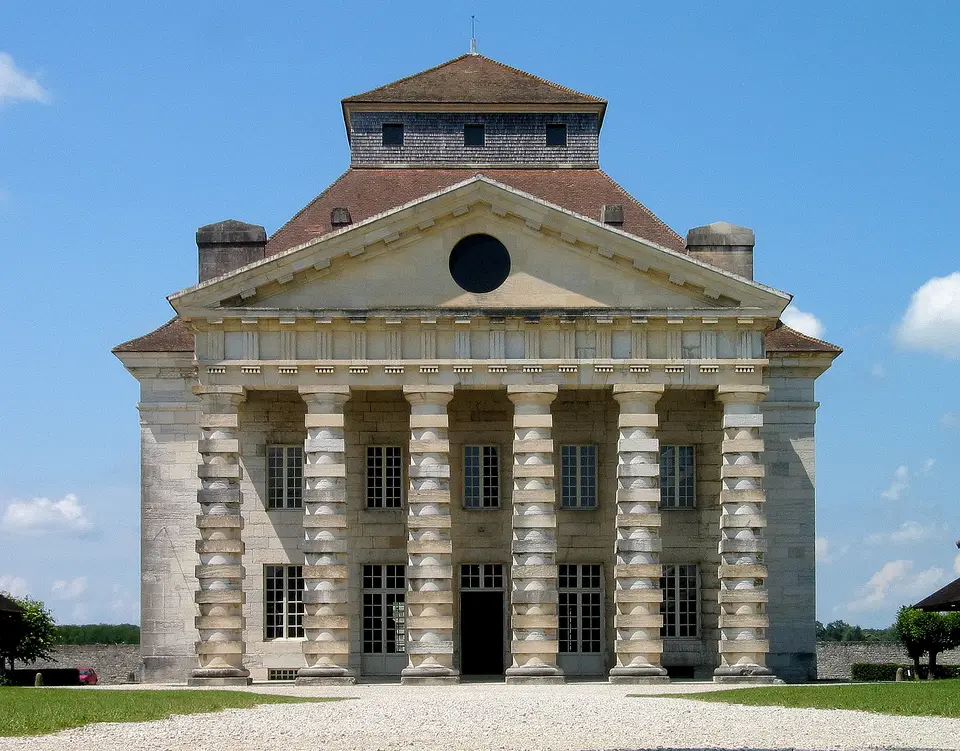
Ledoux answered with a second plan, begun in 1775 under Louis XVI (reigned 1774 to 1792). It formed the semicircular, industrial half of an ideal city that was never built, laid out in a full circle like the path of the sun. Arc-et-Senans is often cited as the first factory built with the grandeur of a palace or a cathedral. You enter at the midpoint of the semicircle through a Doric portico. Behind it, a carved artificial grotto suggests brine gushing from the earth. Guardrooms stand on one side, and a forge and a prison on the other. Around the curving lawn stand the housing and workshop pavilions. Carpenters' and labourers' quarters are on the left and the farriers' and coopers' workshops on the right. Clerks' lodgings close the two ends of the diameter.
At the centre of the diameter stands the tall House of the Director. It has a belvedere, banded rusticated columns and a grand inner staircase leading to the chapel, with a small stable for the director's horses behind it. On either side stand the two great salt buildings. Each is 80 metres long, 28 metres wide and 20 metres high, and they held the boiling pans, drying ovens and salt stores.
At its peak Arc-et-Senans produced 40,000 quintals of salt a year for export to Switzerland. Competition from sea salt carried by rail, and a local lawsuit over polluted wells, ended production in 1895. Lightning burned the director's chapel in 1918, and in April 1926 the private owners, the Society for the Eastern Saltworks, blew up several structures with dynamite. The site was listed as a historic monument on 30 November 1926. The Doubs department bought it on 10 June 1927 and began restoration in 1930. It housed Spanish Republican refugees in 1938, a French anti-aircraft post in October 1939 and a German garrison in June 1940. From May 1941 to September 1943 it was a French internment camp, officially the Centre de rassemblement des tziganes et nomades. Later it served as a film set for Pierre Kast's The Season for Love (1961) and Marcel Bluwal's Dom Juan (1965). In 1973 it became the home of the Institut Claude-Nicolas Ledoux.
Tracing the Salt Route from Salins-les-Bains to Arc-et-Senans
The two parts of the property lie 21 kilometres apart near Besançon. You can see both in a single day by car or regional train, as Arc-et-Senans station is a short walk from the Saline Royale gate. You can also follow the old pipeline route on foot or by bicycle.
- The 13th-century gallery and boiling house at Salins-les-Bains: Start in the valley of Salins-les-Bains and descend into the vaulted gallery of the 13th century. There a 19th-century water wheel and pendulum pump still lift salt water from the halite beds. Above ground, the restored boiling house shows an iron evaporating pan and the tools used until 1962.
- Walking the 21-kilometre brine corridor to the Forest of Chaux: Follow sections of the 21-kilometre pipeline route from Salins-les-Bains to the edge of the Forest of Chaux in the Val d'Amour. Information panels explain how wooden pipes carried the brine to Ledoux's furnaces from 1780 to 1895.
- Ledoux's semicircle, the Director's House and onward to Geneva: Pass through the Doric portico and the carved grotto of the Royal Saltworks at Arc-et-Senans and walk the semicircular court. Visit the Ledoux museum of architectural models in the coopers' building, then enter the two 80-metre salt halls and the House of the Director. Finish in the contemporary festival gardens behind the workshops. Pair your Franche-Comté trip with our UNESCO World Heritage Atlas and our Geneva guide to the south-east.
