Quick Field Data
- UNESCO Inscription: 1979 · Criteria (i), (vi)
- Scale & Footprint: 183 hectares hilltop monastic town and basilica, surrounded by an 18,373 hectares rural buffer zone in Burgundy-Franche-Comté
- Access & Ticketing: Free walk up the fortified village street and free entry to the narthex, nave and crypt of the Basilica of Sainte-Marie-Madeleine
- Arrival Logistics: On a high limestone ridge in the department of Yonne in Burgundy-Franche-Comté, southeast of Paris
From Carolingian Foundations to the Eternal Hill of Mary Magdalene
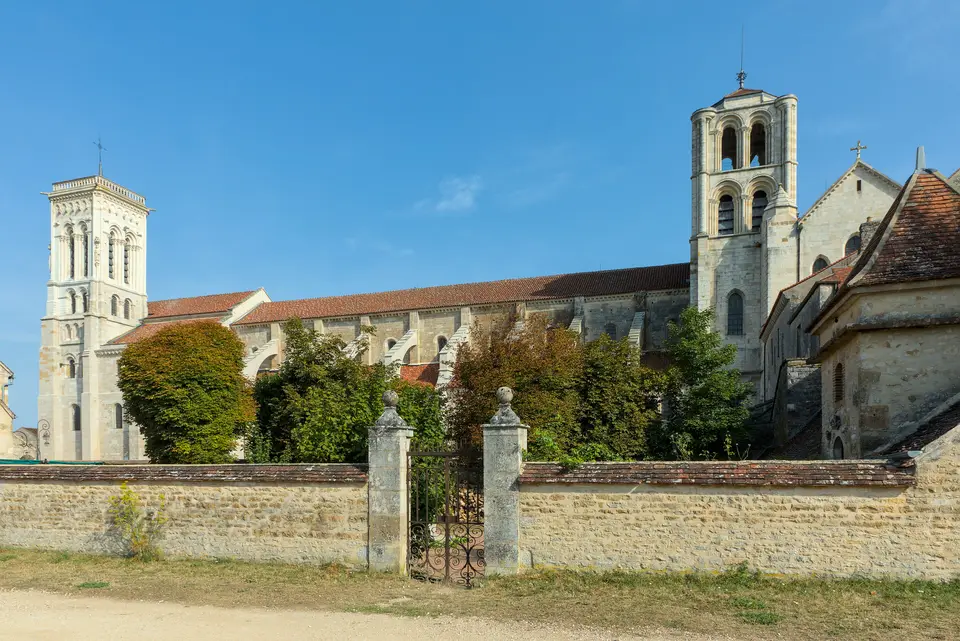
Vézelay Abbey, the Basilica of Sainte-Marie-Madeleine, stands on a steep ridge in the department of Yonne, in the Burgundy-Franche-Comté region. French tradition has long called it the eternal hill. It grew from a ninth-century Carolingian monastery into one of the great spiritual gathering places of medieval Western Christianity. The land was once the late Roman villa of Vercellus. It passed to the Carolingian count Girart of Roussillon, whose two early convents in the valley were looted by eighth-century Moorish raiders. A first convent on the hilltop was then burned by Norman raiders. In the ninth century the monk Badilo refounded the Benedictine monastery on the defensible crest of the hill and linked it to the reformed Benedictine order of Cluny.
Around 1050, in the mid-eleventh century, the fortunes of the hilltop town changed. The monks of Vézelay announced that they held the bodily relics of Saint Mary Magdalene. They were said to have come from the Holy Land, or from a crypt sarcophagus at St-Maximin in Provence showing the Unction at Bethany. Mary Magdalene was the great Christian model of the forgiven sinner. Knights, nobles and freed prisoners flocked to the hill to lay their iron chains before her shrine. In 1037 the newly elected Abbot Geoffroy had these chains melted down and forged into iron railings around her altar. Vézelay was the starting point of one of the four main French pilgrim roads to Santiago de Compostela in Galicia. In the twelfth century the town grew to between 8,000 and 10,000 people. Its abbots fought hard to defend their privileges against the bishops of Autun, the counts of Nevers, the mother abbey of Cluny and the townspeople.
To hold the growing crowds, a new Romanesque abbey church was dedicated on 21 April 1104. Heavy building taxes had provoked a peasant revolt in which the abbot was killed. After a disastrous fire in the nave in 1120, masons built the present nave between 1120 and 1140. They added a large two-storey western narthex, a vestibule for pilgrims, which Pope Innocent II inaugurated in 1132. Another fire damaged the upper nave in 1165. Late-twelfth-century builders then rebuilt the eastern choir and transept in bright early Gothic style. The church now leads the eye from the shadowy Romanesque narthex, through the colourful Romanesque nave, into the light-filled Gothic sanctuary above the Carolingian crypt.
The Pentecost Tympanum, Crusader Summons, and Viollet-le-Duc's Rescue
Vézelay was a launching place for the medieval Crusades. Pope Urban II first planned to preach the First Crusade here in 1095, before moving to the Council of Clermont. Saint Bernard of Clairvaux preached the Second Crusade here at Easter 1146, before King Louis VII and Queen Eleanor. The exiled archbishop Thomas Becket gave his Whitsunday sermon of 1166 here, excommunicating supporters of Henry II of England. King Richard the Lion-Hearted and King Philip II Augustus met here for three months in 1190 before setting off on the Third Crusade. In 1217 the first Franciscan house on French soil was founded here, in the time of Francis of Assisi. The church's sculpture breaks sharply with the usual Romanesque portals. St. Lazare d'Autun and St. Pierre de Moissac show the Last Judgment; Master Gislebertus moved to Autun around 1120 after working at Cluny and Vézelay. The central portal in the Vézelay narthex, completed in 1130, shows instead the Pentecostal Mission of the Apostles. Scholars including George Zarnecki, Adolf Katzenellenbogen (1944) and Peter Low have studied it.
At the centre of the half-round tympanum sits a tall, twisting Christ in a mandorla, arms spread wide. Rays of grace stream from his fingers onto the Apostles on either side. He holds no scroll of judgment. Instead he welcomes and sends out the Crusaders, whose sins were forgiven. Around the central scene, eight compartments divide humanity by how far it had heard the Christian message. The four lower ones show nations that had already received the Gospels, among them the Byzantines, Armenians and Ethiopians, in normal human form. The four upper ones show the Apostles healing the sick and casting out demons, including two lepers comparing their healed limbs. On the lintel below, the unconverted peoples at the ends of the earth appear as medieval caricatures. Pygmies use a ladder to climb onto a horse, and there are figures with pig snouts, a man covered in feathers and men with huge ears, all waiting to hear the Word. The outer arches show the zodiac and the farming labours of the months.
Through this portal lies the Romanesque nave (1120 to 1140), with a bold rhythm. Groin vaults without ribs cover the central space between transverse arches. Their stones alternate between brown and pale cream. Nearly a hundred carved capitals on the piers of the nave and narthex show vivid biblical stories, saints' miracles and moral tales. In 1976 the Franciscan father Hugues Delautre found that the southern clerestory windows line up with the sun. At local noon on the summer solstice in June, shortly before the feast of Saint John the Baptist, sunlight casts a row of bright spots exactly down the centre of the nave floor towards the high altar.
In 1279 Mary Magdalene's body was "found" at Saint-Maximin-la-Sainte-Baume under Charles II, the Angevin king of Sicily, and Vézelay's pilgrimage faded. Huguenots sacked the abbey and burned its relics in 1569, and it was damaged again in the French Revolution. In 1834 Prosper Mérimée, the French inspector of historic monuments, visited the hill. By then the outward push of the groin vaults had driven the nave walls close to collapse. Between 1840 and 1861 the young architect Eugène Viollet-le-Duc saved the basilica. He rebuilt flying buttresses outside, restored the nave vaults and replaced worn carvings on the outer portal, while keeping the original twelfth-century tympanum in the narthex.
Climbing the Hilltop Street and Exploring the Basilica and Ramparts
As you approach Vézelay across the woods and vineyards of the 18,373 hectares buffer zone, the long limestone outline of the Basilica of Sainte-Marie-Madeleine crowns the 183 hectares hilltop village, just as it did for twelfth-century pilgrims bound for Santiago de Compostela. One steep main street climbs from the lower square between medieval stone houses and cellar doors to the open square in front of the west front. Today the Jerusalem monastic community sings daily services in the church, continuing a thousand years of monastic prayer on the ridge.
- Entry and Route Up the Eternal Hill to the Narthex: Park at the foot of the hill near the town walls and walk up the steep paved spine of the village. You pass the hillside where the first Franciscan priory in France was set up in 1217, until the west front of the basilica opens before you. Step first into the enclosed twelfth-century narthex and stand right under the Pentecost tympanum of 1130. The walls of the vestibule have protected the carved rays from Christ's hands, the lintel of distant nations and the zodiac arches from eight centuries of Burgundian rain.
- Tickets, Interiors, and Viewpoints From the Cloister Terrace: Entry is free to the narthex, the two-coloured arches of the Romanesque nave, the white-stone Gothic choir and the Carolingian crypt, which holds the nineteenth-century reliquary of Saint Mary Magdalene. The Maison du visiteur next door explains the solar alignment and the carved capitals. After looking at the capitals along the aisles, leave through the southern chapter house and the one surviving walk of the Romanesque cloister. It opens onto the tree-lined terrace behind the apse, with a wide view over the valley and the northern hillside where Saint Bernard preached the Second Crusade in 1146.
- Timing and Onward Connections: Be in the nave at local noon in mid-to-late June to see the solstice light spots line up along the centre of the floor. Or time your visit for the midday or evening services sung by the monastic community. Vézelay lies in the Yonne department of Burgundy-Franche-Comté, southeast of Paris, and pairs well with other Burgundian and French medieval monuments in our UNESCO World Heritage Atlas.
