Quick Field Data
- UNESCO Inscription: 1991 (Cultural; three monuments in Reims, Marne, Grand Est region, France)
- Scale & Footprint: Three great monuments: the Cathedral of Notre-Dame, about 149 metres long with 81-metre towers; the archbishops' Palace of Tau beside it; and the former Abbey of Saint-Rémi with its 11th-century Romanesque nave
- Access & Ticketing: State-owned since 1905 and managed with the Ministry of Culture; check official sources for tower climbs, Palace of Tau exhibitions and Saint-Rémi opening hours
- Arrival Logistics: On Place du Cardinal Luçon in central Reims, linked to Paris by high-speed train and motorway
Baptism of Clovis, the Holy Ampulla, and the Coronation City of France
Reims rises above the chalk plains of Champagne in the Marne department of north-eastern France. Its cathedral, the archbishops' Palace of Tau and the old Abbey of Saint-Rémi together tell the story of the bond between the Church and the French monarchy over some fifteen centuries. They was inscribed on the UNESCO World Heritage List in 1991. Their shared story goes back to Durocortorum, the town of the Gallic Remi tribe mentioned by Julius Caesar. Under Rome it became the capital of the province of Belgica Secunda. The first Christian community appeared here in the 3rd century. Around 400, Bishop Nicasius moved the cathedral to the site of old Roman baths. There he built a church dedicated to the Virgin Mary, the first on this spot.
In the baptistery of this early cathedral, whose remains lie under the present nave, Bishop Remigius (Saint Rémi) baptised Clovis, King of the Franks. This took place around 496, though some historians prefer a slightly later date. According to legend, a dove brought the holy oil for the ceremony in a small flask, the Holy Ampulla. In 816 Pope Stephen IV crowned Louis the Pious, son of Charlemagne, at Reims. Archbishop Ebbo began a larger Carolingian cathedral soon after. Archbishop Hincmar completed and consecrated it in 862, with King Charles the Bald present. The prestige of the archbishops and the Holy Ampulla, kept at the Abbey of Saint-Rémi, made Reims the coronation city of France. From Henry I in 1027 to Charles X in 1825, some 25 kings were crowned here. The most famous coronation took place on 17 July 1429, when Joan of Arc led Charles VII to Reims during the Hundred Years' War.
In the 12th century Archbishop Samson enlarged the church and gave it an early Gothic front with two towers, inspired by the abbey of Saint-Denis near Paris. A fire on 6 May 1210 destroyed this church. Exactly a year later, on 6 May 1211, Archbishop Aubri de Humbert laid the first stone of the present cathedral. Builders used standard pre-cut stone blocks, which sped up the work despite unrest in the town in the 1230s. Four master builders followed one another: Jean d'Orbais, Jean le Loup, Gaucher de Reims and Bernard de Soissons. The east end was in use by the 1240s, and most of the building stood by the end of the 13th century. The western towers were finished in the 15th century, and the roof was rebuilt after a fire in 1481.
The Smiling Angel, Two Thousand Sculptures, and Twentieth-Century Resurrection
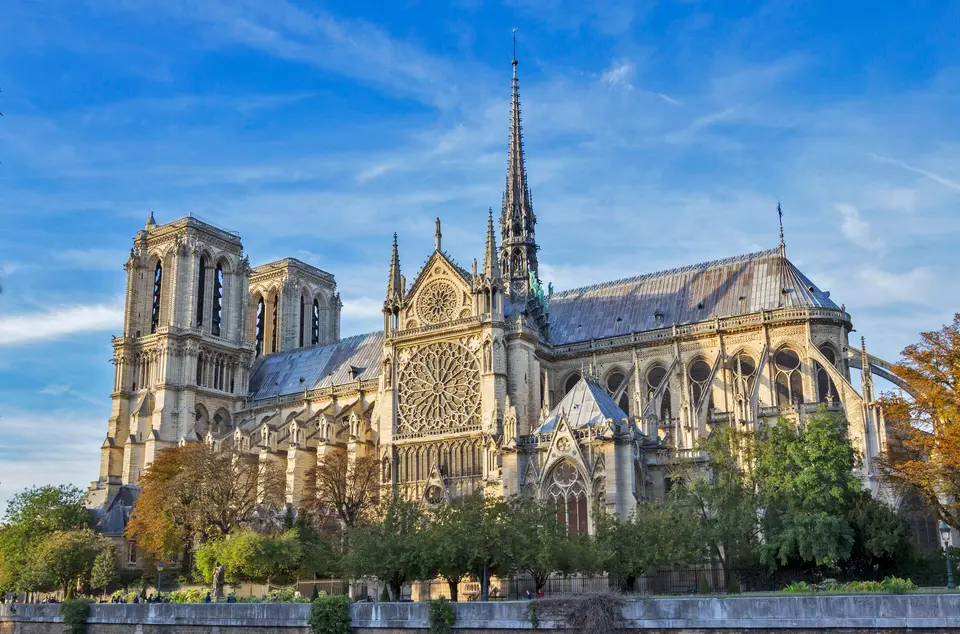
The cathedral is about 149 metres long. Inside, a balanced three-storey elevation rises from clustered piers with rich leafy capitals to ribbed vaults. Outside, double flying buttresses carry statues in small canopies and gargoyles for rainwater. Notre-Dame de Reims joins High Gothic structure with graceful sculpture, and it influenced Gothic builders far beyond France, above all in Germany. Thousands of carved figures fill the building inside and out.
The west front has three deep portals below a great rose window and the Gallery of Kings. In this gallery, 56 statues about 4.5 metres tall show kings, with the baptism of Clovis at the centre. Above the central portal is the Coronation of the Virgin, now a copy of the original. On the jambs, the calm, classical robes of Mary and Elizabeth in the Visitation contrast with the courtly grace of the Annunciation. On the left portal stands the famous Smiling Angel. The inner face of the west wall is carved with rows of niches showing biblical scenes, a rare feature in French Gothic. One shows Abraham, dressed as a 13th-century knight, receiving bread and wine from Melchizedek. Medieval glass survives in the west and north roses and in some upper windows. Modern glass adds to it. In the south transept, Jacques Simon's windows of the 1950s celebrate the champagne trade. Marc Chagall's windows fill the central chapel at the east end. For the cathedral's 800th anniversary in 2011, the German artist Imi Knoebel added six abstract windows beside the Chagall chapel.
Few European monuments have survived as much modern damage. Rebuilding in the 18th century removed medieval choir furnishings. During the Revolution, in 1793, the Holy Ampulla was smashed. Several architects restored the building in the 19th century, among them Eugène Viollet-le-Duc. In the First World War, German artillery hit the cathedral hundreds of times. On 19 September 1914, shells set fire to wooden scaffolding and the oak roof. Wounded German soldiers were lying on straw inside at the time. The bells melted, and molten lead poured from the roof. From 1919 to 1938, chief architect Henri Deneux rebuilt the roof frame in light, fireproof reinforced concrete, with funding from the Rockefeller family. In July 1962, President Charles de Gaulle and Chancellor Konrad Adenauer attended a Mass of Franco-German reconciliation here. In September 1996, Pope John Paul II came to mark 1,500 years since the baptism of Clovis.
Walking the Cathedral Nave, the Palace of Tau, and Saint-Rémi Basilica
Visitors arriving from Paris can see the cathedral and the Palace of Tau side by side on Place du Cardinal Luçon. From there it is a walk or short ride of about two kilometres south to the former Abbey of Saint-Rémi. Light streams through the stained glass. Together, the three monuments let you follow each step of a French coronation.
- West facade portals, interior reverse wall, and the Chagall and Knoebel apse: Start on the square and compare the classical robes of the Visitation with the smile of the angel on the left portal. Inside, study the carved niches of the west wall, then walk down the nave to the transept. Look for the old astronomical clock with its moving figures, the great organ and the statue of Joan of Arc. End in the central east chapel, where Chagall's blue windows stand beside Knoebel's bright modern glass.
- Palace of Tau, the Palatine Chapel, and the Coronation Treasury: Next door, the Palace of Tau was the archbishops' residence, rebuilt in the late 17th century. Kings stayed here before their coronation and held feasts afterwards in the great 15th-century hall. The museum shows original statues taken down from the cathedral, including the Coronation of the Virgin, and fine tapestries. Its treasury holds the 12th-century chalice of Saint Rémi, the jewel known as the Talisman of Charlemagne and the reliquary of the Holy Ampulla.
- Former Abbey of Saint-Rémi and the tomb of the Apostle of the Franks: Head south to the Basilica of Saint-Rémi, where the Holy Ampulla was kept before each coronation. Walk down the long Romanesque nave into the bright early Gothic choir, where the tomb of Saint Rémi stands beneath 12th-century stained glass. Next door, the old monastery buildings house the Saint-Rémi Museum of Roman and medieval history.
