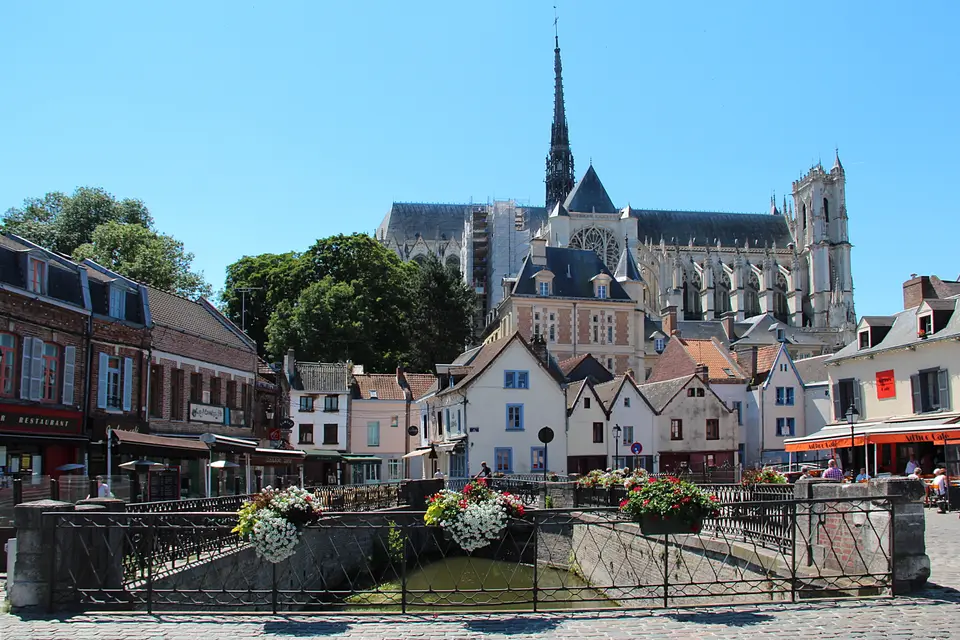
Quick Field Data
- UNESCO Inscription: 1981 (5th session; a French Monument Historique since 1862) · Cultural Criteria (i), (ii)
- Scale & Footprint: 145 metres long and 70 metres wide, 42.30 metres high under the nave vaults, with a 112.70-metre spire and an internal volume of 200,000 cubic metres
- Access & Ticketing: A working Catholic cathedral of the Diocese of Amiens; the nave is open to visitors, with access to the choir stalls, the treasury and the towers, and evening colour projections on the west front
- Arrival Logistics: Above the River Somme in Amiens (Department of the Somme, Hauts-de-France / Picardy), about 120 kilometres (75 miles) north of Paris
Three Master Builders and the Largest Gothic Volume in France
The Gothic Cathedral of Our Lady of Amiens (Cathédrale Notre-Dame d'Amiens, in Picard Cathédrale Noter-Danme d'Anmiens) stands on a low rise above the River Somme. Amiens is the capital of Picardy in the Department of the Somme (Hauts-de-France), about 120 kilometres (75 miles) north of Paris. The cathedral is the largest church in France by internal volume. It encloses 200,000 cubic metres (260,000 cubic yards), more than twice the internal volume of Notre-Dame in Paris. It is 145 metres long and 70 metres across the transept. Its limestone vaults rise 42.30 metres above the floor, against 36 metres at Chartres and Reims. Only the choir of Beauvais Cathedral is higher, and its vaults partly collapsed in 1284. Inscribed in 1981 and featured in our UNESCO World Heritage Atlas, Amiens is a classic example of 13th-century High Gothic. It also shows the bright Rayonnant style that appeared in its triforium and clerestory, begun in 1236, and in the enlarged upper choir windows of the mid-1250s and 1269.
Christian tradition in Amiens goes back to the 3rd century AD and the martyrs Firmin the Martyr and Firmin the Confessor. Later milestones include the baptism of Saint Martin in 334, a mention of Bishop Eulogius in 346 and the baptism of the Frankish King Clovis I in 498 or 499. Bishop Edibus is recorded in 511 and Bishop Salvius around 600. After fire destroyed the earlier churches, a Romanesque cathedral was built between 1137 and 1152, and King Philip II of France married there in 1193. On 17 December 1206 the canon Wallon de Sarton arrived from Constantinople after the Fourth Crusade (1204), bringing what was said to be the head of Saint John the Baptist. Amiens became a major pilgrimage centre. Fire destroyed the Romanesque church in 1218, and in 1220 Bishop Evrard de Fouilloy laid the first stone of the new Gothic cathedral.
The cathedral was built almost entirely between 1220 and about 1270. Unusually, work moved from west to east. The nave was finished by 1236 to 1240, the chevet and high windows around 1269, the roofs from 1284 to 1305 and the side chapels between 1292 and 1375. Its unity of style comes from three closely linked master builders. Robert de Luzarches led the work from 1220 to 1223 or 1228 and changed Gothic building by cutting stone blocks to standard sizes and shapes. His successor Thomas de Cormont led it until 1228 or 1258, and Thomas's son Renaud de Cormont until 1288.
The Sculpted West Facade, the 1498 Iron Chain, and the Spire
The west front was built in one continuous campaign between 1220 and 1236, reaching the level of the rose window around 1240. It has three deep pointed porches with two galleries above. One is the Gallery of Kings, with twenty-two life-size statues of French monarchs restored by Eugène Viollet-le-Duc. Higher up are a 16th-century Flamboyant rose window and two unequal towers: the south tower, finished around 1366, and the Flamboyant north tower, finished in 1406. Between them runs the Musicians or Bell-Ringers Gallery, modelled by Viollet-le-Duc on Chartres.
The central portal shows the Last Judgement, with Christ between the Virgin Mary and Saint John. Laser cleaning in the 1990s and 2001 revealed original 13th-century paint, including red nail marks on Christ's hands. Evening light shows, developed with EDF laboratories and Society Skertzo, now recreate these colours. The right portal honours the Virgin Mary. The left portal honours Saint Firmin and the local saints Victoricus, Gentian, Domitius and Ulphia. Where the north tower meets the north-side chapels of Saint John the Evangelist and Saint John the Baptist stands the Beau Pilier buttress. Cardinal and Bishop Jean de la Grange commissioned it between 1373 and 1375. Its nine statues show the bishop himself, Chamberlain Bureau de la Riviere, Admiral Jean de Vienne, King Charles V, the Dauphin (the future Charles VI) and saints.
Outside, double flying buttresses, built around 1230 along the nave and around 1260 around the choir, steady the tall walls and carry water channels and gargoyles. In 1497 sideways forces cracked the four crossing piers and the chevet columns. In 1498 (and 1503) Pierre Tarisel saved the building by fitting a red-hot wrought-iron chain around the triforium level, which tightened as it cooled. Above the star-vaulted crossing rises the wooden, lead-covered flèche (spire), 112.70 metres (369.8 feet) high. Lightning destroyed the first spire in 1528, and this one was built between 1529 and 1533 and restored from 1973 to 1980. It carries lead statues of Christ, the Virgin Mary, Saint Paul, Saint Firmin, Saint John the Evangelist, Saint James the Great, Saint Peter and Saint John the Baptist.
The Nave Labyrinth, Carved Choir Stalls, and Polychrome Screens
In the nave, arcade pillars 18 metres high, each ringed by four colonnettes, take up half the wall height below the triforium and clerestory. Set into the floor is a 19th-century exact copy of the 240-metre labyrinth laid out in 1288 by Renaud de Cormont. On the north wall is the painted and gilded Baroque pulpit of 1773, carried by figures of Faith, Hope and Charity, with the Latin words Hoc fac et vives. Near the south door, eleven memorial tablets honour soldiers from the British Empire and dominions, including Canada, New Zealand and Australia, who fell in the 1916 Battle of the Somme. Others honour Marie-Eugène Debeney, Raymond Asquith and Philippe Leclerc de Hauteclocque. At the west end, below the rose window, stands the organ first given between 1442 and 1449 by Alphonse Lemire, with pipes and case installed in 1549 and 1620.
The choir was remodelled after the Council of Trent, in campaigns of 1755 and 1766 to 1768, with an ornate iron screen and the gilded Baroque "Gloire" of 1768 behind the high altar. Here stand one hundred and ten of the original one hundred and twenty oak choir stalls, carved between 1508 and 1519 with more than four thousand figures from biblical stories and town trades. On the outer choir enclosure, facing the ambulatory, are famous painted stone sculptures of the life of Saint Firmin on the south side (1490 to 1530) and of John the Baptist on the north (1531).
The transepts hold Jean Wytz's high reliefs of 1523 showing Christ driving the merchants from the Temple, and reliefs of 1511 on the vow of John the Baptist. There is also Gilles Oppenord's Chapel of Saint Peter of 1709, recalling the plague of 1667/68, and Jean-Baptiste Michel Dupuis's statues of 1749 in the southeast transept chapel of Saint Peter and Saint Paul. Nicolas Blasset made the sculptures of 1627 in the Chapel of Saint Sebastian, which also has Louis Duthoit's statue of Saint Louis of 1832. The shrine of Our Lady of the Red Pillar holds 17th-century paintings by Laurent de La Hyre and Frans Francken II.
Seven chapels open off the apse. They include the Drapers' Chapel, Saint Thomas of Canterbury and Saint Francis of Assisi, which has a 13th-century Tree of Jesse glass panel showing King David. The chapel of Saint Theodosius was dedicated in 1854, an occasion linked to Emperor Louis Napoleon (Napoleon III), Empress Eugenie and Pope Pius IX, and has glass by Gérente. The Sacré Coeur / Sacred Heart chapel has Art Deco glass of 1932 to 1934 by Jean Gaudin after Jacques le Breton. The chapel of Saint Eloi, with eight 16th-century paintings of the Sibyls, leads to the treasury. It holds the Crown of Paraclet of 1230 to 1240 and Placide Poussielgue-Rusand's rock-crystal reliquary of John the Baptist of 1876; the relic was saved in 1793 by Mayor Louis-Alexandre Lescouvé.
Much glass was lost to Huguenot looting in 1561, hurricanes in 1627 and 1705, a powder-mill explosion in 1675, the Revolution of 1793 to 1794 and a workshop fire in 1920. Restorations followed under Etienne Hyppolyte Godde in 1810, Francois Auguste Cheussey in 1821 and Viollet-le-Duc from 1849 to 1874. Apse lancets of 1269, triforium panels of about 1300 and the south rose window of 1489 to 1490, with its fourteen angels, still survive.
- Entry and Route: Direct trains from Paris run to Amiens. Study the three west portals and the Beau Pilier of 1373 first. Then go inside to walk the 240-metre labyrinth and see the painted choir screen and the carved choir stalls of 1508 to 1519.
- Tickets and Viewpoints: Before you travel to Picardy, check the official site for tower tickets, treasury entry in the Chapel of Saint Eloi and the summer and winter evening light shows that project 13th-century colours onto the west front. Find more Gothic cathedrals in France in our UNESCO World Heritage Atlas.
