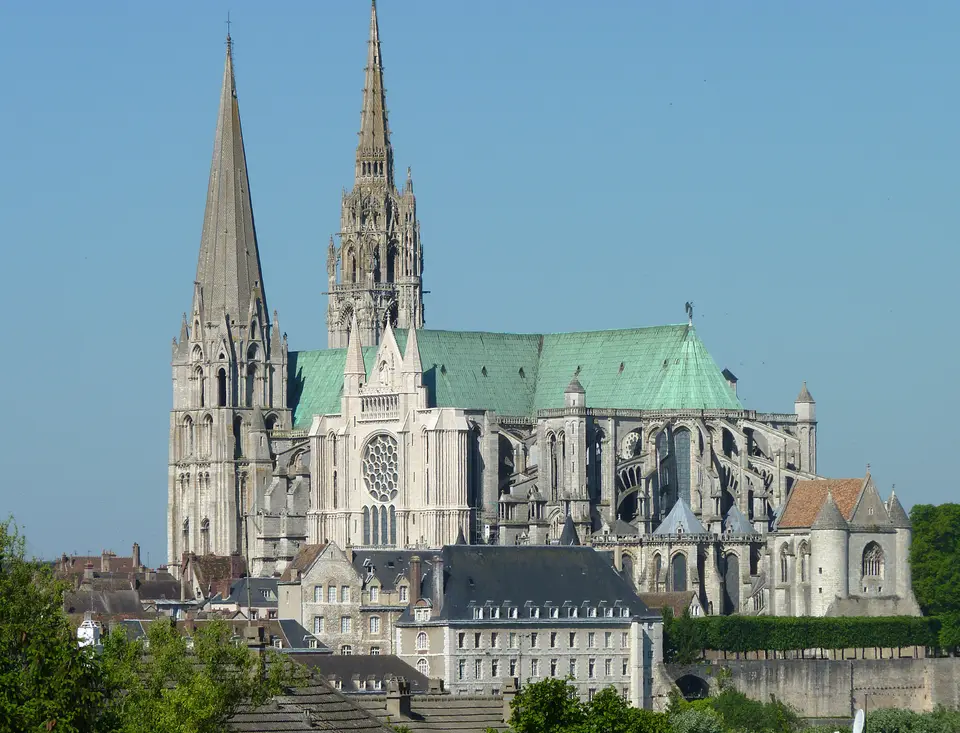
Quick Field Data
- UNESCO Inscription: 1979 · Criteria (i), (ii), (iv)
- Scale & Footprint: 10,875 square metres cathedral, 130 metres long and 32 to 46 metres wide, with a 37-metre-high nave and spires of 105 and 113 metres
- Access & Ticketing: Free entry to the nave, ambulatory, stained glass and floor labyrinth; separate tickets for the North Tower climb, the Crypt of Saint Fulbert and the treasury
- Arrival Logistics: At 16 Cloître Notre Dame in Chartres, in the Centre-Val-de-Loire region, roughly 80 kilometres southwest of Paris
From Fulbert's Crypt and the 1194 Fire to Flying Buttress Engineering
The Cathedral of Our Lady of Chartres (Cathédrale Notre-Dame de Chartres) rises above the grain plains of the Centre-Val-de-Loire region, about 80 kilometres southwest of Paris. At least five earlier cathedrals have stood on the site since Chartres became a bishop's seat in the fourth century. An early church at the foot of the Gallo-Roman wall was burned in 743 on the orders of the Duke of Aquitaine. Its successor was set on fire by Danish pirates in 858. Bishop Gislebert rebuilt it, and the ninth-century Saint Lubin Chapel, named after the sixth-century Bishop Lubinus, survives underground beneath the present apse. In 876 King Charles the Bald gave the cathedral its most important relic, the Sancta Camisa. It is venerated as the silk tunic the Virgin Mary wore when Christ was born. The relic made Chartres the leading centre of pilgrimage to Mary in medieval Western Christianity. Four great yearly trade fairs were held on the feasts of the Presentation, the Annunciation, the Assumption and the Nativity.
Another fire, on 7 September 1020, destroyed the tenth-century church. Bishop Fulbert (bishop from 1006 to 1028) founded the famous School of Chartres, where the scholars Thierry of Chartres, William of Conches and John of Salisbury later pioneered Scholastic philosophy. He asked European monarchs, including Cnut the Great, for help. In 1025 he completed the vast U-shaped Romanesque Saint Fulbert Crypt, 230 metres long, around the earlier vault. It holds the 33-metre-deep Celtic Well of the Saints-Forts (Puits des Saints-Forts). After a town fire in 1134 came the Cult of Carts of 1145. Masons then built the western narthex, the Royal Portal (1145 to 1155) and the octagonal stone south spire, 105 metres high. This spire was completed around 1160 to 1170 with no timber frame inside. On the night of 10 June 1194 lightning started a fire that destroyed everything except the crypt, the western towers and the Royal Portal. Three days later priests came up through iron trapdoors carrying the Sancta Camisa unharmed. A papal legate declared that the Virgin Mary wanted a grander church.
The new High Gothic church was built mostly between 1194 and 1220. The canons took their seats in the choir in 1221, and the cathedral was formally consecrated in October 1260 in the presence of King Louis IX. The rebuilding kept Fulbert's cross-shaped plan of 10,875 square metres: 130 metres long and 32 to 46 metres wide, with a nave 16.4 metres wide and 37 metres high. At the same time it transformed structural engineering. The unknown master architect was the first to plan external flying buttresses into a major cathedral from the outset. They are joined by double stone arches with spokes like wheels, and they push back against the outward thrust of lighter rib vaults with four compartments. Below, round and octagonal clustered piers (pilier cantonné) alternate. This outer frame let the builders drop the Romanesque gallery, shrink the triforium to a narrow band and open the upper clerestory walls into great areas of stained glass. Chartres became the model for Reims, Amiens and Beauvais.
Three Sculpted Façades, 176 Windows, and Nine Centuries of Preservation
Across its western, northern and southern entrances, Chartres displays a vast programme of twelfth- and thirteenth-century sculpture. It is carved in fine Parisian limestone (calcaire), unlike the harder, brittle local Berchères stone used for the piers and capitals inside. On the west front, the twelfth-century Royal Portal, built in a 10:7 ratio, joins three doorways above slender column-statues of biblical kings and queens. The right doorway shows the Incarnation of Christ and the Virgin enthroned as Sedes sapientiae, framed by arches showing the Seven Liberal Arts. The left doorway shows the Ascension, surrounded by the zodiac and the labours of the months. The central tympanum shows Christ in a mandorla, with the Tetramorph symbols, the Twelve Apostles and the 24 Elders of the Apocalypse. The deep triple porches of the north transept were added between 1205 and 1230. They honour the Virgin Mary and St Anne, with scriptural prophets, the vita activa (preparing flax) and the local martyrs St Modesta and St Potentian. The south transept porch shows the Last Judgment, Christian martyrs and confessors, eighteen kings beginning with King David, and an angel holding a sundial.
The nave is dark and vast. Its floor slopes slightly so that medieval stewards could wash out the straw where pilgrims slept. It keeps its stone labyrinth, set into the pavement in the early 1200s. Of the 176 original stained-glass windows, 152 survive intact, the largest set of medieval glass in the world. Above the Royal Portal glow three twelfth-century lancets from before 1145, showing the Jesse Window, the Life of Christ and the Passion. The south choir ambulatory holds the famous composite panel of 1180, Notre-Dame de la Belle-Verrière (the Blue Virgin). The rest were glazed between 1205 and 1250. They include aisle lancets of 8.1 by 2.2 metres, pairs of clerestory windows and three great rose windows, 10.5 to 12 metres across. The western rose (c. 1215) shows the Last Judgment. The northern rose, the Glorification of the Virgin, was given with the arms of Blanche of Castile (c. 1230). The southern rose, the Glorification of Christ, was given by the Mauclerc Counts of Dreux-Bretagne; in it four evangelists sit on the shoulders of four prophets. The lower panels of many windows show trades, with labourers, wine sellers and money-changers.
Later centuries added landmarks without breaking this thirteenth-century unity. The two-storey Chapel of Saint Piatus of Tournai was built at the eastern apse in 1326; its treasury reopened in 2024. Louis de Bourbon founded the Flamboyant Chapel of the Annunciation in the south aisle in 1417. After lightning struck in 1506, Jehan de Beuce (Jean Texier) built the 113-metre Flamboyant north spire and, in 1520, the clock tower with its twenty-four-hour astronomical clock. The sculpted choir screen, 100 metres long with 200 statues in 41 scenes, was built from the sixteenth century to 1714. The grand organ sits 16 metres above the nave floor, with 4,000 pipes and 70 stops.
King Henri IV was crowned here on 27 February 1594, because the Catholic League held Reims; he climbed onto the rood screen before the crowd in the nave. During the French Revolution an architect saved the cathedral from demolition by arguing that the rubble would block the streets for years. In 1836 a fire started by workmen burned the lead-covered wooden roof and melted the bells, except the Pierre Savyet clock bell of 1520; Cavillier bourdons joined it in 1840. Engineers then put on an iron-framed copper roof. On 16 August 1944 the American Colonel Welborn Barton Griffith Jr. stopped an American artillery order, rang the cathedral bells, and died in combat at nearby Lèves. The stained glass came back safely from storage in the countryside and was given protective outer glazing. An interior stone-cleaning campaign ran from 1997 to 2018; Isabelle Paillot defended it despite criticism from Martin Filler.
Reading the Portals, Walking the Labyrinth, and Climbing the North Spire
As you cross the plain to Chartres, the two unmatched spires appear above the roofs of the medieval town long before you reach the square at 16 Cloître Notre Dame. One is the 105-metre Romanesque south pyramid, the other the 113-metre Flamboyant north spire. Inside, the controversial restoration that began in 2009 has returned the Berchères limestone vaults and piers to their bright thirteenth-century paint of cream and ochre false marble. Against it the deep cobalt blues and ruby reds of the glass stand out sharply. Bring binoculars for the windows. Walking the outer porches and the inner aisles in order shows how medieval architecture, sculpture and light worked together as a single book of theology.
- Entry and Route From the Royal Portal to the Labyrinth: Start in the western square and study the twelfth-century column statues and Liberal Arts arches of the Royal Portal. Note the painted clock of 1520 by Jean Texier at the foot of the north tower. Then step into the 37-metre-high nave beneath the three lancets of 1145. Walk slowly along the central axis to the thirteenth-century circular labyrinth in the nave floor. It is cleared of chairs on Fridays from Lent to All Saints' Day, except Good Friday. Notice the slight slope of the medieval floor and the sixteenth-century wooden case of the grand organ above you.
- Tickets, Interiors, and Viewpoints in the Crypt and North Tower: From the main floor you can view the 100-metre sculpted choir screen and the Blue Virgin window (Notre-Dame de la Belle-Verrière). You can also see the Sancta Camisa reliquary and the newly reopened treasury inside the 1326 Chapel of Saint Piatus. Buy a ticket at the north porch to climb the 113-metre Flamboyant spire of Jehan de Beuce. It gives close views of the wheel-like flying buttresses and the iron roof frame of 1836. Join a scheduled tour down into the 230-metre Romanesque Crypt of Saint Fulbert. There you see the ninth-century Saint Lubin vault, the 33-metre Well of the Saints-Forts and the fresco of 1200 in the Our Lady of the Crypt Chapel.
- Timing and Onward Connections: Come on a sunny day to see the full colour of the 152 medieval windows. Look at the north rose in the morning, the south rose at midday and the western Last Judgment rose in the late afternoon. Stay after dark during the seasonal Chartres Light Celebration, when projections light up the three sculpted porches, or attend evening Vespers sung by the Chemin Neuf Community. Chartres is an easy 80-kilometre trip by train or road southwest of Paris, and pairs well with other French cathedrals in our UNESCO World Heritage Atlas.
