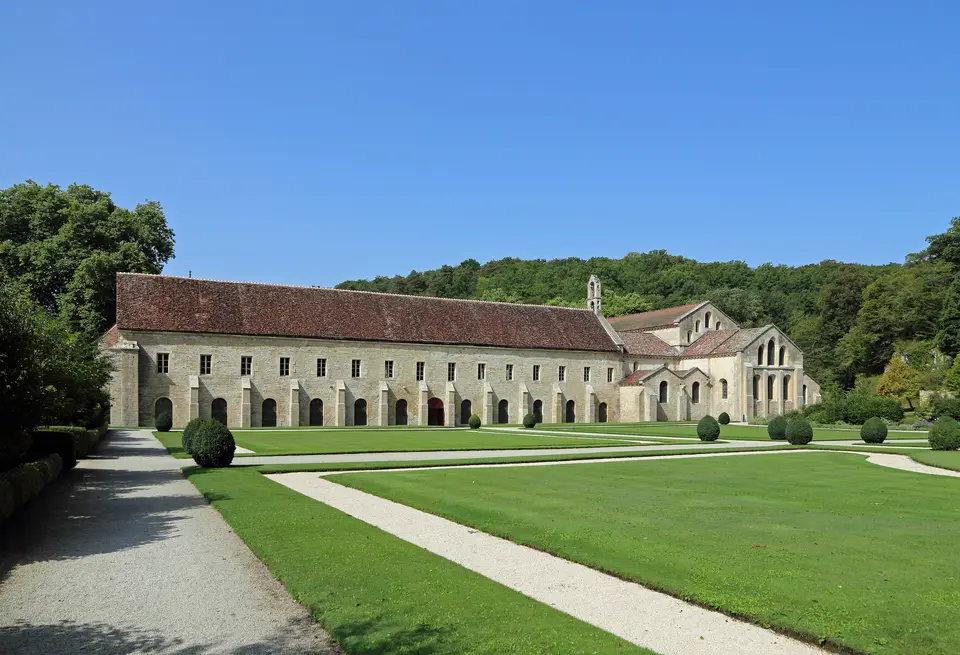
Quick Field Data
- UNESCO Inscription: 1981 (extended in 2007 as ID 165bis) · Cultural Criterion (iv)
- Scale & Footprint: A 5.77-hectare monastic core inside a 1,397-hectare valley buffer zone in the Côte-d'Or Department
- Access & Ticketing: Privately cared for by the Aynard family since 1906; visitors walk through the Romanesque church, dormitory, cloister, chapter house, caldarium, dovecote, forge and the formal parterre gardens
- Arrival Logistics: In a wooded valley in the commune of Marmagne, near Montbard in the Bourgogne Franche-Comté region of France, linked by rail and road to Paris
Saint Robert of Molesme and Saint Bernard of Clairvaux
The Cistercian Abbey of Fontenay lies hidden in a quiet, once marshy valley in the Burgundian commune of Marmagne, near Montbard, in the Côte-d'Or Department of Bourgogne Franche-Comté. It is one of the earliest and most complete Cistercian monasteries in Europe. It was inscribed in 1981 with a 5.77-hectare monastic core, extended in 2007 with a 1,397-hectare valley buffer zone, and appears in our UNESCO World Heritage Atlas. Fontenay expresses the self-sufficient community life of the first generations of Cistercian monks. Its roots lie in the monastic reform movement of the late 11th century. At the height of the great Benedictine abbey of Cluny III in Cluny, France, Saint Robert of Molesme and fellow reforming monks concluded that Cluny had drifted from the Rule of Saint Benedict. They sought to restore its core discipline, summed up in the saying that to work is to pray. Saint Robert broke away and founded Cîteaux Abbey in Citeaux, France. There he created the Order of Cistercians, based on poverty, manual work, no servants and independent, self-sufficient communities.
Bernard of Clairvaux (Saint Bernard) became the chief builder and spiritual voice of the Cistercian reform. He shared Saint Robert's ideals but felt that even Cîteaux Abbey was not strict enough. In 1118 (1119 in traditional foundation accounts) he founded the Abbey of Fontenay in a remote Burgundy valley, where strict austerity could be lived without outside distraction. The monks moved to the present site in 1130. The stone church and monastery were built between 1139 and 1147 under Abbot Guillaume. The money came from Ebraud, Bishop of Norwich, who had fled persecution in England and taken refuge at Fontenay. In 1147 Pope Eugene III, himself a Cistercian and a former pupil of Saint Bernard, consecrated the church.
By 1200 the stone buildings were complete and housed up to 300 monks. In 1259 King Louis freed Fontenay from royal taxation, and ten years later it became a royal abbey. The armies of England's King Edward III plundered it in 1359, during the Hundred Years' War. It suffered again in the Wars of Religion in the late 16th century, and the monks themselves pulled down the refectory in 1745. The rest of the 12th-century complex survived intact. During the French Revolution of 1789, dechristianisation forced the last monks to leave. In 1791 the monastery became a paper mill, later linked to the Montgolfier family, and the industrial use kept the medieval masonry standing. In 1906 the Lyon banker Edouard Aynard bought the abbey, and he completed its restoration by 1911.
In the centralised Benedictine network of Cluny, daughter houses answered to one great abbot. Each Cistercian monastery, by contrast, was a self-governing community led by its own abbot. By choosing a remote valley in Marmagne and refusing to employ lay servants, the monks of Fontenay built a farming and industrial community. Prayer, reading in the cloister and manual work in the fields, the bakery and the ironworks supported one another. Even during the century of industry after 1791, the paper mill used the valley's water channels and solid Romanesque halls instead of pulling them down. This allowed Edouard Aynard and his descendants in the Aynard family to strip out the factory partitions between 1906 and 1911. They revealed the 12th-century monastic plan and the later abbot's lodgings and infirmary.
Romanesque Austerity and Musical Proportions in the Abbey Church
Built of local Burgundian limestone, the Abbey of Fontenay is an important link between the Romanesque and Early Gothic styles. It follows the standard Cistercian model later repeated across Europe, at sites such as Graiguenamanagh Abbey in Ireland (built in 1204). No original building at Fontenay has figurative carving or colour, inside or out. Bernard of Clairvaux did not reject beauty itself. He did, however, guard against images that pull contemplation away from the imago Dei (the image of God) towards the imagines mundi (the images of the world). So there are no carved flowers on the capitals, no painted designs and no bell tower. Small bells were simply fixed to the wall beside the church door to call the lay brothers.
The church has a Latin cross plan. Its blind nave is 66 metres long and 8 metres wide, with two side aisles and a 19-metre transept. In place of the usual semicircular apse there is a flat square apse, with two rectangular chapels on each side of the transept. Inside, massive cross-shaped piers carry high pointed barrel vaults. Pointed transverse and diaphragm arches bring the weight steeply down onto the piers. The beauty comes from the masonry itself, with smooth dressed ashlar set beside rough rubble, and from plain daylight. Following medieval ideas that linked architectural harmony to musical intervals, the builders arranged the seven windows of the west wall in the harmonic ratio of 3/4.
The 36-Metre Cloister, Chestnut Dormitory, and Medieval Forge
The Romanesque cloister, 36 by 38 metres, was the daily centre of reading, prayer and manual work. The buildings around it run parallel and at right angles to the church, with open outer ends so that later extensions would not disturb the core. Stone pillars divide the four walks into bays, where paired columns with lance-shaped capitals carry double arches. Off the cloister open the vaulted chapter house with heavy stone ribs, the monks' day room and the caldarium (warming room). Above stretches the large monks' dormitory, covered in the fifteenth century by an arched chestnut-timber roof shaped like an upturned hull.
Thirty metres south of the main complex stands the large late 12th-century building known as the "forge", near the bakery, guest house and dovecote. It covers 53.3 by 13.5 metres. It may have been an ironworks and forge, a multi-purpose workshop, or a brewery and bakehouse. Either way, it is one of the oldest surviving industrial buildings in France, and it recalls the leading role of Cistercian labour in spreading technology in the Middle Ages. Across the 5.77-hectare complex, rough limestone rubble walls and precisely dressed piers under plain pointed vaults show how Cistercian builders reduced church architecture to pure geometry and light. The 1,397-hectare buffer zone added in 2007 protects the wooded hills and springs of the Marmagne valley from modern development. Walking from the blind nave and square chapels through the 36-by-38-metre cloister to the 53.3-by-13.5-metre forge, visitors still feel the unity, silence and water engineering established in the 12th century by Saint Bernard of Clairvaux, Abbot Guillaume and Bishop Ebraud of Norwich.
- Entry and Route Through the Valley: Take the high-speed train from Paris to nearby Montbard and continue to the wooded valley of Marmagne. Start in the 66-metre Romanesque church, then go into the 36-by-38-metre cloister, the chapter house and the dormitory with its fifteenth-century chestnut roof.
- Tickets and Viewpoints: Before travelling to Montbard, check the official site of the Abbey of Fontenay for seasonal opening hours of the lawns and gravel parterres kept by the Aynard family. Walk 30 metres south of the cloister to see the vaulted 53.3-by-13.5-metre medieval forge and the water channels.
- Timing and Onward Connections: Come in the morning, when soft light falls through the seven west windows of the church and into the double-columned cloister walks. Use our UNESCO World Heritage Atlas and our city guide to Paris to plan more heritage trips in Burgundy and France.
