De Pijp & Dutch Food Guide: Albert Cuyp Market & Dishes
Amsterdam's liveliest food neighbourhood, the Albert Cuyp Market, and the dishes to try.
Walk ten minutes east from Museumplein across the Boerenwetering canal, or ride GVB Metro Line 52 one stop south from Vijzelgracht to De Pijp Station. The museum crowds immediately give way to Amsterdam's liveliest dining and market neighbourhood. Located in Oud-Zuid (postcodes 1072 to 1074), De Pijp (deh PIPE, "The Pipe") was built hurriedly in the late nineteenth century with long, narrow red-brick tenement streets to house a surging working-class population. Many of its streets are named after Dutch Golden Age painters, including Frans Halsstraat, Gerard Doustraat, Govert Flinckstraat, and Ferdinand Bolstraat. Over the twentieth century, students, artists, and immigrant families from Suriname, Indonesia, Morocco, and Turkey turned De Pijp into the culinary capital of Amsterdam.
How to walk and graze the Albert Cuyp Market
Stretching for nearly a kilometre along Albert Cuypstraat between Ferdinand Bolstraat and Van Woustraat, the Albert Cuyp Market (AHL-bert KOWP) has operated since 1905. With roughly 260 stalls open Monday to Saturday from morning until late afternoon (closed Sundays), it is the largest daytime street market in the Netherlands. Come hungry between late morning and early afternoon and eat your way down the strip:
- Freshly Griddled Hot Stroopwafel / Supermarket Packet Stroopwafels: Never leave Amsterdam having only tasted a cold packaged wafer. Follow the scent of toasted cinnamon and caramel to one of the market's traditional stroopwafel (STROHP-vah-fel) carts in the middle of Albert Cuypstraat. The baker presses a ball of spiced yeast dough in a patterned waffle iron, slices the thin round wafer horizontally while still steaming hot, and spreads warm butter-caramel syrup (stroop) inside.
- Poffertjes, Kibbeling, and Raw Herring: Stop at the brass-griddle stall for a paper plate of poffertjes (POF-er-chuhs). These fifteen bite-sized, airy buckwheat-flour pancakes are flipped with a two-pronged fork inside a dimpled cast-iron pan and served hot with a melting pat of butter and icing sugar. At the seafood stalls, order hot kibbeling (KIB-uh-ling), crispy battered chunks of white cod dusted with savoury spice mix and served with garlic or remoulade sauce.
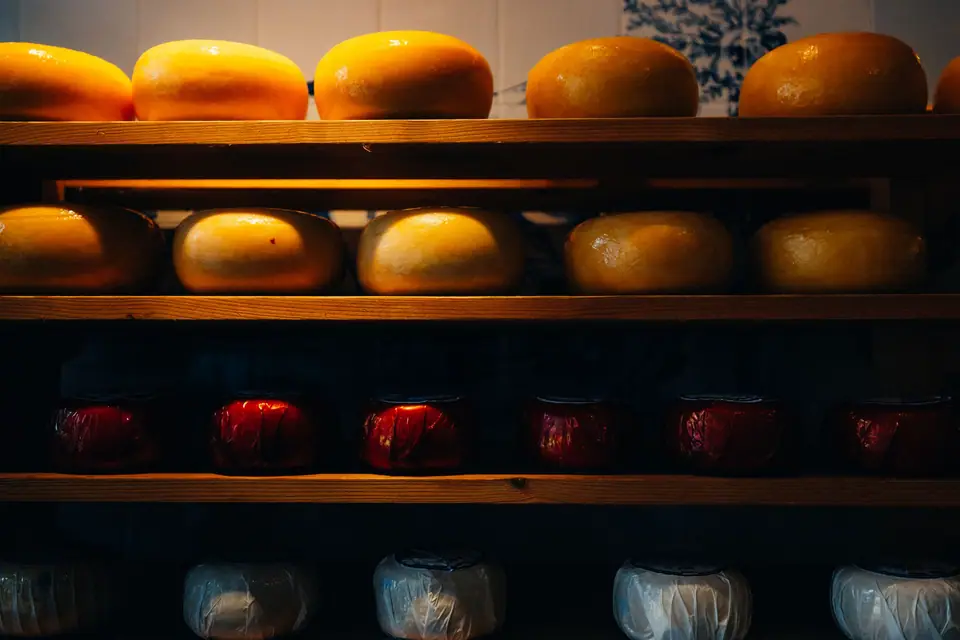
- Dutch Gouda, Edam, and Sheep's Cheese: Market cheese mongers cut samples across the age spectrum of Dutch Gouda (KHOW-dah). Taste mild, buttery four-week jonge kaas, nutty six-month belegen, and crumbly, tyrosine-crystal-studded 24-to-36-month oude kaas (plus tangy Texel sheep's cheese and cumin-spiced Leiden cheese). Stalls vacuum-seal wedges on the spot for luggage transport.
Exploring De Pijp beyond the market stalls
Behind the canvas awnings of the market booths, ground-floor storefronts along Albert Cuypstraat, Gerard Douplein, and Frans Halsstraat are packed with speciality coffee roasters, natural wine bars, and brunch rooms. Pick up a warm takeaway sandwich or pastry and walk one block south into Sarphatipark. This jewel-like 1885 English landscape park is named after nineteenth-century Jewish physician and city planner Samuel Sarphati. At the eastern end of Albert Cuypstraat on Van Woustraat, stop inside a traditional Surinamese-Javanese eatery (eethuis). Order roti (curried chicken, long beans, and potatoes with flatbread) or spicy broodje pom. At the northern edge of De Pijp on Stadhouderskade stands the 1867 red-brick former brewery of the Heineken Experience.
Six essential Amsterdam food and drink traditions
- Hollandse Nieuwe Herring (Haring). Every year from mid-June through summer, Dutch fish kiosks (haringhandels) beside canal bridges (such as Singel/Koningsplein and Vijzelgracht) celebrate the arrival of Hollandse Nieuwe. These young North Sea herring are caught when their fat content exceeds 16 percent and lightly cured in brine using a fourteenth-century process. In Amsterdam, locals order it sliced into bite-sized pieces (in stukjes) with toothpicks, raw white onions, and tangy gherkins, or tucked inside a soft white bun (broodje haring).
- Bitterballen and Oude Jenever in a Brown Café. The undisputed king of Dutch bar snacks is bitterballen (BIT-er-bah-len). These spherical croquettes are filled with a thick beef-stock and parsley roux, rolled in breadcrumbs, and deep-fried until golden. Bite a small corner off first so the molten ragout inside does not burn your tongue, then dip it into coarse Dutch mustard. Pair them with a cold pilsner or a tulip-shaped glass of jenever (yuh-NAY-ver, juniper-flavoured malt spirit, the ancestor of gin). Bartenders pour jenever right to the brim so you stoop to take the first sip without lifting the glass.
- Indonesian Rijsttafel ("Rice Table"). Born during the Dutch colonial period in the East Indies and brought to the Netherlands after 1945, an Indonesian rijsttafel (RICE-tah-fel) is a celebratory banquet of 12 to 20 small sharing bowls. Expect slow-braised beef rendang, charcoal-grilled chicken and goat saté in peanut sauce, and coconut-braised vegetables (sayur lodeh). The feast also includes sweet soy tempeh, spicy sambal relishes, and crisp krupuk prawn crackers around steamed rice. Book dinner several days ahead in De Pijp, Oud-West, or the Jordaan.
- Dutch Apple Pie (Appeltaart) with Slagroom. Unlike thin French tarts, Dutch appeltaart is baked in a deep springform tin with a thick buttery shortcrust lattice packed with chunky tart Goudreinet apples, cinnamon, and raisins. Order it warm with a generous mound of unsweetened whipped cream (slagroom).
- Twice-Fried Dutch Friet (Patatje Oorlog). Amsterdam's historic chip shops (vlaamse friteshuizen) cut thick Agria potatoes and fry them twice at two temperatures for a blistered crust and fluffy centre. They are served in a paper cone with rich Dutch mayonnaise (fritessaus) or "war style" (oorlog, topped with mayonnaise, hot peanut satay sauce, and diced raw onion).
- Stamppot and Pea Soup (Erwtensoep) in Winter. On cold winter days, traditional Dutch kitchens serve stamppot: creamy mashed potatoes pounded together with curly kale (boerenkool), endive, or sauerkraut, topped with a smoked rookworst sausage and a pool of gravy. Pair your food walk with our 3-day Amsterdam itinerary. For hotel options walking distance from the market, see our where to stay in Amsterdam guide.
Where it is
- 1Amsterdam
- Amsterdam Airport Schiphol (AMS) · about 10 km from Amsterdam in a straight line
- Directions in Google Maps
Stations and taxi ranks: OpenStreetMap. Airports: OurAirports. Distances are in a straight line.
Traveller tips
Real advice from people who have been to Amsterdam. Every tip is read by our team before it goes live.
No tips yet. Been here? Yours could be the first.
Thank you! Your tip will appear here after a quick review.
More in Amsterdam
Continue exploring Amsterdam with related neighbourhood, food, and planning guides
How to Get to Amsterdam: Schiphol Trains, OVpay & Trams
Amsterdam, Netherlands
Best Time to Visit Amsterdam: Tulips, King's Day & Seasons
Amsterdam, Netherlands
What to Wear in Amsterdam: Windproof Layers, Shoes & Tips
Amsterdam, Netherlands

Amsterdam Canal Ring & Jordaan: Walking Route & Hofjes
Amsterdam, Netherlands
