Museumplein Guide: Rijksmuseum, Van Gogh & Vondelpark
How to plan the Rijksmuseum and Van Gogh Museum without museum fatigue, plus Vondelpark.
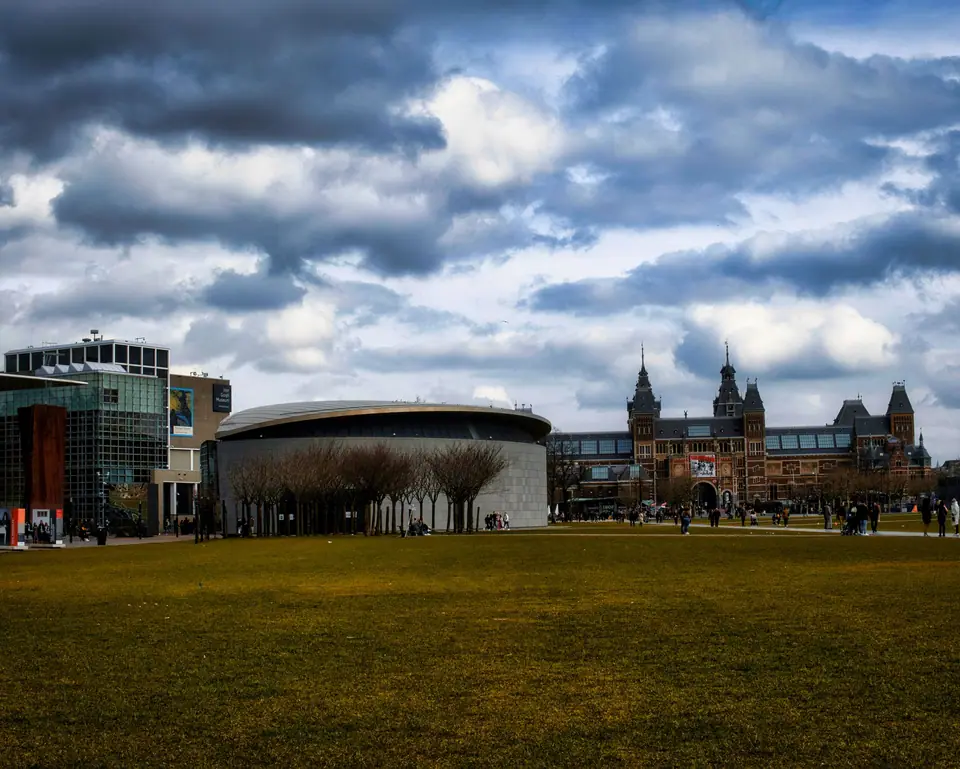
Just south of the Singelgracht outer canal in Oud-Zuid (postcode 1071), a sweeping grassy square called Museumplein (moo-ZAY-um-pline) brings the Netherlands' three greatest art museums within a two-minute walk of one another. At the northern end rises the red-brick palace of the Rijksmuseum. Along the western lawn stand the Van Gogh Museum and the contemporary Stedelijk Museum. Across the southern boulevard sits the world-famous Royal Concertgebouw. Resist the temptation to book both the Rijksmuseum and the Van Gogh Museum back-to-back in a single three-hour morning. Splitting them across two days, or taking a two-hour lunch break in De Pijp or Vondelpark in between, keeps your eyes fresh for every canvas.
Comparing Museumplein's three headline museums
- The Rijksmuseum (800 Years of Dutch History) / The Van Gogh Museum (Single-Artist Chronology): The Rijksmuseum (RIKES-moo-zay-um) is vast, spanning 8,000 objects across 80 rooms on four floors. You can usually book a timed online slot a few days ahead, and the I amsterdam City Card and Dutch Museumkaart are accepted with a mandatory online time-slot reservation. By contrast, the Van Gogh Museum is compact and linear, focused entirely on Vincent van Gogh and his late-nineteenth-century contemporaries. It does not accept the I amsterdam City Card and sells out online one to three weeks in advance.
- The Stedelijk Museum (Modern Art) / Moco Museum (Pop & Street Art): Next door to the Van Gogh Museum sits the Stedelijk Museum (STAY-deh-lik) beneath a white wing nicknamed "the Bathtub". It houses the premier collection of modern and contemporary art in the Netherlands (Piet Mondrian, De Stijl, Rietveld, Kazimir Malevich, and Andy Warhol). Nearby in a historic 1904 villa stands the private Moco Museum, focused on Banksy and digital immersive rooms.
How to visit the Rijksmuseum: start on Level 2 first
Designed by architect Pierre Cuypers (who also designed Amsterdam Centraal Station) and opened in 1885, the Rijksmuseum features a vaulted red-brick public bicycle passage running straight through the middle of the building. Inside, the galleries reward a strategic reverse route. Most visitors enter on Level 0 or Level 1 and exhaust themselves before reaching the seventeenth-century masterpieces. Instead, book the first morning entry slot, drop any backpack in the free subterranean atrium cloakroom, and walk straight up the grand staircase to Level 2 (1600 to 1700):
- The Gallery of Honour (Eregalerij) and The Night Watch. Walk straight down the central vaulted spine toward the dedicated end gallery housing Rembrandt van Rijn's The Night Watch (De Nachtwacht, painted in 1642). Measuring 3.63 by 4.37 metres, the canvas revolutionized group portraiture by showing civic guardsmen under Captain Frans Banninck Cocq stepping out from shadow into light. Visitors can also observe the museum's live glass-chamber conservation project (Operation Night Watch) up close.
- The Four Vermeers and Dutch Interiors. Only 34 to 37 paintings by Delft master Johannes Vermeer survive worldwide, and four hang together in the side bays of the Gallery of Honour. Stand before The Milkmaid (Het Melkmeisje, c. 1658, famous for the luminous pointillist dots of light on the bread basket and pouring milk), The Little Street (Het Straatje), Woman Reading a Letter in blue, and The Love Letter. In the adjacent side cabinets, look for Rembrandt's The Jewish Bride and self-portraits, Frans Hals's The Merry Drinker, and Jan Steen's lively household comedies.
- 17th-Century Dollhouses and Delft Blue (Rooms 2.20 to 2.24). Do not miss the three seventeenth-century tortoiseshell-and-oak miniature collector dollhouses commissioned by wealthy Amsterdam women such as Petronella Oortman. They are not children's toys, but exact scale replicas of Golden Age canal mansions furnished with real woven silk damask, miniature hand-painted Delftware porcelain, and tiny silver utensils.
- The Cuypers Library and Level 1 / Level 0 Highlights. Step onto the quiet second-floor viewing balcony overlooking the 1885 Cuypers Library, the oldest and largest art-historical library in the Netherlands with cast-iron spiral staircases. Afterwards, descend to Level 1 to see the nineteenth-century galleries (including Van Gogh's 1887 Self-Portrait) or Level 0 for medieval wood carvings and ship models. Finish in the free outdoor sculpture gardens designed with geometric boxwood hedges.
How to visit the Van Gogh Museum floor by floor
Opened in 1973 inside a modernist building by De Stijl architect Gerrit Rietveld, the Van Gogh Museum was expanded in 1999 with an elliptical wing by Kisho Kurokawa. Its permanent collection tells the story of Vincent van Gogh (1853 to 1890) across four levels:
- Ground Floor (Level 0) & Level 1 (Netherlands & Paris): Level 0 introduces Van Gogh's face through a series of intense self-portraits. Level 1 begins with his dark, earthy canvases of peasant life in Nuenen, culminating in The Potato Eaters (1885). It then shows how his palette exploded into bright blues and oranges after he moved to Paris in 1886 and encountered Monet, Pissarro, Seurat, and Japanese ukiyo-e woodblock prints.
- Level 2 (Letters & Friends) & Level 3 (Arles, Saint-Rémy & Auvers): Level 2 highlights the crucial role of his brother Theo and Theo's widow, Jo van Gogh-Bonger. She catalogued Vincent's letters and built his global reputation after both brothers died within six months of each other. On top-floor Level 3 hang the world-famous canvases from Southern France: The Yellow House (1888), The Bedroom (1888), and Sunflowers (1889). Nearby hang Almond Blossom (1890), painted for his newborn nephew Vincent Willem, and Wheatfield with Crows (1890) from Auvers-sur-Oise.
The Royal Concertgebouw and Vondelpark
Across Van Baerlestraat at the southern edge of Museumplein stands the 1888 neoclassical Royal Concertgebouw (kon-SERT-khe-bow). Together with Vienna and Boston, it has one of the three finest orchestral acoustics in the world. Look for its free Wednesday midday lunchtime concerts (Lunchconcerten, from September to June). You simply reserve a free ticket online in advance. One block west of Museumplein begins Vondelpark. Its 47 hectares hold winding footpaths, willow-ringed ponds, an open-air summer stage, and the 1937 circular modernist pavilion 't Blauwe Theehuis. Pair your Museumplein visit with Day 2 of our 3-day Amsterdam itinerary.
Where it is
- 1Museumplein
- Amsterdam Airport Schiphol (AMS) · about 10 km from here in a straight line
- Directions in Google Maps
Stations and taxi ranks: OpenStreetMap. Airports: OurAirports. Distances are in a straight line.
Traveller tips
Real advice from people who have been to Amsterdam. Every tip is read by our team before it goes live.
No tips yet. Been here? Yours could be the first.
Thank you! Your tip will appear here after a quick review.
More in Amsterdam
Continue exploring Amsterdam with related neighbourhood, food, and planning guides
Amsterdam: Canal Ring, Bookings & Bike Rules
Amsterdam, Netherlands
Best Things to Do in Amsterdam: Museums, Canals & Markets
Amsterdam, Netherlands
How to Get to Amsterdam: Schiphol Trains, OVpay & Trams
Amsterdam, Netherlands
Best Time to Visit Amsterdam: Tulips, King's Day & Seasons
Amsterdam, Netherlands
