Old Dubai: Al Fahidi, Dubai Creek Abras, Souks and Emirati Food
A walking and abra route through Al Fahidi's wind-tower lanes, along Dubai Creek and into the souks of Deira.
Before the towers of Sheikh Zayed Road, Dubai lived on its creek. This saltwater inlet, described by the transport authority as a 14 kilometre stretch dividing Deira and Bur Dubai, gave boats a sheltered harbour and gave the town its trade. A day on its two banks explains more about modern Dubai than any observation deck. Plan it as a walk, with an abra crossing in the middle and a long, shaded lunch.
Bur Dubai: Al Fahidi and the SMCCU
Start on the Bur Dubai side in Al Fahidi Historical Neighbourhood. Dubai Culture describes buildings made from stone, gypsum, teak, sandalwood and palm, with tall air towers called barajeel (ba-RAA-jeel). The district preserves the traditional way of life here from the mid-nineteenth century to the 1970s. Today the restored courtyard houses hold art galleries, specialised museums and cafés, and the neighbourhood hosts the seasonal Sikka Art Festival.
The wind towers explain the lanes. Before electricity, the towers caught breezes above the rooftops and pushed cooler air into the rooms below. Houses were built close together, so the alleys between them stayed narrow and shaded. Walking here in the early morning, you can still feel how the layout was designed to keep the sun off.
The Sheikh Mohammed Centre for Cultural Understanding (SMCCU) is based at House 26 in Al Fahidi, on Al Musallah Street. Its motto is "Open Doors. Open Minds." The centre runs cultural meals and a heritage tour of the neighbourhood that ends with a visit to the Diwan Mosque. If you want to understand Emirati customs, from coffee rituals to dress, this is the best-placed stop of the day. Book ahead, as group sizes are limited.
Along the water to Al Shindagha
From Al Fahidi, walk north-west along the creek towards its mouth. This stretch passes the textile souk of Bur Dubai, a covered market where the arcades give shade even at midday. Beyond it lies Al Shindagha, a restored waterfront district run by Dubai Culture as Al Shindagha Museum. Its pavilions and houses, including a Perfume House, tell the story of the creek, its families and the trades that grew up around it. Allow at least an hour if you go inside.
Here the relationship between water and city is easy to read. Al Shindagha sits on the spit of land where the creek meets the sea, which made it the natural place to watch boats entering and leaving. The settlement spread inland from the water, which is why the historic quarters of Dubai sit right on the banks rather than further inland.
Across the creek by abra
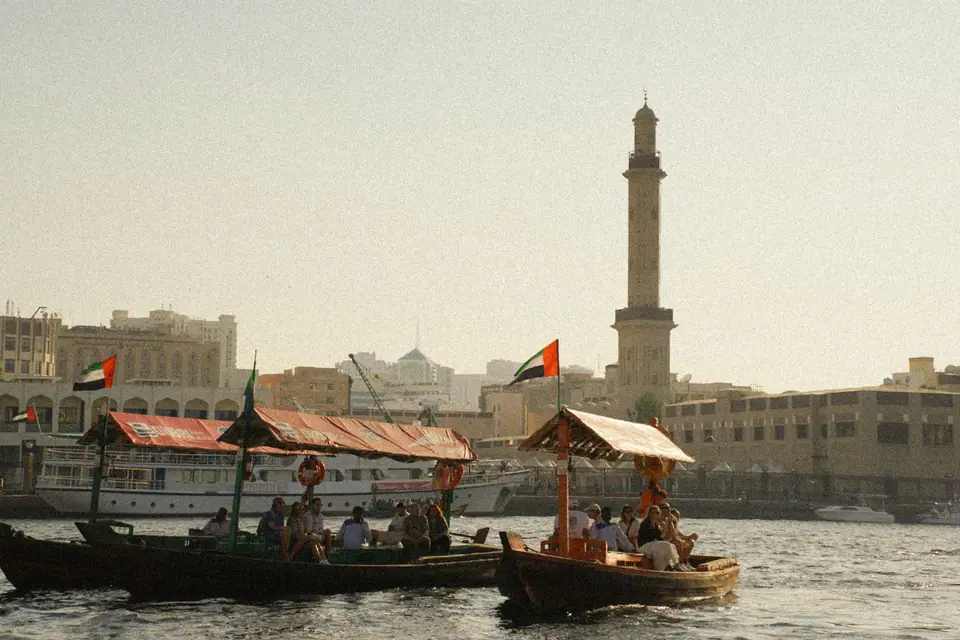
Return to the Bur Dubai Abra Station for the crossing. The transport authority runs motorised traditional abras on two routes: Bur Dubai to Deira Old Souq, and Dubai Old Souq to Al Sabkha. You pay a small fare in cash on board, so carry coins. Boats leave when they fill, and the ride is short, low to the water and lively with traffic. Wooden dhows still moor along the wharves, loading and unloading cargo.
A few practical points help. Board and leave from the side of the boat, holding the rail, as the decks sit low and can move. Keep bags on your lap. If you want a longer look at the waterfront, abras can be chartered privately for a cruise along the creek. Our transport guide explains how abras fit into the wider network, including the one place where cash, not nol, is the rule.
The Deira souks
On the Deira bank, the souks begin a few steps from the abra station. They are working markets before they are attractions, so expect deliveries, bargaining and crowds in the late afternoon:
- Spice Souk / Gold Souk. The Spice Souk is a tight grid of lanes with open sacks of dried limes, saffron, frankincense and spice blends. A short walk north, the Gold Souk is a covered arcade of jewellery shops. In the spice lanes, haggling is normal; in the gold shops, the metal is sold by weight at the day's rate, and bargaining focuses on the workmanship.
- Buying / browsing. Traders will invite you in. A polite "no, thank you" is enough if you are just looking. If you do buy, ask for a receipt and compare a few shops first.
- Daytime / evening. Many shops close for a break in the middle of the day and reopen later, and the souks feel most lively in the evening.
Eating in Old Dubai
The food of the creek reflects the people who traded here. Emirati dishes such as machboos (MACH-boos), spiced rice with meat or fish, and luqaimat (loo-kai-MAAT), small fried dumplings with date syrup, appear in cafés around Al Fahidi. Persian, Indian and Pakistani kitchens line the streets of Bur Dubai and Deira, a reminder of the merchant families who settled on both banks. A cultural meal at the SMCCU is the most structured way to try Emirati food with a host who explains it.
Coffee is part of the welcome here. Arabic coffee, gahwa (GAH-wa), is lightly roasted and often spiced with cardamom, and it is usually served in small cups with dates. Accepting a cup is polite; a gentle shake of the cup when you have had enough signals that you do not want a refill. Small details like this make a walk through Old Dubai more rewarding than a quick photo stop.
Getting here is simple. The Green Line serves both banks of the creek, and taxis can drop you at the edge of Al Fahidi. Walking is the best way to move once you arrive, since the lanes are narrow and the distances between sights are short.
Old Dubai works best early or late. In winter you can stay outdoors all day; from May to September, walk in the early hours after sunrise and return for the souks after dark, as our best time to visit guide explains. Dress modestly in these residential neighbourhoods, following our what to wear guide. For a full day that links the creek with the Museum of the Future and the Dubai Frame, follow Day 1 of our three-day itinerary.
Where it is
- 1Old Dubai
- Dubai International Airport (DXB) · about 8 km from here in a straight line
- Directions in Google Maps
Stations and taxi ranks: OpenStreetMap. Airports: OurAirports. Distances are in a straight line.
Traveller tips
Real advice from people who have been to Dubai. Every tip is read by our team before it goes live.
No tips yet. Been here? Yours could be the first.
Thank you! Your tip will appear here after a quick review.
More in Dubai
Continue exploring Dubai with related neighbourhood, food, and planning guides