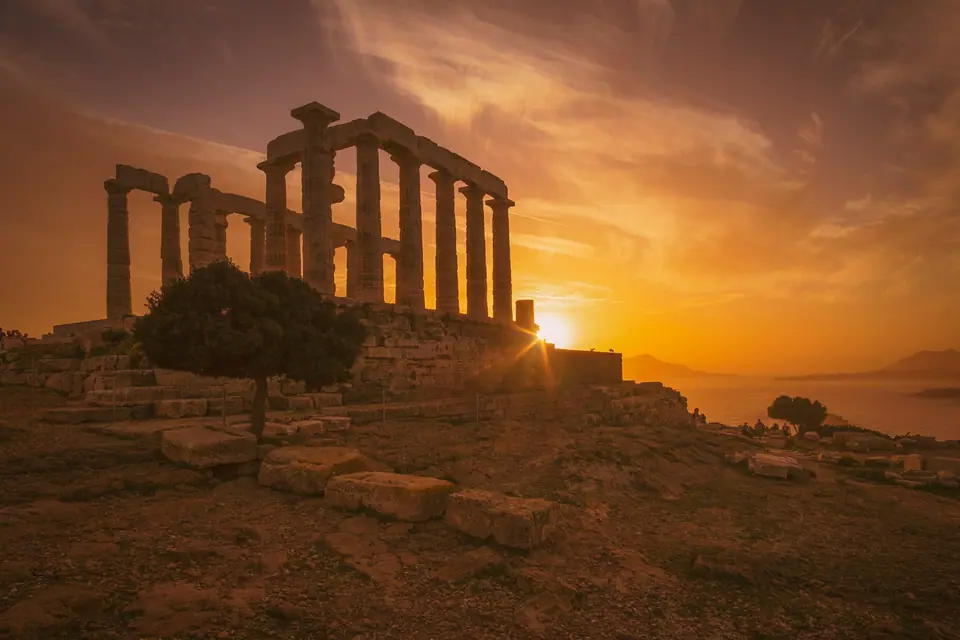
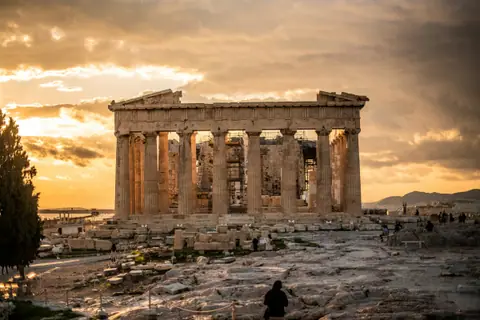
Photo by Cristina Gottardi on Unsplash
Best Day Trips from Athens: Cape Sounion, Delphi, Hydra & Nafplio
From a half-day coastal drive to the Temple of Poseidon at Cape Sounion and fast hydrofoils to car-free Hydra to mountain sanctuaries at Delphi.
Athens sits at the geographical hinge connecting mainland Greece, the Peloponnese peninsula, and the Aegean islands. That position puts three UNESCO World Heritage sanctuaries, a car-free eighteenth-century island harbour, and a dramatic clifftop sea temple within two to three hours of Syntagma Square. Travel times and transport connections vary sharply across each corridor. Choosing the right excursion for your schedule is essential. Below we compare the five classic routes by distance, transport mode, and realistic pacing.
Quick comparison: Half-Day vs Full-Day vs Overnight Excursions
- Cape Sounion (70 km Southeast) / Hydra Island (37 Nautical Miles from Piraeus): If you only have a free afternoon and evening, head down the Athens Riviera to Cape Sounion for sunset, as on Day 3 of our 3-day Athens itinerary. If you have a full summer or shoulder-season day and want island architecture and crystal-clear swimming without flying, board a morning high-speed catamaran from Piraeus Gate E8 to car-free Hydra.
- Delphi (180 km Northwest) / Nafplio, Mycenae & Epidaurus (140 km Southwest) / Meteora (355 km North): Both Delphi on Mount Parnassus and the Argolid circuit of Mycenae, Epidaurus, and Nafplio require a full nine-to-eleven-hour day by rental car, KTEL coach, or small-group tour. By contrast, the clifftop monasteries of Meteora above Kalambaka sit more than four hours each way from Athens. Attempting Meteora as a single day trip means spending nine hours sitting in a vehicle for barely two hours at the rocks. Give Meteora at least one overnight stay in Kalambaka or Kastraki.
Cape Sounion & the Temple of Poseidon (70 km Southeast)
The Doric Temple of Poseidon at Cape Sounion (SOO-nee-on) stands on a sheer 60-metre headland at the southernmost tip of the Attica peninsula. Here the Saronic Gulf meets the open Aegean Sea. Built between 444 and 440 BCE under Pericles, ancient sources attribute it to the same architect who designed the Temple of Hephaestus in the Ancient Agora. Master masons carved it from local white marble quarried at nearby Agrileza without iron clamps so it could resist corrosive sea spray. Sixteen of its original thirty-four fluted columns still stand against the horizon. On one of the southern marble blocks, Romantic poet Lord Byron carved his signature during his visit in 1810.
How to get there: By rental car, drive south down coastal Poseidonos Avenue (National Road 91) along the Athens Riviera in roughly 75 to 90 minutes. Stop earlier in the afternoon for a thermal swim at mineral-rich Lake Vouliagmeni or the beaches of Varkiza and Legrena. By public bus, orange KTEL Attikis coaches depart from central Athens and take roughly two hours along the coast road. Arrive at the archaeological site at least 75 minutes before sunset.
Delphi: The Sanctuary of Apollo on Mount Parnassus (180 km Northwest)
Ancient Greeks revered the UNESCO World Heritage sanctuary of Delphi (thel-FEE) as the Omphalos (navel or centre) of the earth. The ruins cling to a steep terraced amphitheatre at 570 metres elevation on the southwestern flank of Mount Parnassus. Below the cliffs, a vast valley of silver-green olive trees rolls down to the Gulf of Corinth. Starting from the lower precinct of Athena Pronaia with its circular fourth-century BCE Tholos, you climb the paved Sacred Way past city-state treasuries, including the reconstructed Treasury of the Athenians. Above rises the fourth-century BCE Temple of Apollo (where the priestess Pythia delivered enigmatic prophecies), the 5,000-seat hillside theatre, and the topmost ancient stadium. Next door, the Delphi Archaeological Museum displays the life-size 478 BCE Bronze Charioteer of Delphi, the Archaic marble twin statues of Kleobis and Biton, and the Naxian Sphinx.
How to get there: By rental car via the A1 motorway and mountain town of Arachova, the drive takes 2.5 hours each way. On a car trip, stop 35 kilometres before Delphi to see the eleventh-century Byzantine mosaics inside UNESCO-listed Hosios Loukas Monastery. By public coach, KTEL Fokidas buses depart from Athens's Liosion Terminal (Rikaki 6, reached via Kato Patissia on Metro Line 1) and take roughly 3 hours each way.
Hydra & the Saronic Gulf Islands (Piraeus Gate E8)
Unlike the distant Cyclades, the Saronic Islands sit inside the sheltered gulf right off Piraeus:
- Hydra (EE-thrah, 75 to 105 Minutes by High-Speed Catamaran). Wheeled motor vehicles, including cars, motorbikes, and bicycles, are banned by law across the entire island of Hydra. Grey limestone mansions erected by wealthy eighteenth- and nineteenth-century maritime captains rise like an amphitheatre around the horseshoe harbour. Donkeys and water taxis carry luggage and supplies. Walk the coastal flagstone lane west from Hydra port through Kaminia to Vlychos for a swim off the rocks and a seaside lunch.
- Aegina (EH-yee-nah, 40 Minutes by Hydrofoil / 70 Minutes by Conventional Ferry). Closer and gentler on the budget, Aegina is famous for its PDO pistachio orchards, neoclassical waterfront, and the fifth-century BCE Doric Temple of Aphaia set in pine woods above Agia Marina.
Nafplio, Mycenae & the Ancient Theatre of Epidaurus (Argolid Peninsula)
Cross the narrow Corinth Canal (6.4 kilometres long, cut through 80-metre limestone walls in 1893) into the Peloponnese to combine three icons in one long day by car or organised tour. First is Bronze Age Mycenae (mee-KEE-nes, 120 km from Athens) with its thirteenth-century BCE megalithic Lion Gate and beehive Treasury of Atreus. Second is the fourth-century BCE Ancient Theatre of Epidaurus (ep-EE-thav-ros), designed by Polykleitos the Younger for 14,000 spectators. Its acoustics are so pure that a coin dropped on the central orchestra stone can be heard on the top row. Third is Venetian-built Nafplio (NAHF-plee-oh), the first capital of modern Greece from 1828 to 1834, crowned by the 999 steps of the Palamidi Fortress. Book high-speed Saronic ferry tickets ahead for summer weekends. Bring your passport or national ID card when boarding any Greek domestic ferry. Check port and bus terminal transfers in our getting to Athens guide.
Where it is
- 1Best Day Trips from Athens
- Athens Eleftherios Venizelos International Airport (ATH) · about 33 km from here in a straight line
- Directions in Google Maps
Stations and taxi ranks: OpenStreetMap. Airports: OurAirports. Distances are in a straight line.
Traveller tips
Real advice from people who have been to Athens. Every tip is read by our team before it goes live.
No tips yet. Been here? Yours could be the first.
Thank you! Your tip will appear here after a quick review.
More in Athens
Continue exploring Athens with related neighbourhood, food, and planning guides
How to Get to Athens: Airport Metro, Piraeus Ferries & OASA Cards
Athens, Greece
Best Time to Visit Athens: Weather, Summer Heat & Easter Dates
Athens, Greece
What to Wear in Athens: Grippy Shoes, Sun Protection & Church Rules
Athens, Greece
Acropolis Guide: Timed Tickets, Entrances, Heat & the Museum
Athens, Greece
