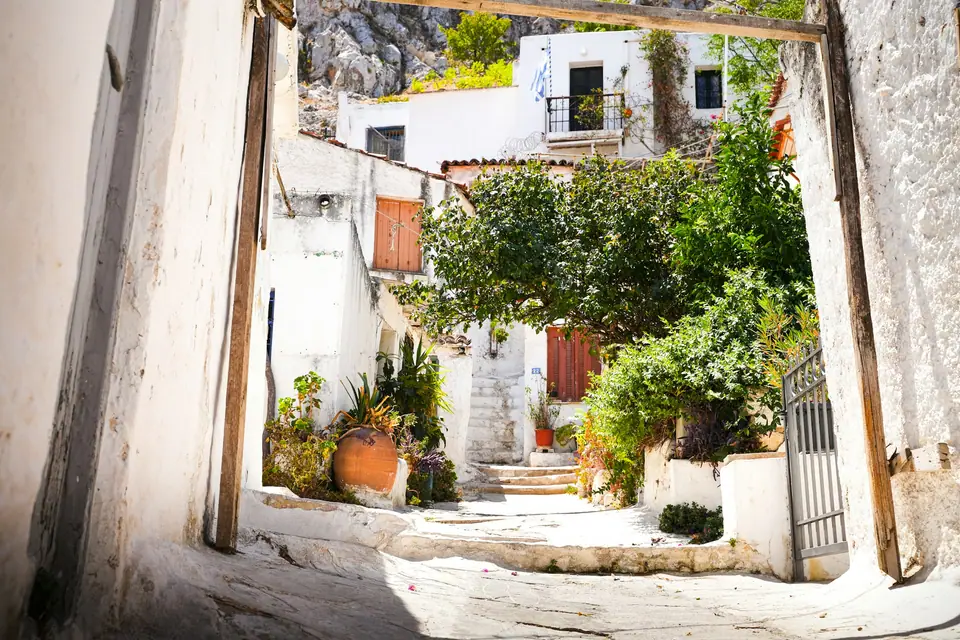
Photo by Kameron Kincade on Unsplash
Plaka, Anafiotika & Monastiraki Walking Guide: 10-Stop Route
A two-and-a-half-hour downhill and hillside loop from Syntagma through Byzantine chapels, Cycladic whitewashed steps, and Roman ruins to sunset at Thissio.
Directly beneath the northern and eastern cliffs of the Acropolis lies Plaka (PLAH-kah, postcode 105 58), the oldest continuously inhabited neighbourhood in Athens. It is the one central district that looks the way first-time visitors imagine Greece. Along its lower main corridors, Adrianou and Kydathineon streets, souvenir shops selling leather sandals, olive-wood bowls, and evil-eye charms crowd the ground floors of pastel nineteenth-century neoclassical mansions. Turn just fifty metres uphill toward the rock, however, and the souvenir stalls vanish into silent stone stairways, Byzantine brick chapels, bougainvillea-shaded courtyards, and the tiny Cycladic village of Anafiotika. This ten-stop self-guided route covers roughly 3 kilometres in two and a half hours and works best in the late afternoon, finishing at sunset in Thissio.
Lower Plaka vs Upper Plaka (Ano Plaka) and Anafiotika
Understanding the vertical split along the northern slope of the Acropolis helps you avoid tourist-trap menus and find the quietest historic lanes:
- Lower Plaka (105 58) / Upper Plaka & Anafiotika (Stratonos & Prytaneiou Slopes): Built along the ancient street plan of Classical and Roman Athens, Lower Plaka sits on flat pedestrian paving lined with cafés and shops. Climbing the stone steps south of Tripodon and Prytaneiou streets brings you into Upper Plaka (Ano Plaka) and Anafiotika (ah-nah-fee-OH-tee-kah). This car-free hillside labyrinth of ochre mansions and cubic whitewashed cottages clings directly to the Acropolis bedrock above the ancient Peripatos ring path.
Step-by-step walking route from Syntagma to the Roman Agora (Stops 1 to 6)
- Syntagma Square to Mitropoleos Street (Postcode 105 63). Begin at the lower west side of Syntagma Square after watching the hourly Evzones guard change, and walk downhill west along Mitropoleos Street (mee-troh-POH-leh-os).
- Metropolitan Cathedral & the 12th-Century Little Metropolis (Mitropoleos Square). Halfway down the avenue rises the 1862 Metropolitan Cathedral of Athens. Directly beside its south wall stands a far older gem: the tiny twelfth-century Byzantine church of Panagia Gorgoepikoos (Agios Eleftherios, the "Little Metropolis"). Medieval builders constructed it entirely from ninety recycled Classical, Hellenistic, and Roman carved marble friezes and blocks, including a fourth-century BCE Attic festival calendar frieze above the west door.
- Kydathineon Street & Tripodon Street (The Oldest Street in Athens). Turn left onto pedestrian Kydathineon Street past shaded Filomousou Eterias Square, then turn onto Tripodon Street (tree-POH-thon, Street of the Tripods). Retaining its exact name and alignment for twenty-five centuries since it connected the Theatre of Dionysus to the Ancient Agora, Tripodon was once lined with bronze tripods awarded to victorious choregoi (theatrical sponsors).
- The Choregic Monument of Lysicrates (334 BCE). At the foot of Tripodon stands the cylindrical marble Monument of Lysicrates, erected by wealthy patron Lysicrates in 334 BCE to display the bronze tripod his boys' chorus won at the Dionysia festival. It represents one of the earliest surviving exterior uses of the Corinthian architectural order.
- Anafiotika (The Cycladic Island Village under the Acropolis). From Lysicrates Square, climb the stone steps past the fourteenth-century church of Agios Nikolaos Ragavas into Anafiotika. In the 1840s, master stonemasons and carpenters from the small Cycladic island of Anafi arrived in Athens to help build King Otto's new royal palace. Needing affordable shelter, they quietly constructed dozens of flat-roofed, whitewashed houses with blue shutters and potted basil along shoulder-width alleys directly above Stratonos Street. Because roughly forty cottages remain private homes today, walk quietly and do not step onto private terraces.
- The Roman Agora, Tower of the Winds & Hadrian's Library (Postcode 105 55). Follow Theorias and Pelopida streets west down the slope to the Roman Agora, built between 19 and 11 BCE with funds from Julius Caesar and Augustus. At its eastern edge stands the twelve-metre octagonal marble Horologion of Andronicus Cyrrhestes, universally known as the Tower of the Winds (first century BCE). It functioned simultaneously as a sundial, weather vane, and hydraulic water clock carved with reliefs of the eight wind gods (Boreas, Kaikias, Apeliotes, Euros, Notos, Lips, Zephyros, and Skiron). One block north stands the towering Corinthian facade of Hadrian's Library (132 CE), beside the seventeenth-century Ottoman Fethiye Mosque.
Monastiraki Square, the Flea Market, and Sunset at Thissio (Stops 7 to 10)
- Monastiraki Square & Tzistarakis Mosque. Step out onto lively Monastiraki Square, framed by the tenth-century Byzantine church of the Pantanassa and views straight up to the Parthenon. On the southern corner stands the 1759 Ottoman Tzistarakis Mosque, which now houses ceramics of the Museum of Modern Greek Culture.
- Ifaistou Street & Avissinias Square Flea Market. Walk west down covered Ifaistou Street past vinyl record stores, copper workshops, and vintage boots into Avissinias Square. Here antique dealers spread brass binoculars, icons, and nineteenth-century furniture across pavement tables, especially on Sunday mornings.
- Adrianou Street along the Ancient Agora. Continue west along the café-lined pedestrian stretch of Adrianou Street, which runs right along the northern rail of the Ancient Agora with open views up to the fifth-century BCE Temple of Hephaestus.
- Apostolou Pavlou Promenade (Thissio) & the Areopagus Rock. Finish where Adrianou meets wide, tree-lined Apostolou Pavlou in Thissio (postcode 118 51). Climb the marble steps of the Areopagus rock as the floodlights switch on across the Acropolis. Afterwards, walk north into Psyrri (105 54) for dinner and live rebetiko music as planned in our 3-day Athens itinerary.
Where to pause for Greek coffee or ouzo along the walk
Skip the waiters waving multi-language laminated menus along lower Adrianou Street. Instead, pause for a traditional Greek coffee brewed in a copper briki on the stone steps of Mnisikleous Street and Klepsydras Street in Upper Plaka. Cushioned stools line the shaded stairway beneath jasmine vines, and evening tavernas serve grilled octopus with ouzo. Two blocks away near Filellinon Street, you can also visit the historic Brettos distillery bar, lined floor to ceiling with glowing coloured liqueur bottles since 1909. Check accommodation options across these historic lanes in our where to stay in Athens guide.
Where it is
- 1Plaka, Anafiotika & Monastiraki Walking
- Athens Eleftherios Venizelos International Airport (ATH) · about 19 km from here in a straight line
- Directions in Google Maps
Stations and taxi ranks: OpenStreetMap. Airports: OurAirports. Distances are in a straight line.
Traveller tips
Real advice from people who have been to Athens. Every tip is read by our team before it goes live.
No tips yet. Been here? Yours could be the first.
Thank you! Your tip will appear here after a quick review.
More in Athens
Continue exploring Athens with related neighbourhood, food, and planning guides
Best Time to Visit Athens: Weather, Summer Heat & Easter Dates
Athens, Greece
What to Wear in Athens: Grippy Shoes, Sun Protection & Church Rules
Athens, Greece
Acropolis Guide: Timed Tickets, Entrances, Heat & the Museum
Athens, Greece
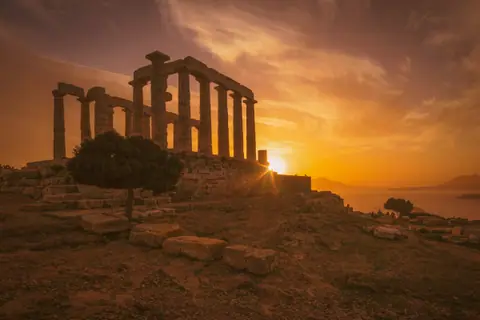
Best Day Trips from Athens: Cape Sounion, Delphi, Hydra & Nafplio
Athens, Greece
