What to Wear in Athens: Grippy Shoes, Sun Protection & Church Rules
Why rubber-soled footwear is non-negotiable on ancient Pentelic marble, how to dress for unshaded summer ruins, and modesty rules at Orthodox churches.
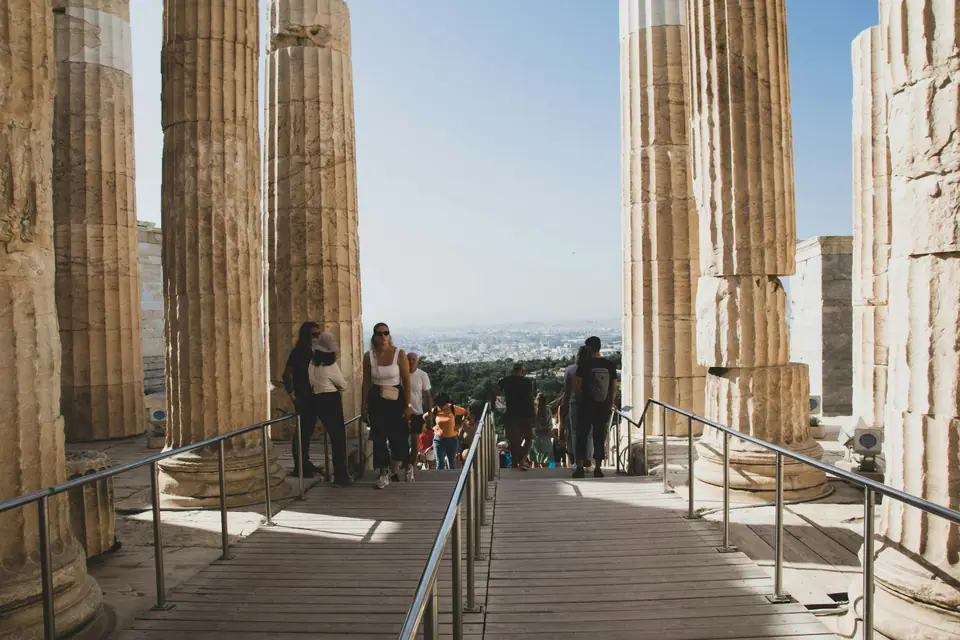
Before you pack a single shirt or dress for Athens, look at the bottoms of your shoes. Twenty-five centuries of footsteps have polished the ancient Pentelic marble and grey limestone bedrock of the Acropolis, Philopappos Hill, and Plaka to a glassy sheen. Even on a bone-dry July morning, smooth leather soles, hard plastic flip-flops, and heels slide sideways on the incline through the Propylaea gateway and around the Areopagus rock. After an autumn rain shower, even flat neoclassical marble pavements along Panepistimiou and Ermou streets become slick. Your footwear choice is the single most important comfort and safety decision of the trip.
Footwear rules: lugged rubber soles vs smooth sandals and heels
To protect ancient stone and prevent falls, Greek heritage rules strictly prohibit high heels on archaeological sites and inside historic theatres. Site guards at the Acropolis and Epidaurus will turn back visitors wearing stilettos:
- Lugged Rubber Trainers & Sandals / Smooth Leather Slides & Flip-Flops: Pack broken-in running trainers, low-cut trail shoes, or strapped walking sandals with a deeply grooved rubber outsole. Modern concrete pathways and anti-slip grooves have been added along sections of the Acropolis summit. Even so, you still step constantly onto original tilted limestone and polished marble slabs around the Erechtheion, the Ancient Agora, and the steep rock-cut steps of the Areopagus and Anafiotika. Save flat leather sandals exclusively for level evening dinners in Koukaki or Kolonaki.
Dressing for the sun and 35°C+ summer heatwaves
There is virtually zero natural tree shade atop the Acropolis rock, around the Temple of Olympian Zeus, or across the upper terraces of the Panathenaic Stadium and Cape Sounion. White marble reflects solar radiation upward from the ground as well as downward from the sky. Between May and early October, dress to block UV rays while letting air circulate:
- Breathable Natural Fabrics (Linen & Lightweight Cotton). Choose loose-fitting 100-percent linen or fine cotton shirts, wide-leg trousers, or midi dresses in pale colours. Avoid heavy denim or tight synthetic polyester activewear that traps sweat. In central Athens, locals dress neatly even in high summer. Swimwear and shirtless walking belong strictly at the beaches of the Athens Riviera, never in city streets or metro stations.
- Sun Hat with a Chin Cord or Snug Fit, UV Sunglasses & Sunscreen. The meltemi wind blows briskly across the exposed summit of the Acropolis and at Cape Sounion. A floppy straw hat without a snug band will blow straight over the cliff wall within minutes. Pack a close-fitting canvas bucket hat, linen cap, or sun hat with an adjustable cord, plus Category 3 polarized sunglasses and high-SPF sunscreen.
- Insulated Refillable Water Bottle. Athens tap water is clean, cold, and completely safe to drink. Drinking fountains operate inside the Acropolis precinct and Ancient Agora. Carry a 500 ml or 750 ml insulated stainless-steel bottle in your daypack so your water stays cold for hours.
Greek Orthodox church and monastery dress code
While Athens is much more relaxed than Istanbul regarding everyday religious dress, stepping inside active Greek Orthodox churches requires respectful attire. That rule applies at the nineteenth-century Metropolitan Cathedral of the Annunciation (Mitropoli) on Mitropoleos Street, the twelfth-century Byzantine Church of Panagia Kapnikarea on Ermou Street, and tiny Panagia Gorgoepikoos:
- City Churches (Covered Shoulders & Knees) / Monasteries on Day Trips (Strict Skirt & Long Trousers Rule): Inside central Athenian churches, both men and women should have shoulders and knees covered. Men remove hats at the door, while women do not need to cover their hair in urban parish churches. Working Greek Orthodox monasteries outside the capital enforce much stricter dress codes at the gate. That applies at the eleventh-century UNESCO Hosios Loukas Monastery near Delphi and the clifftop monasteries of Meteora. Men must wear full-length trousers, as shorts are often rejected. Women must wear a long skirt or dress reaching below the knee rather than trousers. Monasteries lend wrap-around skirts at the entrance, or you can wrap your own large cotton sarong over trousers in five seconds.
Spring, autumn, and winter layers
If you visit between October and April (see our seasonal weather guide), pack a windproof shell or denim jacket for breezy sunset hours atop Mount Lycabettus and Philopappos Hill. From December through February, bring a waterproof raincoat, a compact umbrella, and a warm fleece or merino sweater for cool evenings. Older neoclassical buildings and tavernas keep doors open in mild weather, so a cosy scarf or cardigan is useful indoors as well as outside. Pack two pairs of cushioned cotton or merino socks so you always have a dry pair after an autumn shower. On bright winter mornings, the sun over the Saronic Gulf still calls for UV sunglasses even when the air feels crisp.
Evening attire, island ferries, and daypack rules at archaeological sites
For evening cocktails at rooftop terraces overlooking the floodlit Parthenon around Syntagma and Monastiraki, smart-casual attire is the norm. Athenians dress up for dinner in the evening, wearing tailored linen shirts, summer dresses, or dark jeans with clean trainers or leather loafers. If you are boarding a high-speed catamaran from Piraeus to Hydra or Aegina, pack a light sweater even in July because the air conditioning inside ferry cabins is kept frigid. Swimwear, reef shoes for rocky coves, and a fast-drying microfibre towel belong in your daypack whenever you head down the Athens Riviera to Lake Vouliagmeni or out to the Saronic islands. Finally, remember that large backpacks and suitcases are prohibited inside the Acropolis and major museums. Carry a small zipped crossbody bag or compact daypack worn on your front when riding Metro Line 1 or Line 3. Pack a small packet of tissues and hand sanitiser for public park washrooms, plus blister plasters for long stone walks across our 3-day Athens itinerary. Keeping a lightweight cotton tote folded in your pocket also helps when picking up pistachios, thyme honey, or olives around the Varvakios market. A compact power bank is equally useful on long sightseeing days when your phone serves for metro tap-in payments and digital museum tickets.
Weather by month
Athens is warmest in July, with average highs around 33°C, and coldest in January, when nights drop to about 5°C. December is the wettest month by rainfall (86 mm), with rain on about 8 days. For mild weather with fewer rainy days, aim for April, May and October.
| Month | Low | Range | High | Rain | Rainy days |
|---|---|---|---|---|---|
| Jan | 5°C | 12°C | 72 mm | 8 d | |
| Feb | 7°C | 14°C | 50 mm | 7 d | |
| Mar | 8°C | 16°C | 52 mm | 7 d | |
| Apr | 11°C | 20°C | 27 mm | 5 d | |
| May | 16°C | 25°C | 30 mm | 5 d | |
| Jun | 20°C | 30°C | 31 mm | 6 d | |
| Jul | 23°C | 33°C | 10 mm | 2 d | |
| Aug | 23°C | 33°C | 12 mm | 2 d | |
| Sep | 20°C | 29°C | 30 mm | 3 d | |
| Oct | 15°C | 23°C | 28 mm | 3 d | |
| Nov | 11°C | 19°C | 65 mm | 7 d | |
| Dec | 8°C | 14°C | 86 mm | 8 d |
Averages of daily values from 2015 to 2024. Rainy days are days with at least 1 mm of rain. Source: Open-Meteo · Compare destinations by month.
Where it is
- 1Athens
- Athens Eleftherios Venizelos International Airport (ATH) · about 20 km from Athens in a straight line
- Directions in Google Maps
Stations and taxi ranks: OpenStreetMap. Airports: OurAirports. Distances are in a straight line.
Traveller tips
Real advice from people who have been to Athens. Every tip is read by our team before it goes live.
No tips yet. Been here? Yours could be the first.
Thank you! Your tip will appear here after a quick review.
More in Athens
Continue exploring Athens with related neighbourhood, food, and planning guides

Plaka, Anafiotika & Monastiraki Walking Guide: 10-Stop Route
Athens, Greece
Best Day Trips from Athens: Cape Sounion, Delphi, Hydra & Nafplio
Athens, Greece

Where to Stay in Athens: Plaka, Koukaki, Syntagma & Kolonaki
Athens, Greece
Athens 3-Day Itinerary: Acropolis, Agora, Plaka & Cape Sounion
Athens, Greece
