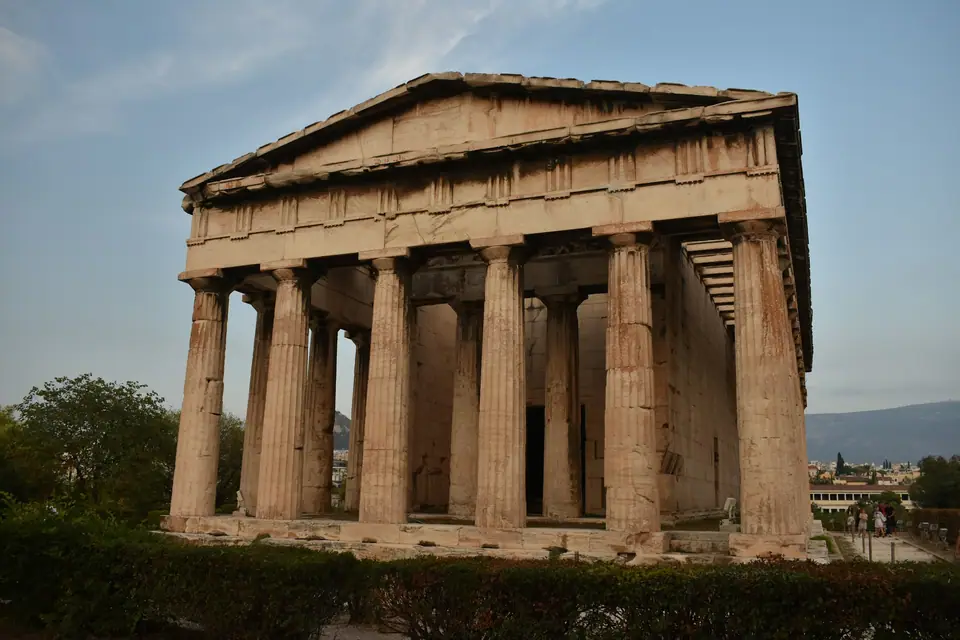
Photo by Matheus Oliveira on Unsplash
Best Things to Do in Athens: 13 Ancient Ruins, Hills & Museums
From the fifth-century BCE Parthenon and the Temple of Hephaestus to gold Mycenaean masks, pine-covered sunset hills, and open-air summer cinemas.
Athens holds enough Classical, Roman, and Byzantine sites to occupy a historian for a month. Fortunately, its greatest monuments sit so close together that a first-time visitor can see the highlights in three unhurried days. The smartest rhythm is pairing one major outdoor archaeological precinct early each morning with an air-conditioned museum at midday. Save the late afternoon and evening for hilltop viewpoints and pedestrian dining lanes. You can follow this exact daily sequence in our Athens 3-day itinerary.
The Sacred Rock & Its Footprints: Acropolis, Acropolis Museum & Ancient Agora
- The Acropolis of Athens (Postcode 105 58). Inscribed on the UNESCO World Heritage list in 1987, the flat-topped limestone citadel rises 156 metres above the basin. Built under the leadership of Pericles during the second half of the fifth century BCE, its crown jewels include the Doric Parthenon (447 to 432 BCE) and the monumental Propylaea gateway. Nearby stand the tiny Temple of Athena Nike and the Erechtheion with its Porch of the six sculpted Caryatid maidens. Book the first morning timed slot using our Acropolis guide.
- The Acropolis Museum (Dionysiou Areopagitou 15, Postcode 117 42). Designed by architect Bernard Tschumi and opened in 2009 just 300 metres southeast of the rock, this glass-and-concrete museum floats on concrete pillars above an excavated Christian Athenian neighbourhood visible through glass floors. The Archaic Gallery displays sixth-century BCE painted marble korai statues in natural daylight, while five of the six original Caryatids stand on a mezzanine balcony. On the top level, the glass-walled third-floor Parthenon Gallery aligns to the exact cardinal orientation of the temple outside to display the 160-metre frieze and metopes.
- The Ancient Agora & Temple of Hephaestus (Adrianou 24, Postcode 105 55). Stretching northwest below the Acropolis, the Ancient Agora (ah-goh-RAH) functioned for centuries as the commercial market, law court, and political assembly ground of the city. Here Socrates questioned citizens and St Paul later preached. Crowning the Agoraios Kolonos hill on its western edge is the Doric Temple of Hephaestus (c. 449 to 415 BCE). It remains the best-preserved Classical temple in Greece, with all thirty-four exterior columns and much of its coffered marble ceiling intact. Across the grounds stands the two-storey Stoa of Attalos, gifted by King Attalos II of Pergamon around 150 BCE. Reconstructed in the 1950s, it houses the site's museum of ceramic voting shards (ostraca) and bronze jury ballots.
World-Class Museums & Roman Imperial Monuments
- National Archaeological Museum (106 82) / Museum of Cycladic Art & Benaki Museum (106 74): Founded in 1889 on Patission Street, the National Archaeological Museum holds the richest collection of ancient Greek art on earth. Highlights include the sixteenth-century BCE beaten-gold Mask of Agamemnon from Mycenae, the 2.09-metre bronze Zeus or Poseidon of Artemision (c. 460 BCE), the Hellenistic bronze Jockey of Artemision, Akrotiri wall frescoes from Santorini, and the corroded bronze gears of the first-century BCE Antikythera Mechanism. In Kolonaki near Syntagma, pair it with the Museum of Cycladic Art (housing 3,000-year-old folded-arm marble figurines) or the Benaki Museum of Greek Culture.
- Panathenaic Stadium (Kallimarmaro, 116 35) & Temple of Olympian Zeus: East of the Acropolis in Pangrati sits the Panathenaic Stadium (kah-lee-MAHR-mah-roh, meaning "beautifully marbled"). It is the only major stadium in the world built entirely of white Pentelic marble. Constructed by Lycurgus in 330 BCE for the Panathenaic Games and refurbished in marble by Herodes Atticus in 144 CE, it was restored in 1896 to host the first modern Olympic Games. Visitors can jog its hairpin track and climb its 50,000-seat tiers. Five minutes west beside Hadrian's Arch (131 CE) stand the sixteen surviving 17-metre Corinthian columns of the colossal Temple of Olympian Zeus, completed by Roman Emperor Hadrian in 132 CE.
Old Quarters, Sunset Hills, Markets & the Athens Riviera
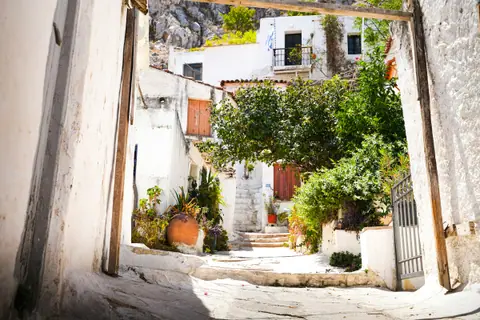
- Plaka, Anafiotika & the Roman Agora. Lose yourself in the bougainvillea-draped steps of Plaka and Anafiotika, passing the fourth-century BCE Monument of Lysicrates and the octagonal first-century BCE Tower of the Winds inside the Roman Agora.
- Sunset on Philopappos Hill (Hill of the Muses) & the Areopagus Rock. Directly southwest of the Acropolis, follow the hand-laid marble and stone pathway designed in the 1950s by architect Dimitris Pikionis through Aleppo pines up Philopappos Hill (147 metres). Pass the rock-cut chambers known as the Prison of Socrates to reach the second-century Roman funeral monument at the summit. At golden hour, the unobstructed eye-level view across to the Parthenon is unforgettable. Closer to the Acropolis entrance, the smooth marble outcrop of the Areopagus (Mars Hill) offers close-up twilight views over Monastiraki.
- Mount Lycabettus (Lykavittos, 277 Metres). Rising twice as high as the Acropolis above Kolonaki, conical Lycabettus Hill is the highest natural point in central Athens. Ride the underground funicular railway from the top of Ploutarchou Street or hike the zig-zagging pine path to the whitewashed nineteenth-century Chapel of St George for 360-degree views stretching to Piraeus and the Saronic islands.
- Evzones Guard Change at Syntagma & the National Garden. Every hour on the hour, the presidential guard, known as the Evzones (EV-zoh-nes), perform their slow-motion, high-kick changing of the guard. They wear pleated 400-fold foustanella kilts and hobnailed tsarouchia pom-pom clogs before the Tomb of the Unknown Soldier on Syntagma Square. The grand ceremonial parade with a military band takes place every Sunday morning. Behind Parliament lies the shaded 15.5-hectare National Garden.
- Varvakios Central Market, Open-Air Cinemas & the Stavros Niarchos Center (SNFCC). Experience everyday Athens by walking through the loud, tiled meat and seafood halls of the nineteenth-century Varvakios Agora on Athinas Street. On warm May-to-October nights, watch an English-language classic with Greek subtitles under the stars at historic Cine Thisio (founded in 1935 with the floodlit Acropolis right behind the screen). Down on the Faliro waterfront, Renzo Piano's Stavros Niarchos Foundation Cultural Center (SNFCC) pairs the Greek National Opera and National Library with a free Mediterranean roof park overlooking the sea. From there, the coastal tram heads down the Athens Riviera toward Vouliagmeni and our Cape Sounion day trip.
Where it is
- 1Athens
- Athens Eleftherios Venizelos International Airport (ATH) · about 20 km from Athens in a straight line
- Directions in Google Maps
Stations and taxi ranks: OpenStreetMap. Airports: OurAirports. Distances are in a straight line.
Traveller tips
Real advice from people who have been to Athens. Every tip is read by our team before it goes live.
No tips yet. Been here? Yours could be the first.
Thank you! Your tip will appear here after a quick review.
More in Athens
Continue exploring Athens with related neighbourhood, food, and planning guides
Best Time to Visit Athens: Weather, Summer Heat & Easter Dates
Athens, Greece
What to Wear in Athens: Grippy Shoes, Sun Protection & Church Rules
Athens, Greece
Acropolis Guide: Timed Tickets, Entrances, Heat & the Museum
Athens, Greece
Plaka, Anafiotika & Monastiraki Walking Guide: 10-Stop Route
Athens, Greece
