Photo: KL KL · CC BY-SA 4.0
Basilica of the Holy Blood, Veneration Schedule & Jeruzalemkerk Guide
Visit Bruges's two extraordinary sacred sites: the double-chapel Basilica of the Holy Blood on Burg Square and the Adornes Jeruzalemkerk in Sint-Anna.
Beyond its towering Gothic cathedrals, Bruges preserves two intimate medieval chapels linked directly to the Crusades and pilgrimage routes to Jerusalem. The double-storey Basilica of the Holy Blood (Heilig-Bloedbasiliek) sits tucked into the corner of Burg Square, while the privately owned Jeruzalemkerk stands in the quiet Sint-Anna quarter. Visiting both reveals how Bruges's feudal counts and Genoese merchant families recreated the sacred geography of the Holy Land in Flemish stone and brick.
| Sacred Monument | Entry Information | Visiting Schedule | Architectural & Historical Highlight |
|---|---|---|---|
| Lower Chapel of St Basil (Burg Square). | Free entry. | Check the official site. | Romanesque dark stone crypt chapel with carved tympanum. |
| Upper Chapel of the Holy Blood. | Free entry to chapel. | Check the official site. | Polychrome neo-Gothic interior and crystal phial of the Holy Blood relic. |
| Basilica Museum (Schatkamer Treasury). | Check the official site. | Check the official site. | Historical reliquary shrine and ecclesiastical treasures. |
| Adornes Domain & Jeruzalemkerk (Peperstraat 3). | Check the official site. | Check the official site. | Replica of Jerusalem's Holy Sepulchre, Golgotha altar and black marble tomb. |
Basilica of the Holy Blood: Two Stacked Chapels
Tucked into the corner of Burg Square immediately to the right of the Gothic Town Hall, the Basilica of the Holy Blood is actually two completely distinct churches stacked one on top of the other. Before climbing the flamboyant Renaissance staircase (De Steegheere) adorned with gilded statues of the Counts of Flanders, duck through the low street-level doorway into the Lower Chapel of St Basil (Sint-Basiliuskapel).
Built by Count Thierry (Diederik) of Alsace as his private comital chapel, it is dedicated to St Basil the Great. Count Robert II brought St Basil's relics back from Caesarea during an overseas campaign. Today it remains a remarkably preserved Romanesque church in West Flanders. Notice the heavy dark Tournai limestone piers, the bare rib vaults, and the carved stone tympanum of the Baptism of St Basil. In the side aisle sits a revered polychrome oak statue of the Sedes Sapientiae (Seated Madonna). The quiet, dim austerity of this lower stone room contrasts dramatically with the explosion of colour waiting directly upstairs.
The Relic of the Holy Blood and Daily Veneration Schedule
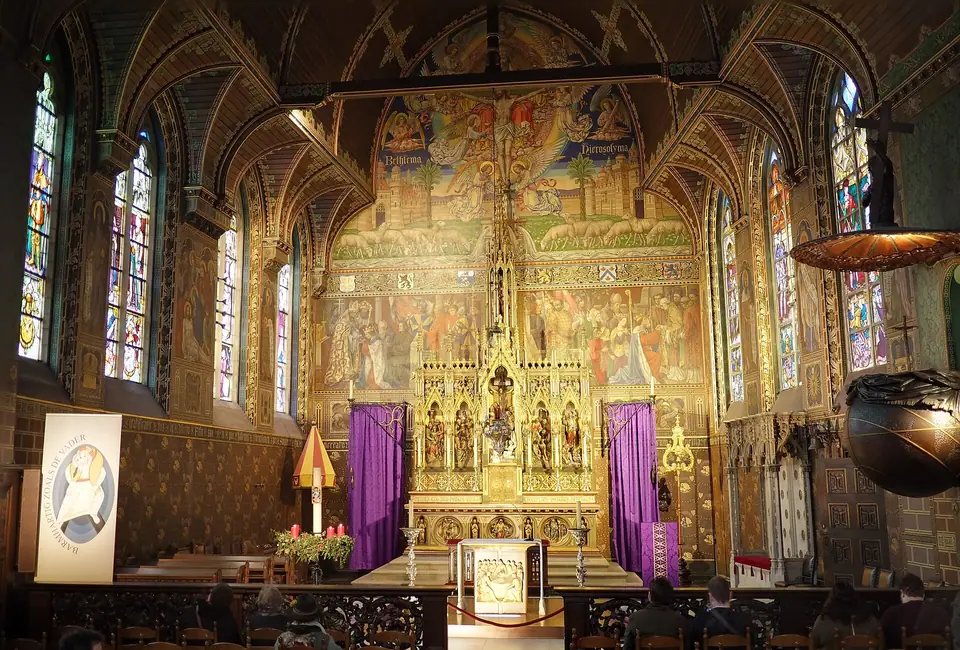
Climb the wide stone stairs to the Upper Chapel. Originally built in the Romanesque era and rebuilt in Gothic style later, the upper church was ransacked during the French Revolution. In the nineteenth century, William Curtis Brangwyn and Jean-Baptiste Bethune redecorated the hall in rich polychrome neo-Gothic style, adding stained-glass windows of the Burgundian rulers.
Inside the side tabernacle rests Bruges's most famous relic: a rock-crystal perfume phial of Byzantine workmanship from Constantinople, sealed at the neck with gold thread and red wax. Inside the crystal bottle sits a piece of cloth stained with what tradition venerates as the blood of Jesus Christ. The colourful pageant associated with it dates back to the thirteenth century, when a citizen of Bruges is said to have brought the relic back from the Second Crusade.
Admission to both the lower and upper chapels is free. To see the crystal vial up close, time your visit during regular veneration periods, checking times beforehand on the official site. During veneration, a priest sits on a raised platform holding the silver cylinder while visitors file up the steps to view the relic. Step into the adjacent Treasury Museum (Schatkamer) to see remarkable ecclesiastical artifacts. Its centrepiece is carried through the city each spring during the Procession of the Holy Blood, which draws tens of thousands of spectators on Ascension Day.
The Adornes Domain and the Jeruzalemkerk in Sint-Anna
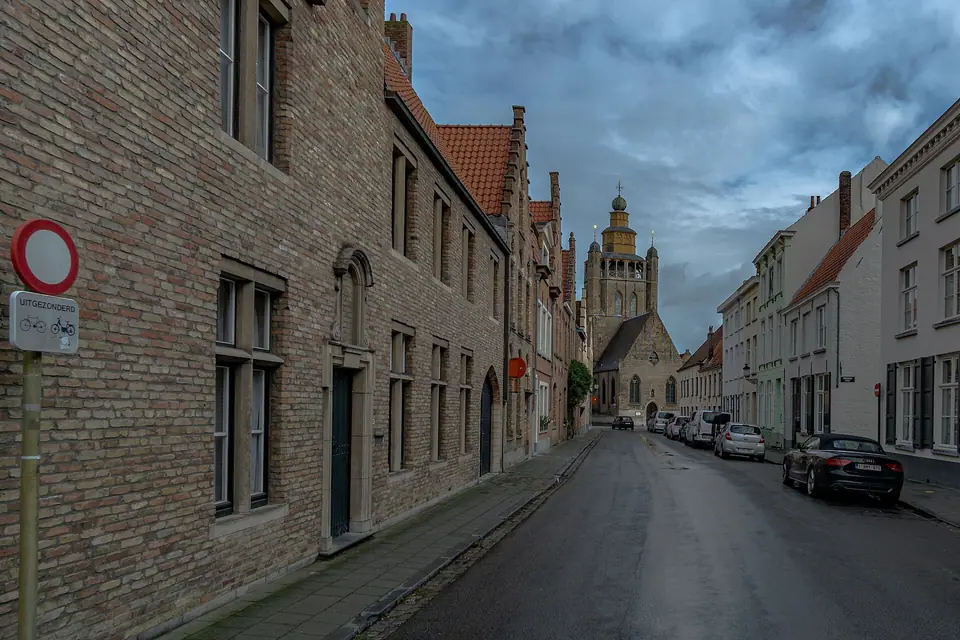
Northeast of Burg Square along Peperstraat in the quiet Sint-Anna quarter stands the Adornes Domain (Adornesdomein), an exceptional historical private estate. The noble Adorno (Adornes) family emigrated from Genoa to Bruges to serve as bankers and diplomats to the Dukes of Burgundy. Remarkably, the estate is still privately owned by their direct descendants, the Count and Countess Limburg Stirum.
Brothers Pieter II and Jacob Adornes made an arduous pilgrimage to the Holy Land. Upon returning, they obtained permission from Pope Martin V to build the Jeruzalemkerk (Jerusalem Chapel) modelled on the Church of the Holy Sepulchre. Stepping inside is unlike any other church in Belgium. Instead of a standard altar, a monumental stone Calvary (Golgotha) sculpted with skulls and the Instruments of the Passion rises, flanked by two stone staircases leading to an elevated octagon chapel. In the centre of the nave lies the black Tournai marble cenotaph of Anselm Adornes and his wife Margareta van der Banck. Anselm was murdered in Scotland while serving King James III, and his heart was interred here. Behind the altar, duck through a low crawl-door into a dim stone replica of Christ's Tomb.
Inside the Adornes Domain, admission includes entry to the restored almshouse cottages lining the garden courtyard. Here an informative multimedia exhibition screens a short film on the life of Anselm Adornes, a Renaissance tournament champion, diplomat. Pilgrim to Mount Sinai, and friend of King James III of Scotland.
Before leaving the Adornes estate, step into the cosy Scottish Lounge inside the historic carriage house. Included in the domain grounds, this quiet lounge serves Scottish shortbread, single malt whiskies, coffee, and local Bruges beers overlooking the private garden.
Directly across Peperstraat from the Jeruzalemkerk stands the Kantcentrum (Lace Museum) on Balstraat. Housed in the former lace school of the Apostoline Sisters, it hosts live demonstrations of traditional bobbin lacework.
Discovering the city's sacred architecture takes you from Burg Square's two-storey chapel to the quiet parish streets of Sint-Anna. Downstairs at the Basilica, the austere Romanesque arches of the lower chapel preserve the medieval Romanesque sanctuary in town. Upstairs, the richly painted upper basilica houses the venerated relic and silver tabernacle carried through the streets each spring. Attending the museum treasury next door adds context on medieval reliquaries, embroidered vestments, and the civic procession.
Walking fifteen minutes northeast into the residential lanes brings you to the privately founded Adornes Estate and its extraordinary Jeruzalemkerk. Inspired by an ancestral pilgrimage to the Holy Land, the octagonal tower, skull-carved altarpiece, and replica sepulchre form a singular monument of late-medieval devotion. Nearby, the lace centre and folklore museum housed in restored almshouses round out a quiet afternoon in the eastern quarter.
Pairing the civic basilica on Burg Square with the quiet family chapel of Jeruzalemkerk highlights the range of medieval devotional architecture in town. In the lower chapel of St Basil, thick cylindrical piers and carved tympanum reliefs evoke twelfth-century Romanesque stone craftsmanship. Up the curved staircase, stained-glass windows depicting Burgundian rulers fill the upper sanctuary with warm colour. Checking the display schedule at the entrance lets visitors observe the veneration ritual respectfully when the relic is brought out.
Over on Peperstraat, the Adornes Estate exhibition explains the commercial and diplomatic links between medieval Flanders, Genoa, and Scotland. After touring the two-level chapel and garden courtyard, you can pause in the estate's historic coach-house lounge for a quiet coffee.
Exploring both the civic sanctuary on Burg Square and the private merchant chapel in Sint-Anna shows the depth of medieval religious life in Flanders. Quiet morning hours inside the lower Romanesque chapel and upper gothic basilica allow visitors to study the wall paintings, stained glass, and silver reliquaries unhurriedly. Walking northeast through the cobbled parish lanes to the Adornes Estate reveals a peaceful neighbourhood of lace workshops and whitewashed almshouses.
Where it is
- 1Basilica of the Holy Blood, Veneration Schedule & Jeruzalemkerk
- Brussels Airport (BRU) · about 94 km from here in a straight line
- Directions in Google Maps
Stations and taxi ranks: OpenStreetMap. Airports: OurAirports. Distances are in a straight line.
Traveller tips
Real advice from people who have been to Bruges. Every tip is read by our team before it goes live.
No tips yet. Been here? Yours could be the first.
Thank you! Your tip will appear here after a quick review.
More in Bruges
Continue exploring Bruges with related neighbourhood, food, and planning guides
Where to Stay in Bruges: Canal-Front Dijver vs Sint-Anna & 't Zand
Bruges, Belgium
3-Day Bruges Itinerary: Medieval Canals, Flemish Masters, Beer & Damme
Bruges, Belgium
Markt Square, Belfort Climb & Burg Square Town Hall Guide
Bruges, Belgium
Bruges Canal Boat Tours, Rozenhoedkaai & Secret Bridges Walk
Bruges, Belgium
