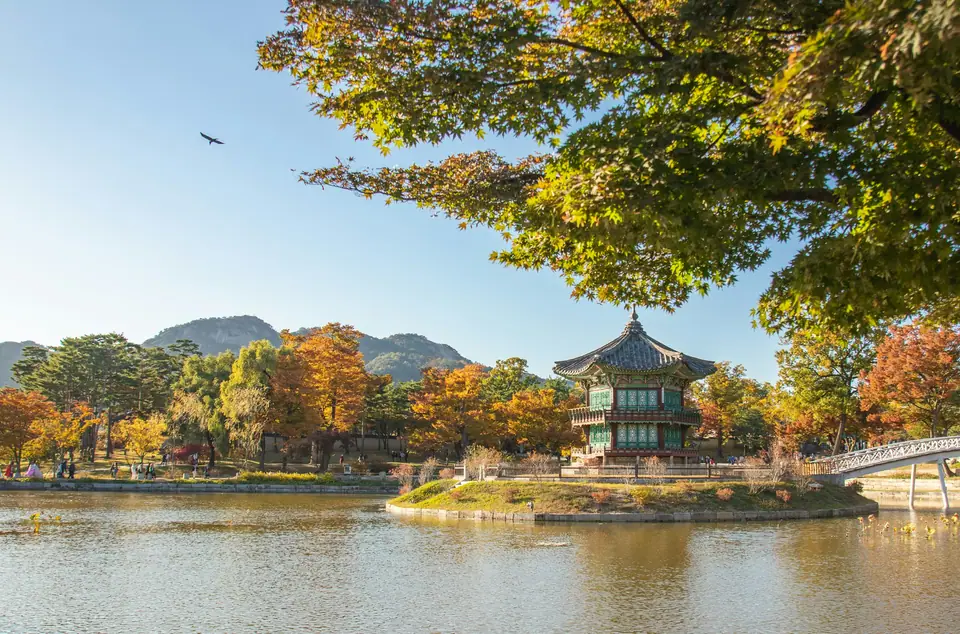
Photo by INHYEOK PARK on Unsplash
Seoul Palaces Guide: Gyeongbokgung, Changdeokgung and Bukchon
The royal palaces of the Joseon kings and the shrine of their ancestors: history, closing days, the hanbok rules and how to pair them with Bukchon.
Short answer: visit Gyeongbokgung on any day except Tuesday, and Changdeokgung on any day except Monday. Walk between them through Bukchon in daytime hours. Add Jongmyo on a Saturday, when you can explore on your own, and add Deoksugung on Sejong-daero if you have time. Free entry in hanbok is possible when your outfit meets the official rules.
The palaces at a glance
- Gyeongbokgung: the main palace, built in 1395. Closed on Tuesdays.
- Changdeokgung: a UNESCO site with the Secret Garden. Closed on Mondays.
- Changgyeonggung: linked to Jongmyo by a stone-wall road. Closed on Mondays.
- Deoksugung: on Sejong-daero, home to Seokjojeon Hall. Closed on Mondays.
- Jongmyo: the royal ancestral shrine, a UNESCO site. Mostly visited on guided tours.
When a closing day falls on a public holiday, the palaces usually open and close on the next working day instead. Check the Korea Heritage Service website for that week before you go.
Gyeongbokgung, the main palace
The Joseon dynasty was founded in 1392, and Gyeongbokgung followed three years later, in 1395. It burned during the Imjin War of 1592 and lay in ruins until it was rebuilt in 1867. In 1915 most of its halls were demolished, and the restoration you see today began in the 1990s.
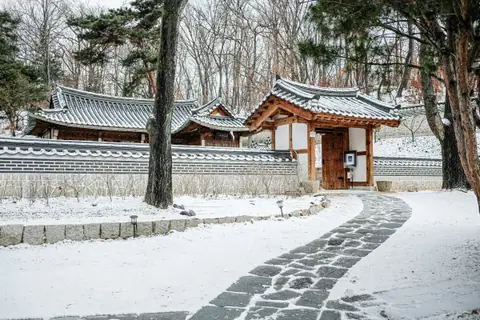
Enter through Gwanghwamun, the main gate, which faces a wide avenue. Inside, Geunjeongjeon is the throne hall, a National Treasure, where kings such as Sejong held their enthronement ceremonies. Look closely at its stone platform, whose carved figures represent the sculpture of the period. Further in, Gyeonghoeru and the pond at Hyangwonjeong both survive in their original form.
Two museums share the grounds. The National Palace Museum of Korea stands outside Heungnyemun gate, on the west side, and the National Folk Museum of Korea sits inside the palace, east of Hyangwonjeong. The royal guard changing ceremony takes place at the palace and around Gwanghwamun. The palace address is 161 Sajik-ro, Jongno-gu.
Changdeokgung and the Secret Garden
King Taejong ordered Changdeokgung built in the early 15th century as a second palace. For 200 years it served as a secondary palace to Gyeongbokgung. After it burned in 1592, King Gwanghaegun restored it in 1611, and it then served as the main seat of the dynasty for 250 years. UNESCO listed it in December 1997. The complex covers 57.9 hectares in Jongno-gu.
The rear garden, known as Huwon or Biwon, the Secret Garden, was laid out under King Taejong as a place of rest for the royal family. It holds more than 56,000 trees and plants, set around ponds and pavilions. It needs a separate ticket from the palace itself, so check the official site for how visits work on your date. Changdeokgung closes on Mondays.
Bukchon between the two palaces
Bukchon Hanok Village fills the hillside between Gyeongbokgung and Changdeokgung, and many visitors walk through it on the way from one palace to the other. It is a residential area, and families live in the hanok. Since 1 March 2025 tourists may enter its red zone, behind Jeongdok Library, during daytime hours and not in the evening or early morning. Anyone who goes in for sightseeing outside those hours can be fined.
The rule was brought in to cut noise and litter. Keep your voice down, do not sit on doorsteps, and photograph the streets rather than people's homes. Our practical briefing covers the other local rules that visitors miss.
Jongmyo Shrine
Jongmyo is where the Joseon dynasty honoured its kings and queens. UNESCO describes it as the oldest and most authentic of the Confucian royal ancestral shrines that survive. Its grounds cover a 19.4-hectare oval site, and the main buildings are Jeongjeon, the main shrine, and Yeongnyeongjeon, the Hall of Eternal Peace. The ancestral rites known as Jongmyo Jerye, with ritual music and dance, are still carried out.
On most days you join a guided tour, offered in four languages, so check when your language runs. Self-guided visits are allowed on Saturdays, on the last Wednesday of the month and on national holidays. A stone-wall road connects Jongmyo with Changgyeonggung.
Changgyeonggung
Changgyeonggung is linked to Jongmyo by a stone-wall road. It was renovated and given its present name during the reign of King Seongjong, who ruled from 1469 to 1494. It is quieter than the main palaces and pairs well with a visit to Jongmyo. It closes on Mondays.
Deoksugung on Sejong-daero
Deoksugung began as the home of Grand Prince Wolsan, who lived from 1454 to 1488. It became a royal palace in 1611 under Gwanghaegun, when it was called Gyeongungung, and it took the name Deoksugung in 1907. Inside, Seokjojeon Hall holds an exhibition with docent tours. The palace stands at 99 Sejong-daero, Jung-gu, and closes on Mondays.
Free entry in hanbok
The Korea Heritage Service lets visitors in hanbok enter the palaces for free, and both traditional and modernised styles are accepted. You need a jeogori top with a separate skirt or trousers, fastened ties and buttons, and legs covered. T-shirt-style hanbok, outfits mixed with jeans or T-shirts, and revealing styles do not qualify, and staff can refuse entry to anyone dressed inappropriately. Our what to wear guide lists the rules in full.
A one-day palace plan
- Start at Gyeongbokgung (not on a Tuesday) and give it the whole morning, including one of the museums.
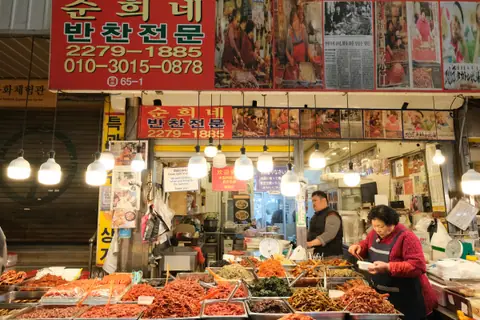
- Have lunch at Tongin Market, west of the palace, where you pay for dishes with brass coins.
- Walk east through Bukchon in daytime hours.
- Spend the afternoon at Changdeokgung (not on a Monday) and the Secret Garden.
- Finish in Insadong, a short walk south, for tea houses and craft shops.
Our three-day route builds this plan into a longer trip, and the street food guide explains the Tongin lunch box system.
How long to allow
Give Gyeongbokgung a full morning, more if you visit a museum. Changdeokgung and the Secret Garden fill most of an afternoon. Jongmyo works well as a shorter visit, especially on a guided tour. If palace grounds tire you, split them across two days and add a market lunch between visits.
Where it is
- 1Seoul Palaces
- Seoul Gimpo International Airport (GMP) · about 17 km from here in a straight line
- Directions in Google Maps
Stations and taxi ranks: OpenStreetMap. Airports: OurAirports. Distances are in a straight line.
Traveller tips
Real advice from people who have been to Seoul. Every tip is read by our team before it goes live.
No tips yet. Been here? Yours could be the first.
Thank you! Your tip will appear here after a quick review.
More in Seoul
Continue exploring Seoul with related neighbourhood, food, and planning guides