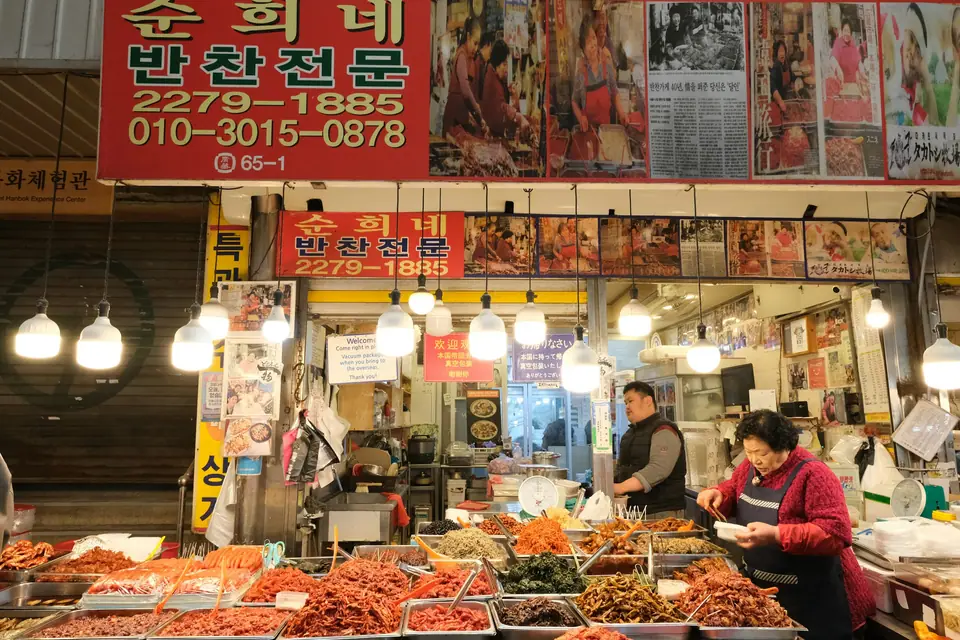
Photo by Luo Jin Hong on Unsplash
Seoul Street Food and Markets Guide
Gwangjang's food alley, Tongin's brass-coin lunch box, Namdaemun's noodle alley and Mangwon Market: what to order, when to go and how each one works.
Short answer: eat at Gwangjang Market for mung bean pancakes and beef tartare, try the brass-coin lunch box at Tongin Market, and sit shoulder to shoulder for noodle soup in Namdaemun's Kalguksu Alley. For an evening snack, head to the street stalls of Myeongdong or to Mangwon Market before a picnic by the Han River.
Gwangjang Market
Gwangjang Market opened in the early 20th century and is one of the large traditional markets of Korea. It sells clothing and food, with hanbok and vintage clothing shops on the 2nd floor and silk goods, linen and handmade items in the stalls below. The part most visitors come for is the food alley, where stalls serve dishes ready to eat.
Use exit 8 of Jongno 5-ga Station on Line 1, which opens almost beside the market. The food alley opens every day of the year, but the rest of the market closes on Sundays.
What to order at Gwangjang
- Bindae-tteok: a thick mung bean pancake fried until crisp at the edges.
- Modum-jeon: a plate of assorted savoury pancakes.
- Mayak gimbap: small rice rolls wrapped in seaweed, easy to share.
- Sundae and head meat: Korean sausage with sliced pork.
- Yukhoe: Korean beef tartare, served raw.
- Tteokbokki and eomuk: rice cakes in a spicy sauce and fish cakes in broth.
Go with a friend or two so you can order several plates and share them. If you want somewhere less crowded, come between meal times rather than at lunch or on a weekend afternoon.
Tongin Market's lunch box
Tongin Market, west of Gyeongbokgung, dates back to June 1941 and now has 75 stores, mostly restaurants and grocers. It is known for its Dosirak Cafe, which turns lunch into a game. Walk up the steps to the cafe and buy a handful of yeopjeon, brass coins, which come with a disposable lunch box.
Then walk through the market and trade coins for food at the stalls that take part. Choices include oil tteokbokki, tteokgalbi (grilled short rib patties), gimbap and dakgangjeong (sweet fried chicken). Take your box back upstairs, where the cafe has microwaves, cutlery and rice. Use exit 2 of Gyeongbokgung Station on Line 3. The Dosirak Cafe closes on Mondays.
Namdaemun's Kalguksu Alley
Kalguksu Alley in Namdaemun Market specialises in noodle soup and steamed barley rice. Most orders come as sets of two or three dishes, such as noodle soup, rice and cold buckwheat noodles, with kimchi on the side. You sit at the stalls shoulder to shoulder with other diners, and waits are common at meal times and on weekends.
The entrance is easy to miss. It is a small, clear plastic door beside an eyeglasses shop, directly across from exit 5 of Hoehyeon Station on Line 4. Look for it before you give up and assume you have the wrong street.
Mangwon Market and the river
Mangwon Market in Mapo-gu is a neighbourhood food market popular with people in their twenties and thirties. Stalls sell chicken gangjeong in spicy and fruit versions, croquettes and doughnuts, tteokgalbi and traditional alcohol. It sits near exit 2 of Mangwon Station on Line 6.
The best part comes after shopping. Mangwon Hangang Park is close by, so buy a few snacks and eat them by the Han River. Combine it with an evening in Hongdae, as our things to do list suggests.
Myeongdong in the evening
Myeongdong is Seoul's shopping hub, with cosmetics stores, fashion outlets and street stalls along its main lanes. Street stalls sit among the shops, so you can snack as you browse. Use exits 5 to 10 of Myeongdong Station on Line 4.
Ordering without Korean
- Point at what you want on the counter.
- Keep some cash for market stalls, together with a card for larger restaurants.
- Use a translation feature on your phone to read menus, or call the 1330 Korea Travel Helpline, which answers in English and other languages.
- Ask before you sit. At busy counters, seats are often shared, and someone may be waiting.
Eating well and safely
Choose busy stalls that are cooking fresh batches. Yukhoe is raw beef, so skip it if you avoid raw meat. If you have an allergy, write it down in Korean before you travel and show it at each stall.
Leave your stool when you finish. Stalls at Gwangjang and Namdaemun depend on quick turnover, especially at mealtimes, and the next diner will be grateful.
A simple food day
- Lunch at Tongin Market with brass coins, after a morning at Gyeongbokgung.
- An afternoon walk along Cheonggyecheon towards Jongno 5-ga.
- An early dinner of pancakes and gimbap at Gwangjang Market.
- A snack in Myeongdong before heading up Namsan for the view.
The three-day route fits these stops into a full trip, and our neighbourhood guide shows which bases sit closest to the markets.
Match the market to your sightseeing
- After Gyeongbokgung: Tongin Market, near exit 2 of Gyeongbokgung Station.
- After Jongmyo or Cheonggyecheon: Gwangjang Market at Jongno 5-ga.
- Before Namsan: Namdaemun's Kalguksu Alley at Hoehyeon, or the stalls in Myeongdong.
- Before Hongdae: Mangwon Market and the park by the river.
- In Insadong: the street vendors who sell traditional snacks between the craft shops.
Opening days to check
Gwangjang's food alley opens every day, but the rest of the market closes on Sundays. Tongin's Dosirak Cafe closes on Mondays, and opening days for the other Tongin stores vary by shop. In Kalguksu Alley, too, each stall sets its own days. If a particular dish matters to you, plan a second chance later in the trip, and arrive outside the lunch rush, when waits are shorter.
A little market history
Tongin Market was set up in June 1941, during Japanese rule, as a public market for Japanese residents near Hyoja-dong. Today it serves a neighbourhood west of the palace, and its stores are mostly small restaurants and grocers. Gwangjang, older still, dates from the early 20th century. Both are working markets as much as visitor sights, so expect local shoppers and keep the aisles clear while you eat.
Where it is
- 1Seoul
- Seoul Gimpo International Airport (GMP) · about 17 km from Seoul in a straight line
- Directions in Google Maps
Stations and taxi ranks: OpenStreetMap. Airports: OurAirports. Distances are in a straight line.
Traveller tips
Real advice from people who have been to Seoul. Every tip is read by our team before it goes live.
No tips yet. Been here? Yours could be the first.
Thank you! Your tip will appear here after a quick review.
More in Seoul
Continue exploring Seoul with related neighbourhood, food, and planning guides