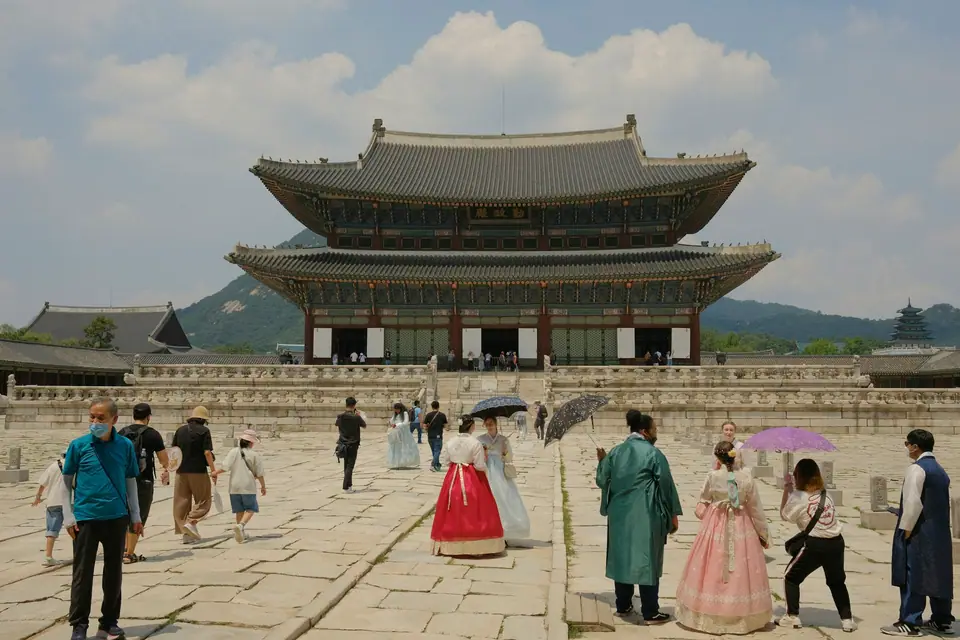
Photo by Daesun Kim on Unsplash
Best Things to Do in Seoul
Palaces, shrines, markets, a tower on a mountain and the modern districts: the sights that shape a Seoul trip, with the closing days to watch.
Short answer: start with Gyeongbokgung and Changdeokgung, walk through Bukchon in daytime, eat at Gwangjang Market and ride up to N Seoul Tower. Then give a day to a modern district such as Hongdae, Seongsu or Gangnam. Check closing days before you set out, because the palaces close on different weekdays.
Gyeongbokgung, the main palace
Gyeongbokgung was built in 1395, three years after the Joseon dynasty was founded. It burned during the Imjin War in 1592 and was rebuilt in 1867. Most of its halls were torn down in 1915, and restoration began in the 1990s. You enter through Gwanghwamun, the main gate, and walk north to Geunjeongjeon, the throne hall where kings such as Sejong held their enthronement ceremonies.
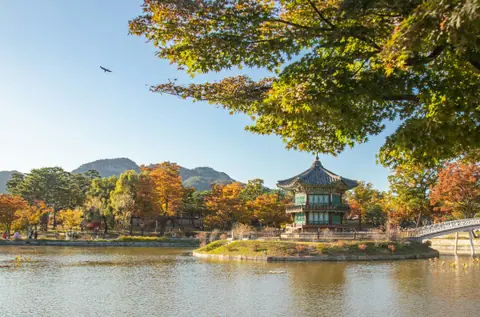
Further in, Gyeonghoeru and the pond at Hyangwonjeong both survive in their original form. The National Palace Museum of Korea stands just west of Heungnyemun gate, and the National Folk Museum of Korea sits inside the palace, east of Hyangwonjeong. Gyeongbokgung closes on Tuesdays. The royal guard changing ceremony takes place at the palace and around Gwanghwamun.
Changdeokgung and the Secret Garden
King Taejong ordered Changdeokgung built in the early 15th century as a second palace. After the fire of 1592 it was restored in 1611 and served as the main seat of the dynasty for 250 years. UNESCO listed the complex in 1997. Behind the halls lies Huwon, also called the Secret Garden, which holds more than 56,000 trees and plants and is entered on a separate ticket. The palace closes on Mondays.
Our palaces guide explains how to combine both palaces with Bukchon in one day.
Jongmyo Shrine
Jongmyo honours the kings and queens of the Joseon dynasty. UNESCO calls it the oldest and most authentic of the Confucian royal ancestral shrines that survive, and the Jongmyo Jerye rites, with ritual music and dance, are still carried out there. Most visits are guided tours, offered in four languages. You can walk around on your own on Saturdays, the last Wednesday of the month and national holidays.
Bukchon and Insadong
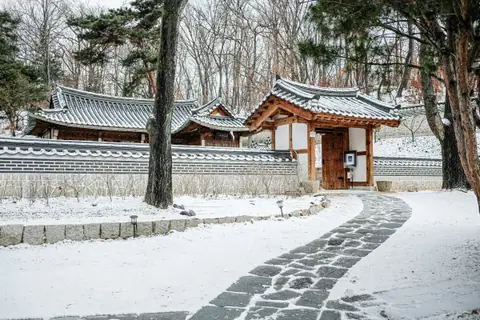
Bukchon's lanes of hanok houses sit between the two main palaces. People live there, and since March 2025 tourists may visit the red zone in daytime hours and face a fine outside them. A short walk south, Insadong sells antique furniture, paintings, folk art and crafts, with wooden tea houses and small galleries along the way. Ssamzie-gil, a crafts complex that opened in 2004, is a convenient stop, and Jogyesa, the head temple of the Jogye Order of Korean Buddhism, is close by.
Cheonggyecheon Stream
Cheonggyecheon runs for 11 km through downtown Seoul. For decades an elevated highway covered it, and in 2003 that road was removed to bring the stream back. The walk starts at Cheonggye Plaza and follows the water under 22 bridges towards the Han River. It makes a calm link between the palace district and the markets, and the Cheonggyecheon Museum tells the story with old photographs and a scale model.
Gwangjang and the other markets
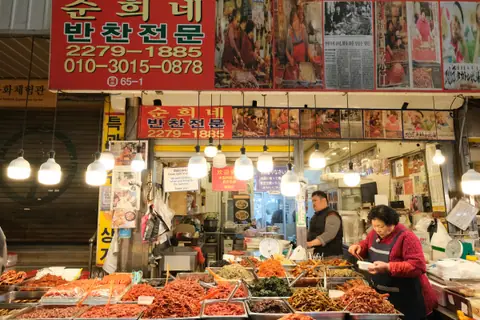
Gwangjang Market opened in the early 20th century and is one of the large traditional markets of Korea. Its food alley serves mung bean pancakes, small mayak gimbap rolls, sundae sausage and yukhoe, a beef tartare. The food alley opens every day, but the rest of the market closes on Sundays. Tongin Market, near Gyeongbokgung, runs a lunch box system paid with brass coins. Our street food guide covers both, plus Namdaemun and Mangwon.
N Seoul Tower and Namsan
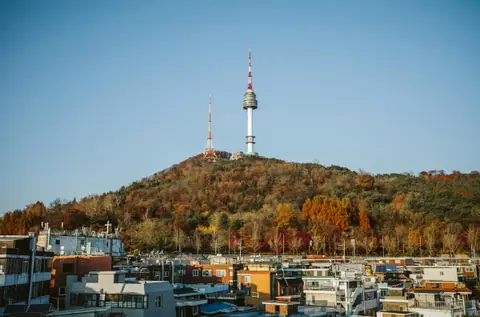
N Seoul Tower stands 236.7 metres tall on the summit of Namsan, a hill of 262 metres in the middle of the city. Its observation decks sit about 480 metres above sea level and look out over the city. The tower was built in 1969 and opened to the public in 1980. Couples leave padlocks on the Locks of Love terrace. Get up by the Namsan cable car, by the Namsan circular bus 01 from Chungmuro Station, or on foot through the park.
Myeongdong for shopping
Myeongdong is the city's shopping hub, packed with Korean cosmetics stores, fashion outlets and street stalls. Use Myeongdong Station on Line 4, where exits 5 to 10 open onto the main streets.
Hongdae and Mangwon
Hongdae, around Hongik University Street in Mapo-gu, is the place for street music. Buskers and dance crews perform on the pavements, and a club street fills up at night. Nearby Mangwon Market is popular with people in their twenties and thirties for fried chicken, croquettes and tteokgalbi, and Mangwon Hangang Park is a short walk away for a riverside picnic.
Seongsu and Seoul Forest
Seongsu-dong was an industrial district. When the factories closed, their buildings became cafes, shops, workshops and culture spaces, and the area now fills with pop-up stores. Its handmade-shoe street once produced 80% of the handmade shoes in Korea. Seoul Forest, a large park on a former royal hunting ground, lies at the edge of the district.
Gangnam: Bongeunsa and COEX
South of the river, Bongeunsa is a Buddhist temple founded in 794, during the Silla period. It runs a templestay programme that includes the dawn service and Zen meditation. Nearby, Starfield Library fills the centre of COEX Mall with books and close to 600 magazines, and entry is free. Use Bongeunsa Station on Line 9 or Samseong Station on Line 2.
Bukhansan National Park
Bukhansan became a national park in 1983 and rises to Baegundae, a peak of 836.5 metres with views across Seoul. The terrain is rugged, but there are easier trails for casual walkers. Our day trips guide covers the hike, the DMZ and Suwon.
Changgyeonggung and Deoksugung
Two smaller palaces round out the set. Changgyeonggung was renovated and renamed under King Seongjong, who ruled from 1469 to 1494, and a stone-wall road links it with Jongmyo. Deoksugung began as the home of Grand Prince Wolsan, became a palace in 1611 and took its present name in 1907. Its Seokjojeon Hall holds an exhibition with docent tours. Both close on Mondays.
Plan around the closing days
Gyeongbokgung closes on Tuesdays, and Changdeokgung, Changgyeonggung and Deoksugung close on Mondays. Gwangjang Market's general stalls close on Sundays, while its food alley opens daily, and Tongin's Dosirak Cafe closes on Mondays. Put the palaces on the right days and the rest of the list falls into place. Our three-day route is already arranged that way.
Where it is
- 1Seoul
- Seoul Gimpo International Airport (GMP) · about 17 km from Seoul in a straight line
- Directions in Google Maps
Stations and taxi ranks: OpenStreetMap. Airports: OurAirports. Distances are in a straight line.
Traveller tips
Real advice from people who have been to Seoul. Every tip is read by our team before it goes live.
No tips yet. Been here? Yours could be the first.
Thank you! Your tip will appear here after a quick review.
More in Seoul
Continue exploring Seoul with related neighbourhood, food, and planning guides