The Grand Canal, Rialto Market and Dorsoduro Walking Guide
Grand Canal palace architecture, the morning Rialto Market, San Polo's great churches and Dorsoduro's galleries.
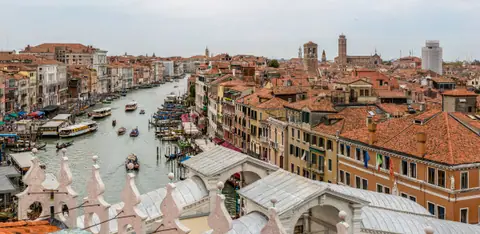
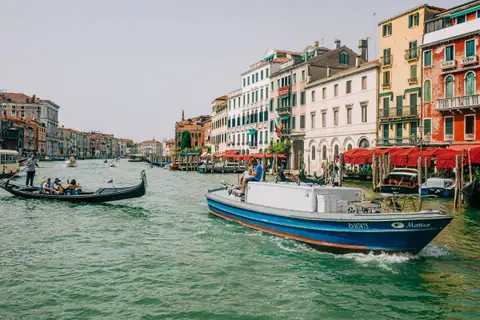
Cutting a reverse S-curve for 3.8 kilometres from the railway station basin to St Mark's Basin, the Grand Canal (Canal Grande, kah-NAHL GRAHN-deh) varies between 30 and 90 metres in width. Its deep channel follows the submerged ancient bed of a prehistoric Brenta River branch. For eight centuries, Venice's patrician merchant families treated this waterway as their ceremonial avenue. Each noble house built its combination warehouse and residence (called Ca', short for Casa; only the Doge's residence was officially a Palazzo under the Republic) with the main facade facing the water. Pairing a boat ride down the canal with a walk from the Rialto Market through San Polo (postcode 30125) and Dorsoduro (30123) covers the artistic spine of Venice in a single sweep.
Reading the palaces from ACTV Vaporetto Line 1
Board ACTV Vaporetto Line 1 at Ferrovia or Piazzale Roma using your multi-day pass from our transport guide. Only four bridges cross the entire channel. Santiago Calatrava's glass-and-steel Ponte della Costituzione opened in 2008 at Piazzale Roma, while the stone Ponte degli Scalzi (1934) stands outside Santa Lucia station. Further down sit the sixteenth-century Ponte di Rialto at the central bend and the timber-and-iron Ponte dell'Accademia in the south. Between them, more than 170 facades illustrate four distinct eras of Venetian architecture:
- Veneto-Byzantine (12th to 13th centuries). low waterside storage porticos supporting elongated stilted arches, seen at the Ca' da Mosto and the Fondaco dei Turchi (now the Natural History Museum in Santa Croce).
- Venetian Floral Gothic (14th to mid-15th centuries). pointed ogee arches and quatrefoil marble tracery carved like stone lace to keep facades light on soft lagoon clay. The style reached its peak at the Ca' d'Oro (completed in 1430 for the Contarini family and now housing the Galleria Giorgio Franchetti in Cannaregio) and the Ca' Foscari on the widest bend of the canal.
- Renaissance (late 15th to 16th centuries). classical Roman columns, round arches and symmetrical white Istrian stone rustication brought by Mauro Codussi, Jacopo Sansovino and Michele Sanmicheli. Fine examples include Ca' Vendramin Calergi (where Richard Wagner died in 1883) and Palazzo Grimani.
- Venetian Baroque (17th to early 18th centuries). deeply sculpted keystones, giant columns and theatrical ballrooms designed by Baldassare Longhena at Ca' Pesaro (now the International Gallery of Modern Art). Downstream in Dorsoduro stands Longhena's Ca' Rezzonico, now the Museum of Eighteenth-Century Venice decorated with ceiling frescoes by Giambattista Tiepolo.
Rialto Bridge and the Morning Markets (Erberia & Pescheria)
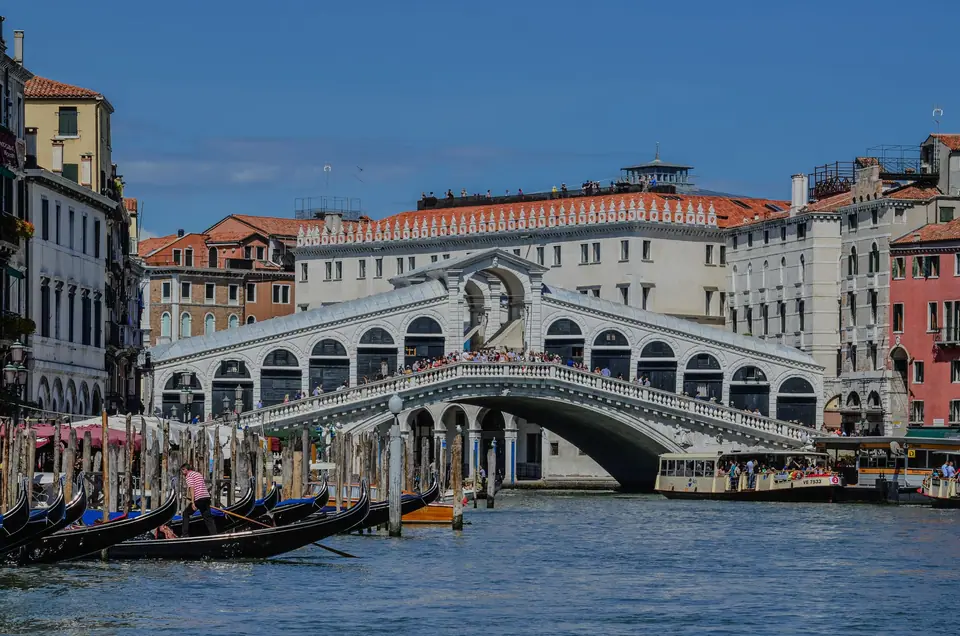
Settled on high ground (Rivo Alto) in the ninth century, the Rialto bend was the financial and commercial exchange of medieval Europe. After earlier timber drawbridges burned or collapsed, the Senate selected Antonio da Ponte over Michelangelo and Palladio to build a stone replacement. Completed between 1588 and 1591, the single-arch Ponte di Rialto spans 28 metres on 12,000 elm piles driven into each bank. Three pedestrian staircases climb the bridge, separated by two rows of 24 vaulted shops.
Cross the bridge from the San Marco side onto the San Polo bank before 08:30 on any morning from Tuesday to Saturday (the fish market closes on Sundays and Mondays):
- Mercato di Rialto (Morning Produce & Fish Stalls) / Afternoon Rialto Bridge Souvenir Corridor. arriving at the San Polo market square between 07:30 and 10:30 lets you watch cargo barges unload crates of Sant'Erasmo purple artichokes at the Erberia. Next door under the carved capitals of the Pescheria, fishmongers skin Adriatic rays, monkfish, razor clams (cappelletti) and mantis shrimp (canoce). Arriving after 12:30 finds the fish slabs scrubbed empty and the surrounding lanes packed with midday excursion crowds.
Before walking south, duck behind the market stalls to eleventh-century San Giacomo di Rialto (San Giacometto), traditionally Venice's oldest church. Stop at a historic standing wine bar (bacaro) such as Cantina Do Mori or All'Arco for a mid-morning cicchetto. Across the water on the San Marco bank stands the 1508 Fondaco dei Tedeschi, the former German merchants' exchange.
San Polo: the Basilica dei Frari and Scuola Grande di San Rocco
From the Rialto Market, follow the twisting lanes southwest across spacious Campo San Polo toward the monumental brick campanile of the Basilica di Santa Maria Gloriosa dei Frari (consecrated in the fourteenth and fifteenth centuries). Step inside to see the original carved wooden fifteenth-century choir screen still in place. It frames Titian's Assumption of the Virgin (Assunta, 1518) blazing in crimson above the high altar. In the right aisle rises the white marble pyramid tomb designed by Antonio Canova (holding the sculptor's heart), opposite the nineteenth-century monument to Titian, who died in the 1576 plague. In the left aisle hangs Titian's revolutionary Pesaro Madonna (1526), and in the sacristy glows Giovanni Bellini's 1488 Frari Triptych in its original gilded frame.
Walk directly behind the Frari's apse into the square of the Scuola Grande di San Rocco, one of Venice's six major lay charitable confraternities founded to care for plague victims. Starting in 1564, Jacopo Tintoretto spent 23 years painting more than fifty sweeping canvases across its three halls. Begin upstairs in the Sala dell'Albergo before his 12-metre Crucifixion (1565). Use one of the hand-held mirrors provided in the Sala Maggiore to study the dramatic Old Testament ceiling panels without craning your neck.
Dorsoduro: Santa Margherita, Accademia, Guggenheim and the Zattere
Five minutes south of San Rocco, cross into the university and art district of Dorsoduro (postcode 30123). Pause for coffee or lunch on lively Campo Santa Margherita. Two blocks south, peek at the wooden workshops of the Squero di San Trovaso, one of the last seventeenth-century boatyards still building and repairing gondolas by hand. Continue to the wooden Ponte dell'Accademia for the classic view east toward the twin domes of Santa Maria della Salute (begun by Baldassare Longhena in 1631 after the 1630 plague). Spend your afternoon choosing between five centuries of Venetian painting at the Gallerie dell'Accademia and modern surrealism at the Peggy Guggenheim Collection. Finish by strolling the south-facing stone quay of the Zattere (TSAH-teh-reh) along the wide Giudecca Canal with a hazelnut-chocolate gianduiotto ice cream before an evening crawl in Cannaregio.
Where it is
- 1The Grand Canal, Rialto Market and Dorsoduro Walking
- Venice Marco Polo Airport (VCE) · about 8 km from here in a straight line
- Directions in Google Maps
Stations and taxi ranks: OpenStreetMap. Airports: OurAirports. Distances are in a straight line.
Traveller tips
Real advice from people who have been to Venice. Every tip is read by our team before it goes live.
No tips yet. Been here? Yours could be the first.
Thank you! Your tip will appear here after a quick review.
More in Venice
Continue exploring Venice with related neighbourhood, food, and planning guides