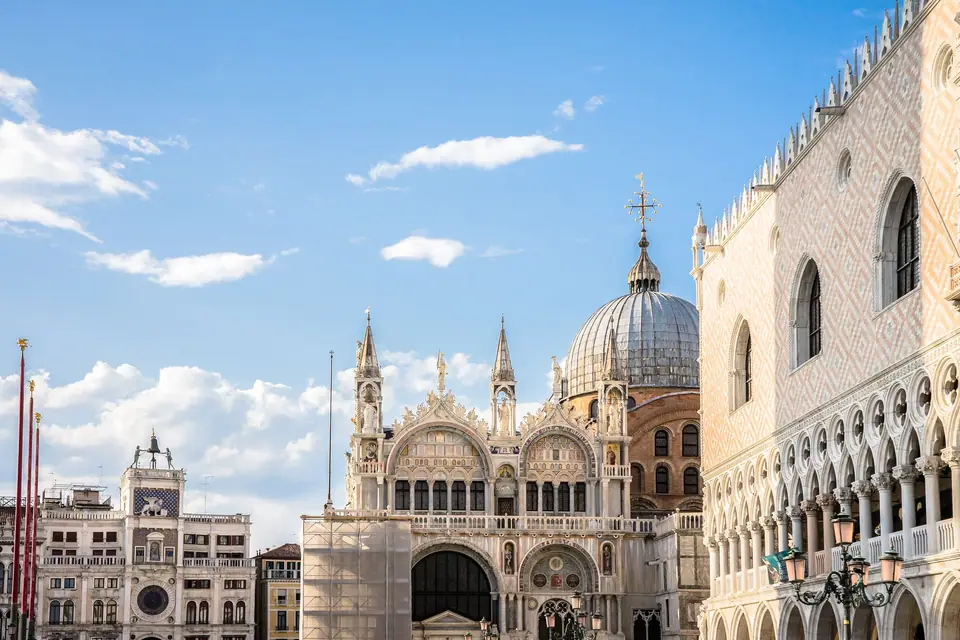
St Mark's Square, the Basilica and the Doge's Palace Guide
Byzantine mosaics, the Doge's Palace council halls, the Bridge of Sighs and how to beat the San Marco queues.
For a thousand years, the monumental civic and religious heart of the Venetian Republic has been Piazza San Marco (PYAHT-sah sahn MAHR-koh, postcode 30124). Beside it opens the waterside threshold of the Piazzetta San Marco, where visiting ambassadors stepped ashore between two twelfth-century granite columns brought from the Levant. Those columns are crowned by the bronze Winged Lion of St Mark and St Theodore, the city's earlier Byzantine patron. Visit this complex twice. Walk through first between 07:30 and 09:00 before day-tripper boats arrive, and return after 21:00 when string orchestras play under the illuminated marble arcades of the Procuratie Vecchie and Procuratie Nuove.
Orientation around Piazza San Marco
Framed on three sides by Renaissance and Napoleonic colonnades, the Piazza opens at its eastern end onto St Mark's Basilica and the Doge's Palace. On the north side rises the Torre dell'Orologio (St Mark's Clock Tower, built between 1496 and 1499). At its summit, two bronze figures known as the Mori (Moors) strike the hours on a rooftop bell above a blue-and-gold astronomical dial. Guided tours climb its internal stairs by advance reservation at orologio.visitmuve.it. Under the arcades sit two of Europe's oldest coffee houses: Caffè Florian (opened in 1720 under the Procuratie Nuove) and Gran Caffè Quadri (opened in 1775 opposite). Ordering an espresso standing at the interior bar costs standard Venetian counter rates. Sitting at an outdoor table while the live orchestra plays carries a table-and-music supplement printed on the menu.
St Mark's Basilica (Basilica di San Marco)
In 828 CE, two Venetian merchants smuggled the body of St Mark the Evangelist out of Alexandria hidden beneath layers of pork in a basket. That bold theft gave Venice an apostolic relic to rival Rome's St Peter. The current third basilica on the site was consecrated in 1094 on a Greek-cross plan with five domes modelled on the Church of the Apostles in Constantinople. After the Fourth Crusade of 1204, Venetian galleys returned from Constantinople loaded with carved marble capitals and porphyry reliefs. On the exterior south-west corner stand the four embracing porphyry Roman emperors known as the Tetrarchs. Those liturgical treasures turned the facade into a trophy chest of Mediterranean empire.
Reserve a timed skip-the-line entry slot ahead on the official website (basilicasanmarco.it). Remember the strict ban on backpacks detailed in our packing and dress guide, and add the two interior tickets that transform the visit:
- Ground-Floor Nave and the Pala d'Oro / Upstairs St Mark's Museum and Loggia dei Cavalli. the ground-floor route leads across undulating twelfth-century geometric marble carpets (opus sectile). Overhead shimmer 8,000 square metres of gold-leaf glass mosaics leading to the high altar, where St Mark's sarcophagus rests. Behind the altar gleams the Pala d'Oro, a Byzantine gold-and-cloisonné-enamel screen studded with 1,927 precious gems including pearls, sapphires, emeralds and rubies. The ticketed upstairs staircase inside the narthex climbs to the Museum of St Mark, bringing you within arm's reach of the twelfth-century dome mosaics. Upstairs you see the original gilded-copper classical Horses of St Mark (Cavalli di San Marco, moved indoors for conservation while replicas stand outside). You then step onto the open Loggia dei Cavalli balcony overlooking Piazza San Marco and the lagoon.
The Doge's Palace (Palazzo Ducale) and Bridge of Sighs
Adjoining the basilica on the south, the Doge's Palace (palazzoducale.visitmuve.it) was the political nerve centre of La Serenissima. Unlike mainland castles fortified with thick ground-floor stone walls, the palace reverses architectural weight. Two airy Gothic arcades of white Istrian stone support a massive upper wall faced in diagonal pink Verona marble and white limestone. Enter through the Porta del Frumento on the waterfront and cross the Renaissance courtyard. At the far end rises the Scala dei Giganti, where Doges were crowned between Sansovino's marble statues of Mars and Neptune. From the upper loggia, ascend the stuccoed Scala d'Oro (Golden Staircase).
The upper floors trace the republic's constitutional machinery through the Doge's private apartments into the state council halls. In the Sala del Collegio and Sala del Senato, ceiling canvases by Paolo Veronese and Tintoretto celebrate Venetian naval dominion. Next opens the vast, pillarless Sala del Maggior Consiglio (Hall of the Great Council, 53 metres long by 25 metres wide), where up to 2,000 noblemen voted. Covering the entire eastern wall above the Doge's throne hangs Jacopo Tintoretto's Il Paradiso (painted after the 1577 fire and measuring 22 by 7 metres). Around the upper frieze run portraits of the first 76 Doges. One frame is covered by a painted black veil over Marino Faliero, beheaded for treason in 1355.
Pass the carved wooden letterboxes (bocche di leone) for anonymous denunciations outside the courtroom of the Council of Ten and explore the four-room Armoury. The route then crosses the enclosed limestone Bridge of Sighs (Ponte dei Sospiri, POHN-teh day soh-SPEE-ree) over the Rio di Palazzo into the sixteenth-century New Prisons (Prigioni Nuove). Standard admission is sold via the combined St Mark's Square Museums Pass. That ticket includes the Museo Correr, the National Archaeological Museum and Sansovino's Biblioteca Nazionale Marciana across the square. To visit the attic torture chamber and the lead-roofed cells (I Piombi) from which Giacomo Casanova escaped in 1756, book the guided Secret Itineraries Tour (Itinerari Segreti) several weeks ahead.
Campanile di San Marco vs San Giorgio Maggiore
Rising 98.6 metres at the corner of the Piazza, the brick Campanile di San Marco (rebuilt in 1912 after collapsing in 1902) has a lift to its five-bell belfry. If the queue is long, walk two minutes east along Riva degli Schiavoni to the San Zaccaria pier. Board ACTV Vaporetto Line 2 for one stop across the basin to the island of San Giorgio Maggiore. Ride the quiet lift up Palladio's bell tower so both the Doge's Palace and St Mark's Campanile sit at the centre of your view, as timed in our 3-day itinerary.
Where it is
- 1St Mark's Square, the Basilica and the Doge's Palace
- Venice Marco Polo Airport (VCE) · about 8 km from here in a straight line
- Directions in Google Maps
Stations and taxi ranks: OpenStreetMap. Airports: OurAirports. Distances are in a straight line.
Traveller tips
Real advice from people who have been to Venice. Every tip is read by our team before it goes live.
No tips yet. Been here? Yours could be the first.
Thank you! Your tip will appear here after a quick review.
More in Venice
Continue exploring Venice with related neighbourhood, food, and planning guides