Venice: Practical Rules Before You Go
Lagoon access rules, ACTV waterbus passes, stepped bridge etiquette and how Venice's district numbering works.
Short answer. sleep at least two or three nights on the historic islands rather than visiting only at midday. Pack a compact bag you can lift over stepped stone bridges. Buy a multi-day ACTV waterbus pass, and follow painted yellow wall signs rather than phone GPS.
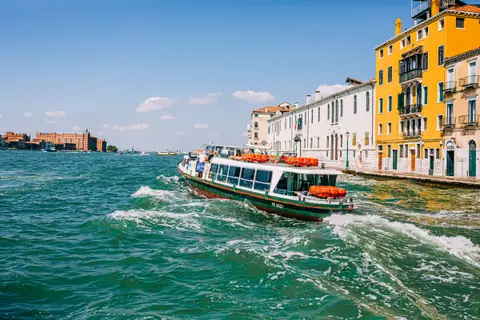
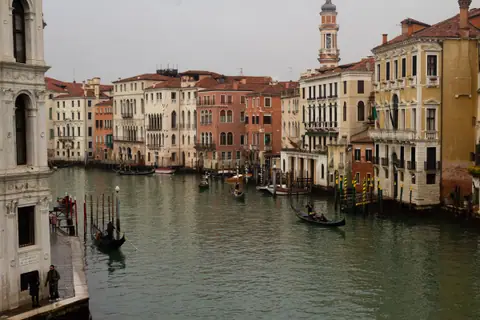
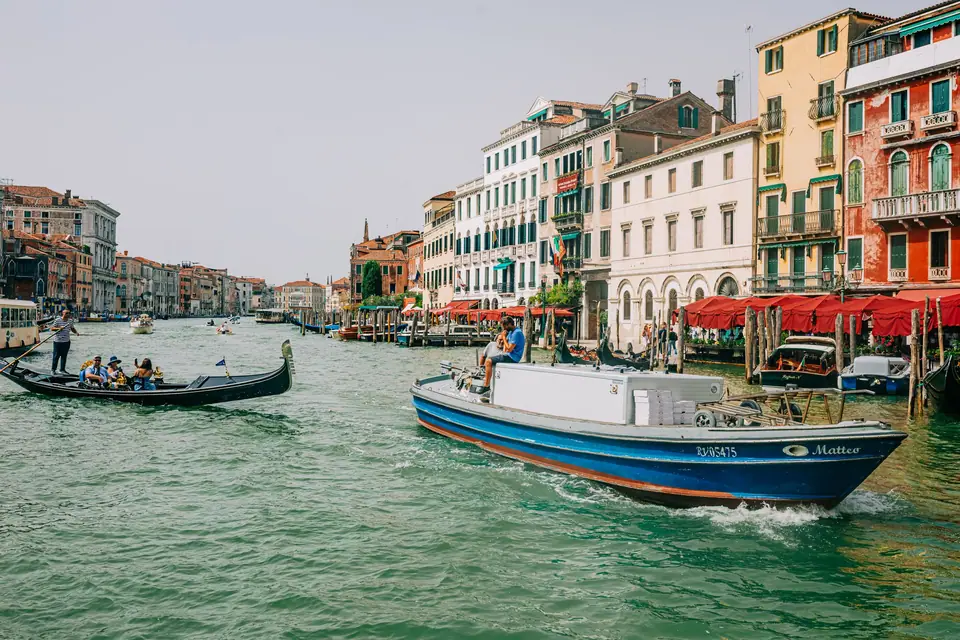
Venice is the only major European city where every single movement happens by boat or handcart. Municipal rubbish boats, yellow water ambulances and cargo barges replace vans and lorries on the canals. Built across 118 islands linked by more than 400 footbridges inside the Venetian Lagoon, the historic centre (Centro Storico) spans roughly four kilometres from west to east. Once you understand its six historic districts, its waterbus piers and a handful of civic laws, walking the city becomes straightforward.
The Venice Access Fee (Contributo di Accesso)
On designated peak dates between April and July, the Municipality of Venice enforces a daytime registration scheme called the Contributo di Accesso (kohn-tree-BOO-toh dee ahk-CHES-soh). It applies primarily on Fridays, Saturdays, Sundays and Italian public holidays for visitors entering the Old City between morning and mid-afternoon. Check the official municipal calendar at cda.ve.it via veneziaunica.it before you travel.
- Day-tripper Access Payment / Overnight Hotel Guest Exemption. visitors arriving only for the day without an overnight booking pay the access fee online to receive a QR code. Travellers staying at least one night inside the Municipality of Venice are exempt because they pay the nightly municipal tourist tax. That exemption covers hotels and registered flats on the historic islands, the Lido, Murano, Burano and mainland Mestre. Overnight guests still register their hotel dates on the official portal to download a free exemption QR code for stewards at Santa Lucia station and Piazzale Roma.
How Venice's six sestieri and house numbers work
Venice does not assign house numbers along individual streets. Instead, the historic city is divided into six administrative quarters called sestieri (ses-TYEH-ree), each tied to a specific Italian postal code (CAP). These are Cannaregio (30121), Castello (30122), Dorsoduro including Giudecca (30123), San Marco (30124), San Polo (30125) and Santa Croce (30135). The outer northern islands of Murano, Burano and Torcello use postcodes 30141 and 30142.
Within each sestiere, a single continuous numbering sequence spirals across the entire district from 1 up to several thousand. In Castello, the numbers approach 7,000 before ending near the hospital of Santi Giovanni e Paolo. An address such as San Marco 3144 or Castello 4210 tells a resident postman the exact doorway. For a visitor, however, that number means little without the name of the nearest square or waterbus pier. Before arriving, write down your hotel's nearest ACTV vaporetto stop, the adjacent square name, and how many bridges sit between the pier and the door. We compare all six quarters in our where to stay in Venice guide.
Local vocabulary and yellow wayfinding signs
Across the islands, only two thoroughfares bear the standard Italian title via or strada (Strada Nova in Cannaregio and Via Garibaldi in Castello). Only Piazza San Marco and Piazzale Roma use the word piazza. Every other street, square and quay uses traditional Venetian terms painted onto white plaster wall plaques called nizioleti (neet-syoh-LEH-tee):
- Campo (KAHM-poh) / Campiello (kahm-PYEL-loh). a campo is an open paved square anchored by a parish church and a carved stone rainwater wellhead (vera da pozzo). A campiello is a smaller residential courtyard surrounded by houses.
- Calle (KAHL-leh) / Ruga (ROO-gah) and Salizada (sah-leet-SAH-dah). a calle is a narrow pedestrian lane running between brick walls. A ruga is a commercial lane lined with shops, while a salizada marks the first main parish street paved with stone bricks in the thirteenth or fourteenth century.
- Fondamenta (fohn-dah-MEN-tah) / Riva (REE-vah). a fondamenta is a paved walkway running directly beside a canal. A riva is a wider, stepped embankment built for mooring cargo barges and passenger ferries.
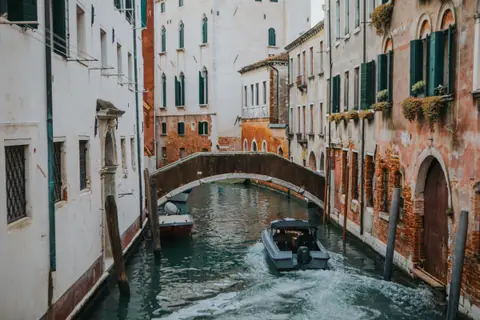
- Rio (REE-oh) / Rio Terà (REE-oh teh-RAH). a rio is a narrow interior side canal used by gondolas and delivery boats. A rio terà is a former canal that was filled in with earth and paved over during the eighteenth or nineteenth century.
- Sotoportego (soh-toh-POR-teh-goh) / Ramo (RAH-moh). a sotoportego is a low, tunnel-like passageway cut directly beneath an upper-floor building. A ramo is a short side branch off a main lane.
Tall masonry walls bounce satellite signals inside narrow alleys, causing phone maps to jump across canals. Instead of staring at a screen, look up at building corners for painted yellow directional signs with black arrows. These signs point reliably along the main pedestrian routes toward Per Rialto, Per San Marco, Per Ferrovia (Santa Lucia station) and Per Piazzale Roma.
Anti-nuisance laws, bridge etiquette and drinking water
To keep narrow walkways moving, municipal stewards enforce strict civic decency laws backed by on-the-spot fines. Never sit or picnic on the steps of bridges, church thresholds, stone wellheads or the marble arcades of Piazza San Marco. Use the shaded park benches inside the Royal Gardens (Giardini Reali) behind San Marco, the Papadopoli Gardens near Piazzale Roma, or the pine groves of Sant'Elena instead. Walking bare-chested or in swimwear, swimming or dangling your feet in canals, feeding pigeons and wheeling bicycles or scooters are all strictly prohibited. When crossing stepped bridges, walk on the right and avoid stopping on the narrow crest for photographs when residents are climbing behind you.
Carry a reusable water bottle throughout the day. More than 120 green cast-iron public fountains (fontanelle) stand in squares across every parish, flowing continuously with cold, clean drinking water piped from mainland Alpine springs. Public toilets operated by Veritas sit near major hubs including Piazzale Roma, Rialto, San Marco and the Accademia Bridge. You can also use a café bathroom after ordering a morning espresso at a neighbourhood bar. Afterwards, continue along the Grand Canal or board a waterbus with our transport guide.
Where it is
- 1Venice
- Venice Marco Polo Airport (VCE) · about 8 km from Venice in a straight line
- Directions in Google Maps
Stations and taxi ranks: OpenStreetMap. Airports: OurAirports. Distances are in a straight line.
Traveller tips
Real advice from people who have been to Venice. Every tip is read by our team before it goes live.
No tips yet. Been here? Yours could be the first.
Thank you! Your tip will appear here after a quick review.
More in Venice
Continue exploring Venice with related neighbourhood, food, and planning guides