National Mall & Tidal Basin Walk: Washington Monument, WWII, Lincoln, Vietnam, MLK & Jefferson Memorials
An 8-stop east-to-west route from the Capitol and Washington Monument to the Lincoln Memorial and Tidal Basin.
Stretching 2.0 miles (3.2 kilometres) from the foot of Capitol Hill west to the Potomac River, the National Mall is America's civic front lawn. Envisioned by Pierre Charles L'Enfant in 1791 and rescued from railroad tracks by the 1901 to 1902 McMillan Plan, the park divides into two halves. An eastern museum corridor runs between 3rd and 14th Streets. A western memorial axis stretches from 15th to 23rd Streets and curves south around the 107-acre Tidal Basin. Walked end-to-end in one sweep, the eight-stop route below covers 5.0 miles (8.0 kilometres). You can split it across two half-days or unlock a Capital Bikeshare bike for the Tidal Basin loop.
Stops 1 to 4: Capitol West Front to the World War II Memorial
- US Capitol West Front and the Ulysses S. Grant Memorial (1st to 3rd Streets). Start at the eastern head of the Mall below Thomas U. Walter's 288-foot cast-iron Capitol Dome, completed in 1866. At the foot of the hill overlooking the 6-acre Capitol Reflecting Pool stands Henry Merwin Shrady's 252-foot-long Ulysses S. Grant Memorial, dedicated in 1922 after 20 years of work. Its 17-foot-2-inch central bronze equestrian statue of General Grant is flanked by dramatic bronze Artillery and Cavalry groups capturing the strain of the Civil War.
- The Elm-Lined Museum Corridor and Smithsonian Castle (3rd to 14th Streets). Follow the compacted gravel walkways west for 1.1 miles (1.8 kilometres) beneath four parallel rows of American elm trees. To your right along Constitution Avenue NW rise the National Gallery of Art, the Natural History Museum, and the American History Museum. On Independence Avenue SW stand the National Museum of the American Indian and the National Air and Space Museum. Further west rise the cylindrical Brutalist Hirshhorn Museum and James Renwick Jr.'s 1855 red Seneca sandstone Smithsonian Institution Building ("The Castle").
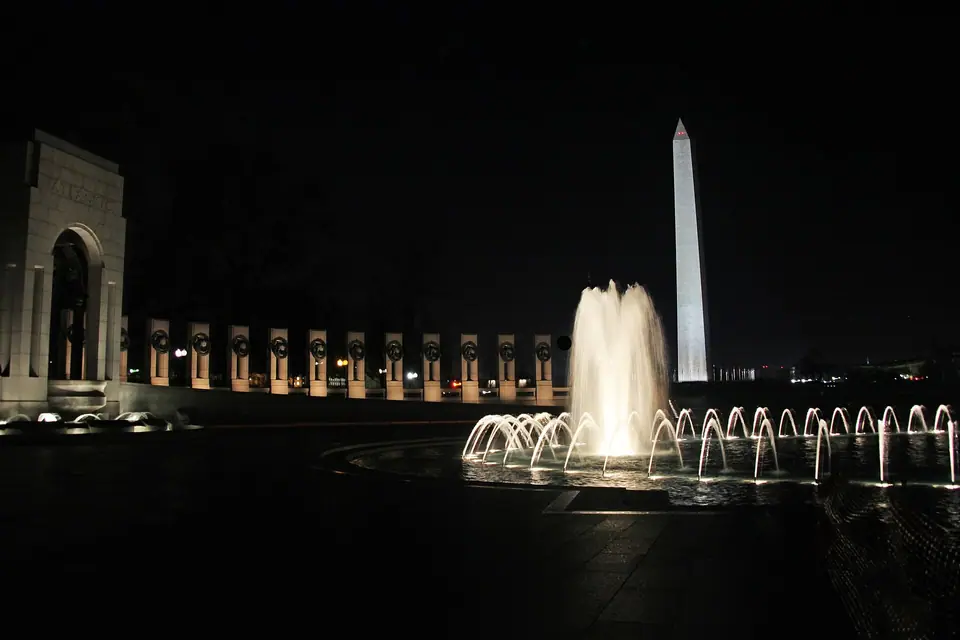
- The Washington Monument (15th Street Axis). Rising 555 feet 5⅛ inches (169.29 metres) inside 50 flags, Robert Mills's obelisk is the world's tallest free-standing stone structure and tallest obelisk. Look one-third of the way up the shaft at the 152-foot (46-metre) mark to spot a clear horizontal colour change in the stone. Construction began in 1848 using white Maryland marble, then halted in 1854 when funds ran dry and the Civil War intervened. Work resumed in 1876 under Lieutenant Colonel Thomas Lincoln Casey of the US Army Corps of Engineers. Quarriers supplied marble from Massachusetts and a slightly darker vein of the Maryland quarry, topping the shaft with a 100-ounce aluminium apex in 1884. Book the 70-second lift to the 500-foot windows on
recreation.gov30 days ahead at 10:00 ET (1 USD fee). Next-day tickets release at 15:00 ET. - World War II Memorial (17th Street Plaza). Descend the western slope of Monument Hill into Friedrich St. Florian's granite plaza, dedicated in May 2004 to the 16 million Americans who served in the Second World War. Two 43-foot arches (Atlantic and Pacific) and 56 granite pillars for the 48 states of 1945 and eight territories encircle the Rainbow Pool fountains. On the western side stands the Freedom Wall, where 4,048 gold stars each represent 100 Americans who died in the war (over 405,399 total dead). Look behind the pavilions for two hidden "Kilroy Was Here" engravings.
Stops 5 to 8: Vietnam, Lincoln, Korean War, and the Tidal Basin loop
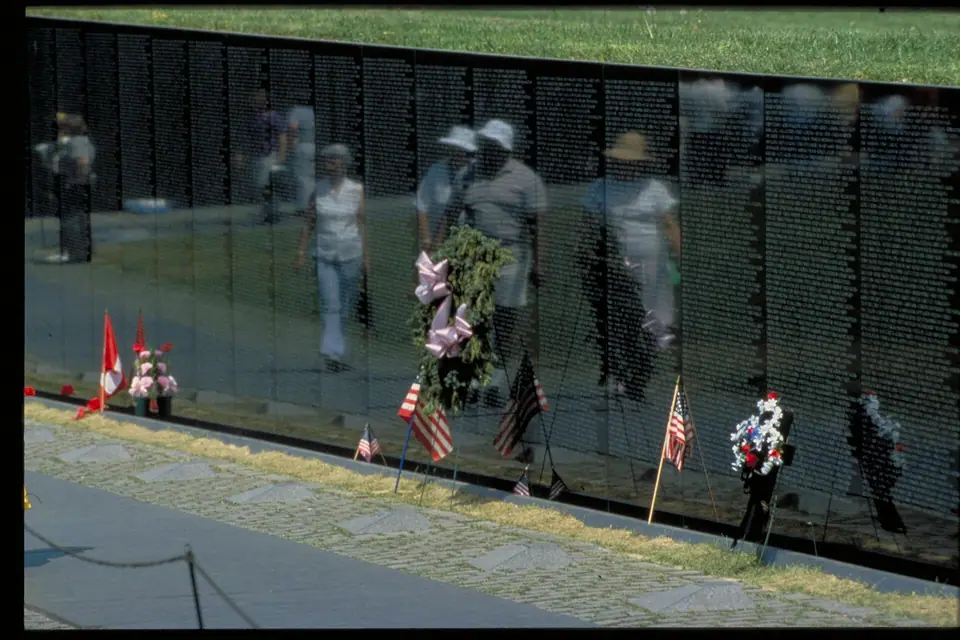
- Vietnam Veterans Memorial and Constitution Gardens. Angle northwest beside the 2,029-foot Reflecting Pool to the sunken meadow where 21-year-old Yale student Maya Lin's black gabbro wall was dedicated in November 1982. Two 246-foot-9-inch walls meet at a 125-degree-12-minute angle, pointing their tapered tips directly at the Washington Monument and the Lincoln Memorial. Carved chronologically by date of casualty from 1959 to 1975 across 140 panels are 58,318 names of Americans killed or missing in action. Nearby stand Frederick Hart's bronze The Three Servicemen (1984) and Glenna Goodacre's Vietnam Women's Memorial (1993).
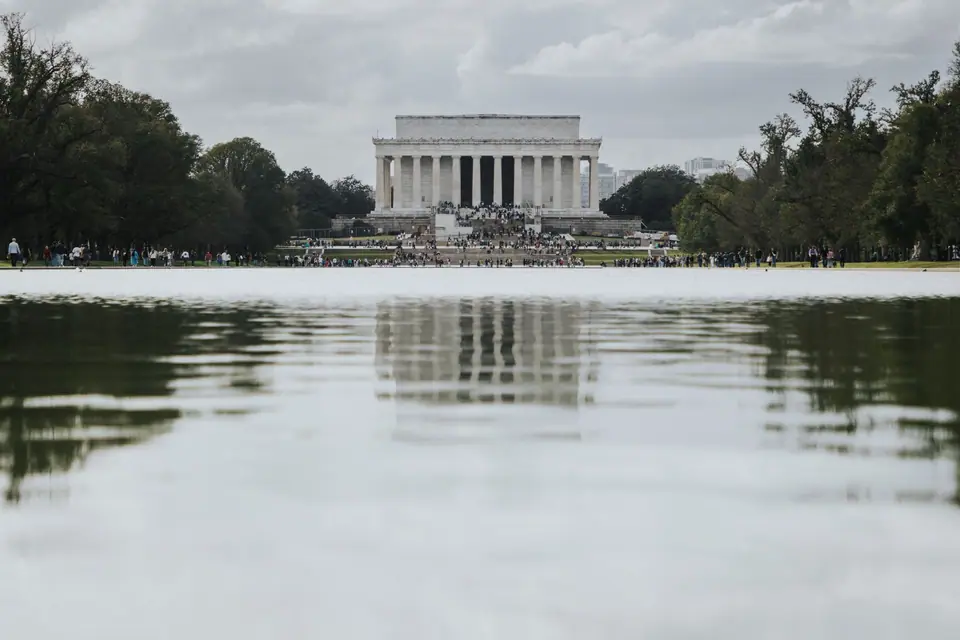
- The Lincoln Memorial (23rd Street Terminus). Climb the 87 marble steps to Henry Bacon's 1922 Greek Doric temple, ringed by 36 fluted columns for the 36 states of 1865. The 48 states of 1922 are carved along the upper attic frieze. Inside, Daniel Chester French's 19-foot seated Abraham Lincoln looks east down the Mall between the inscribed walls of the Gettysburg Address and Second Inaugural Address. Eighteen steps below the chamber door, stand on the carved granite landing where Dr. Martin Luther King Jr. delivered his "I Have a Dream" address on 28 August 1963.
- Korean War Veterans Memorial. Just southeast of the Lincoln steps, Frank Gaylord's 19 larger-than-life (7-foot-3-inch) stainless-steel soldiers in windblown ponchos advance through strips of granite and juniper bushes. The patrol includes 14 Army, 3 Marine Corps, 1 Navy medic, and 1 Air Force observer. Reflected against Louis Nelson's 164-foot black granite Mural Wall etched with 2,400 faces, the 19 statues double to 38 figures. That reflection symbolises the 38th Parallel and the 38 months of the 1950 to 1953 war. Surrounding the plaza, the 2022 Wall of Remembrance lists 36,634 American and 7,174 KATUSA fallen.
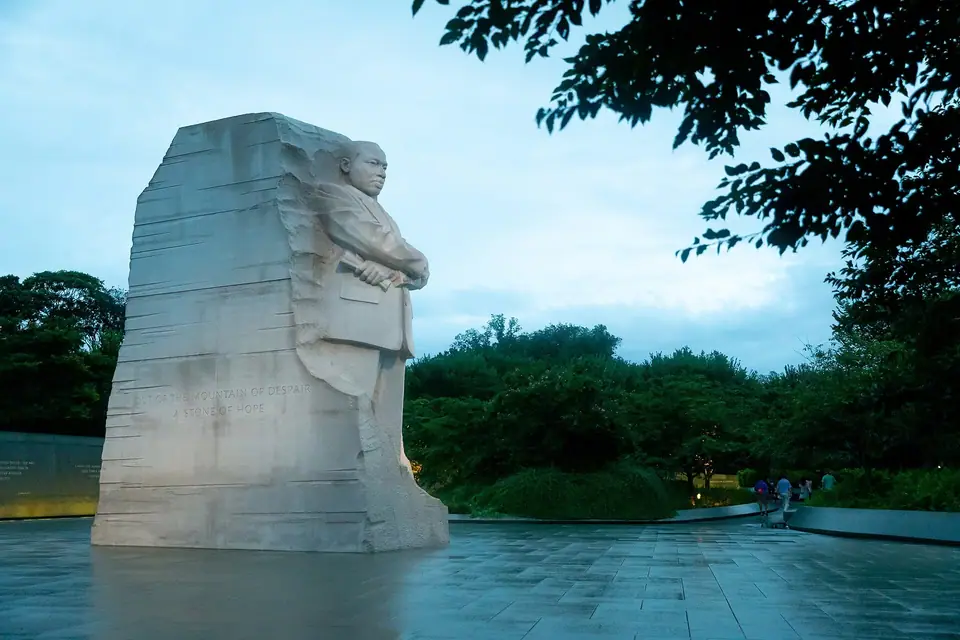
- Tidal Basin Loop (MLK Jr., FDR, and Thomas Jefferson Memorials). Cross Independence Avenue SW to the northwest bank of the Tidal Basin, built between 1887 and 1897 to flush the Washington Channel. Note that a 2024 to 2027 National Park Service seawall reconstruction project detours short waterside sections. At 1964 Independence Avenue SW (recalling the 1964 Civil Rights Act), walk through the split boulders of the Mountain of Despair. Just beyond rises Lei Yixin's 30-foot granite relief of Dr. King emerging from the Stone of Hope at the 2011 Martin Luther King Jr. Memorial. Continue south through Lawrence Halprin's 7.5-acre, four-room red granite Franklin Delano Roosevelt Memorial (1997, with George Segal's Fireside Chat and Breadline bronzes). Finish at John Russell Pope's Pantheon-inspired 1943 Thomas Jefferson Memorial, where a 19-foot bronze Jefferson stands inside 26 Vermont marble Ionic columns.
In summer, avoid walking the open gravel Mall between 11:30 and 16:30. Start at 08:00 when morning sunlight illuminates the Lincoln statue, or walk the western half after 19:30 under floodlights. National Park Service rangers staff desks and restrooms from 09:30 to 22:00. This route forms Day 1 of our Washington DC 3-day itinerary.
Where it is
- 1National Mall & Tidal Basin Walk
- Ronald Reagan Washington National Airport (DCA) · about 4 km from here in a straight line
- Directions in Google Maps
Stations and taxi ranks: OpenStreetMap. Airports: OurAirports. Distances are in a straight line.
Traveller tips
Real advice from people who have been to Washington DC. Every tip is read by our team before it goes live.
No tips yet. Been here? Yours could be the first.
Thank you! Your tip will appear here after a quick review.
More in Washington DC
Continue exploring Washington DC with related neighbourhood, food, and planning guides
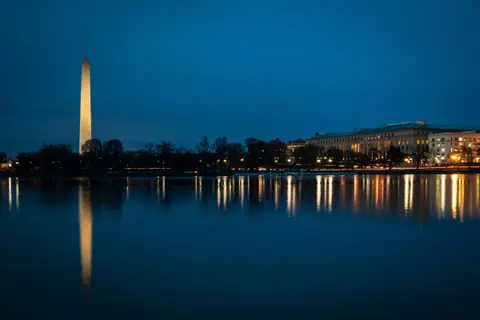
Arriving in Washington DC: Reagan National (DCA), Dulles (IAD) Silver Line, BWI MARC, Union Station & SmarTrip
Washington DC, United States
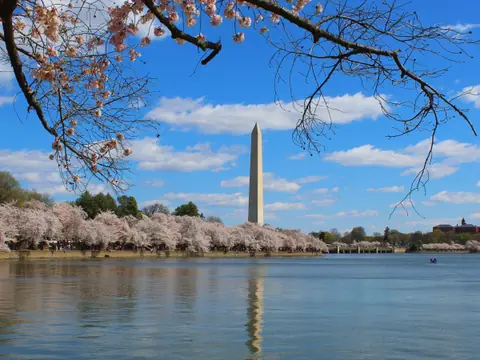
Best Time to Visit Washington DC: NOAA Climate Normals, Tidal Basin Cherry Blossoms & Autumn Foliage
Washington DC, United States
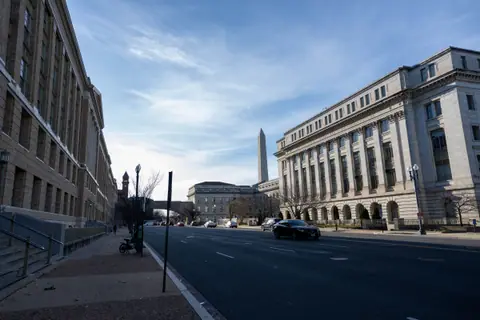
What to Wear in Washington DC: Walking Shoes for Marble Monuments, Humid Summers & Capitol Security Rules
Washington DC, United States
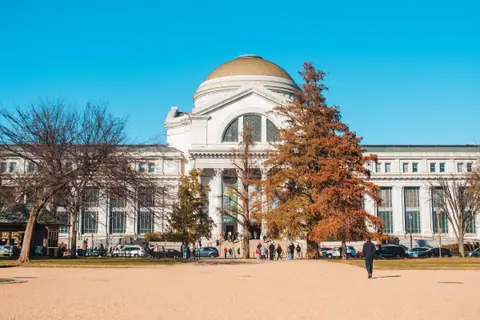
Smithsonian Museums & National Gallery Guide: Mandatory Timed Passes, Hope Diamond, Air & Space & Udvar-Hazy
Washington DC, United States
