Smithsonian Museums & National Gallery Guide: Mandatory Timed Passes, Hope Diamond, Air & Space & Udvar-Hazy
Which free museums require advance timed passes, what not to miss inside each, and how to reach Udvar-Hazy.
Founded on 10 August 1846 through a bequest from British scientist James Smithson, the Smithsonian Institution is the world's largest museum complex. Smithson never visited the United States during his lifetime, yet his gift funds 17 museums and galleries plus the National Zoo across Washington. Every single Washington facility offers free admission and welcomes visitors 364 days a year, closing on 25 December. Standard National Mall venues operate from morning to late afternoon, while the Penn Quarter art museums stay open until early evening (check current seasonal opening hours on the official site). Because admission costs nothing, you can drop into a flagship for an hour or two to see its core masterpieces before museum fatigue sets in.
Mandatory free timed-entry passes vs walk-up entry (critical field rule)
Most Smithsonian museums allow spontaneous walk-up entry through contactless security scanners. However, three Smithsonian venues and one adjacent Mall museum require mandatory free timed-entry passes during peak periods. Note these release windows before your trip:
- National Air and Space Museum (National Mall Building, 6th St & Independence Ave SW). Requires a mandatory free timed-entry pass booked via
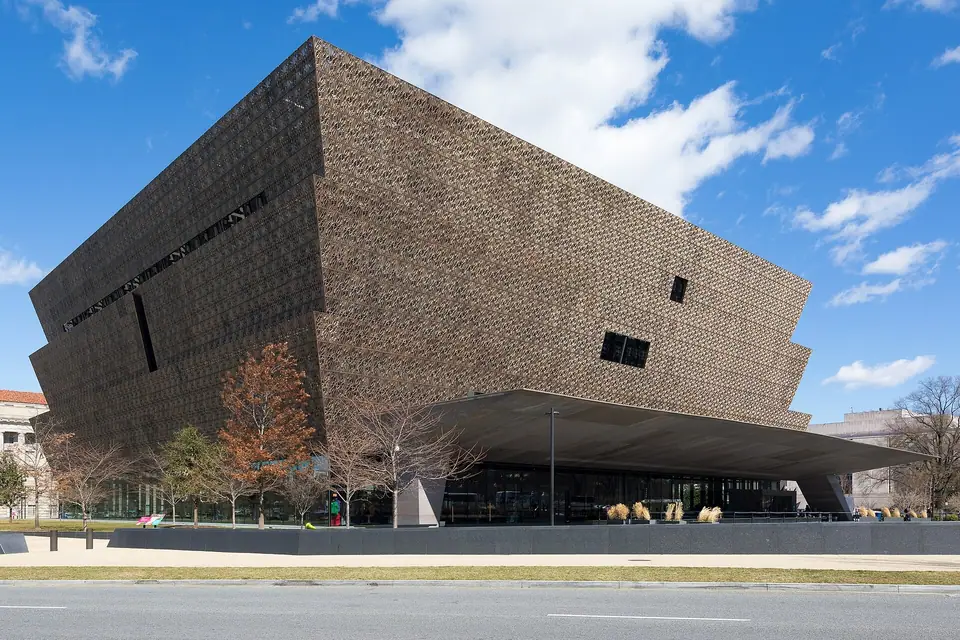
si.eduorairandspace.si.edu. Advance passes open in bulk four to six weeks ahead, and same-day timed-entry passes release online every morning at 08:30 ET. Since 2018, the 1976 building has undergone an exterior stone replacement and a phased 23-gallery renovation completing in July 2026. Iconic displays inside include the original 1903 Wright Flyer, Charles Lindbergh's 1927 Spirit of St. Louis, and the 1969 Apollo 11 Command Module Columbia. - National Museum of African American History and Culture (NMAAHC, 1400 Constitution Ave NW). Requires a mandatory free timed-entry pass released 30 days in advance at 08:00 ET, with same-day passes released online daily at 08:15 ET. Designed by David Adjaye and Philip Freelon (opened September 2016), its three-tiered bronze-coloured cast-aluminium Corona draws inspiration from West African Yoruban Caryatid crowns. Start 70 feet underground in the subterranean History Galleries. They trace the 1400s transatlantic slave trade, an 1850s South Carolina enslaved cabin, Reconstruction, a 1920s Jim Crow railcar, and the Civil Rights Movement. Pause at the waterfall Contemplative Court, then ascend to the upper Culture Galleries for Chuck Berry's red 1973 Cadillac Eldorado and George Clinton's Parliament-Funkadelic Mothership.
- Smithsonian National Zoological Park (3001 Connecticut Ave NW, Woodley Park / Adams Morgan). Spanning 163 acres in Rock Creek Park on the Red Line, the Zoo requires free timed-entry passes for all walk-in visitors. Drivers must reserve paid advance parking passes to visit giant pandas Bao Li and Qing Bao.
- United States Holocaust Memorial Museum (USHMM, 100 Raoul Wallenberg Place SW / 14th St SW just off the Mall). An independent museum designed by James Ingo Freed (opened 1993). Admission is free, but timed-entry passes (1 USD fee) are mandatory from 1 March through 31 August for the three-floor Permanent Exhibition (same-day release at 07:00 ET).
Natural History and American History walk-up highlights
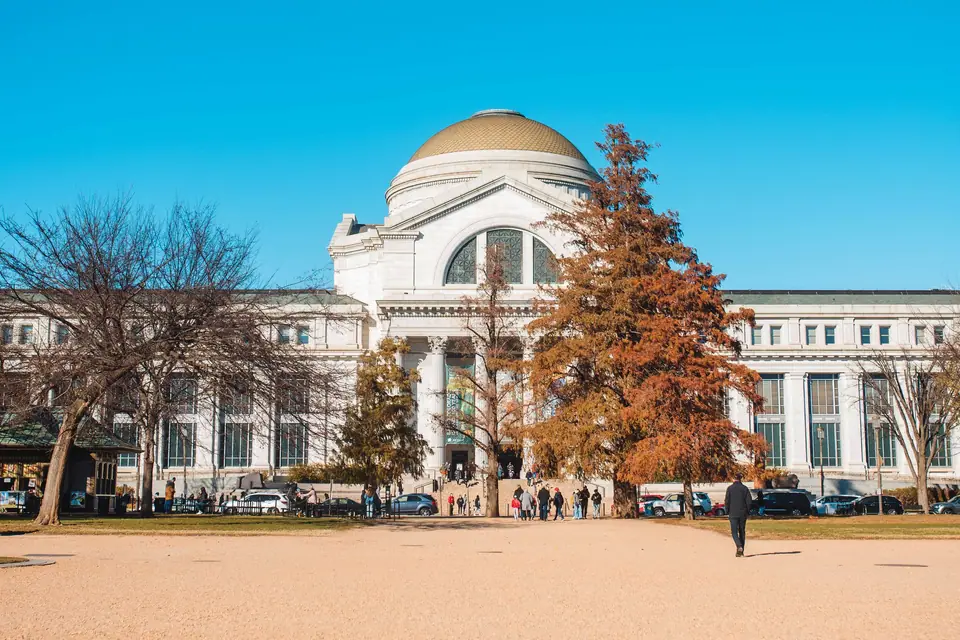
Across the Mall on Constitution Avenue NW stand two walk-up flagships that require no timed passes. Inside the 1910 Beaux-Arts National Museum of Natural History, greet Henry, the 11-ton mounted African bush elephant standing in the 90-foot Rotunda since 1959. Climb to the second-floor Janet Annenberg Hooker Hall of Geology, Gems, and Minerals to view the rotating 45.52-carat deep-blue Hope Diamond. Mined in India and purchased by King Louis XIV of France in 1668, the stone was stolen during the 1792 French Revolution. Jeweller Harry Winston donated and mailed it to the Smithsonian in 1958. Down on the ground floor, the David H. Koch Hall of Fossils: Deep Time (reopened in 2019 after a 110-million-USD renovation) displays the 38-foot Nation's T. rex skeleton.
Next door at the 1964 National Museum of American History, start in the second-floor chamber housing the original Star-Spangled Banner. Sewn in Baltimore by Mary Pickersgill, this 30-by-34-foot wool-and-cotton 15-star garrison flag flew over Fort McHenry during the September 1814 Battle of Baltimore. Surrounding galleries showcase Abraham Lincoln's silk top hat worn on 14 April 1865 and Dorothy's Ruby Slippers from the 1939 film The Wizard of Oz. Nearby stand Julia Child's complete Cambridge kitchen, a four-seat section of the 1960 Greensboro F.W. Woolworth sit-in lunch counter, and the First Ladies' Inaugural Gowns.
Penn Quarter and South Mall gems ("smaller and calmer")
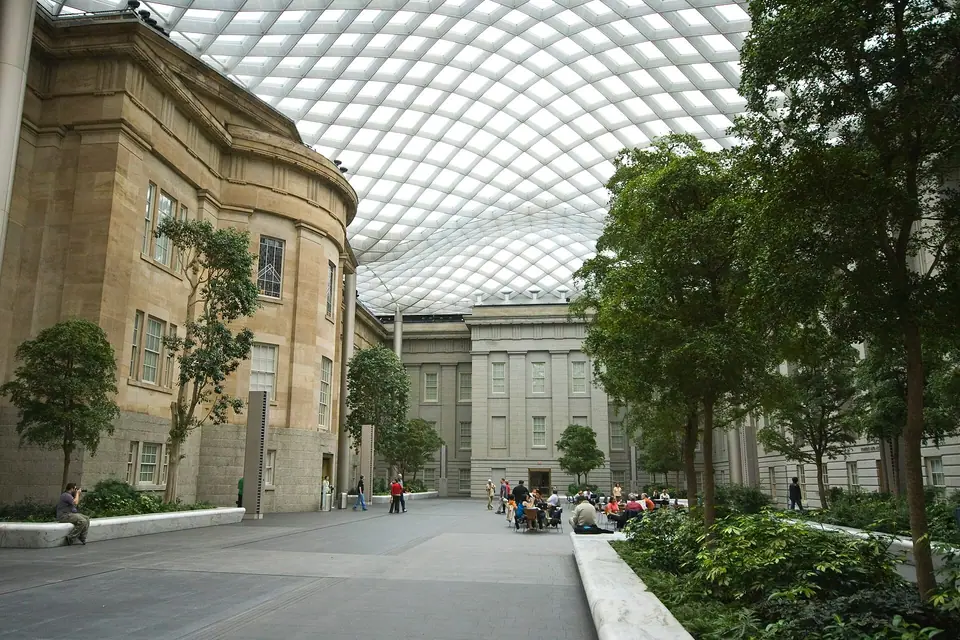
- Old Patent Office Building (Donald W. Reynolds Center, 8th & F Streets NW in Penn Quarter). Built between 1836 and 1867 by Robert Mills and Thomas U. Walter in Greek Revival style, this landmark is shared by the National Portrait Gallery and the Smithsonian American Art Museum (SAAM). Inside the Portrait Gallery's America's Presidents wing hang Gilbert Stuart's 1796 Lansdowne Portrait of George Washington and Kehinde Wiley's 2018 portrait of Barack Obama. Between the two museums stretches British architect Norman Foster's wavy glass-and-steel enclosed Robert and Arlene Kogod Courtyard (2007), open until 19:00 daily.
- National Museum of the American Indian (4th St & Independence Ave SW). Wrapped in curving golden Kasota limestone, its ground-floor Mitsitam Native Foods Cafe serves Indigenous dishes across five regional stations of the Americas. Menu favourites include wild salmon, bison, frybread tacos, and three-sisters stew.
- Hirshhorn Museum, Asian Art & The Castle. Beside James Renwick Jr.'s 1855 red Seneca sandstone Smithsonian Institution Building ("The Castle") stands Gordon Bunshaft's 1974 cylindrical Brutalist Hirshhorn Museum and Sculpture Garden. Next door sits the National Museum of Asian Art (Freer and Sackler Galleries), famous for James McNeill Whistler's gilded 1876 to 1877 Peacock Room.
National Gallery of Art and Steven F. Udvar-Hazy Center logistics
Occupying Constitution Avenue NW between 3rd and 9th Streets, the National Gallery of Art is governed independently of the Smithsonian and offers free walk-up entry. Contrast architect John Russell Pope's 1941 neoclassical pink Tennessee marble West Building (home to Leonardo da Vinci's Ginevra de' Benci, c. 1474, the only painting by Leonardo in the Americas, plus Vermeer and French Impressionists) with I.M. Pei's 1978 geometric prism East Building (where Alexander Calder's 76-foot mobile hangs overhead). An underground moving walkway connects the two buildings through Leo Villareal's Multiverse tunnel of 41,000 LED lights. Outside, the 6.1-acre Sculpture Garden hosts a winter ice rink.
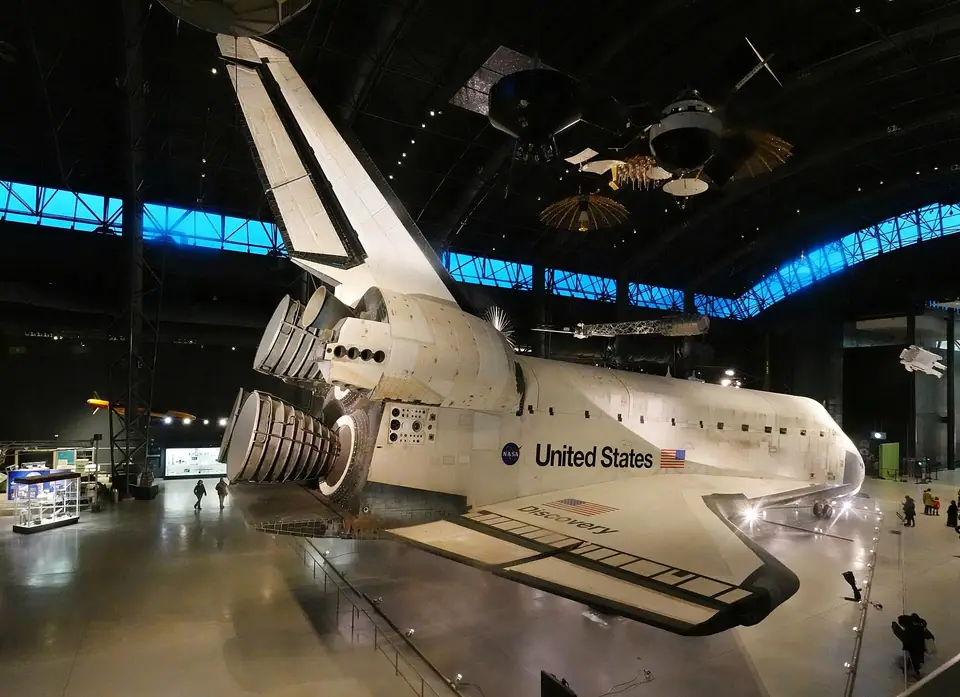
To see full-scale aircraft and spacecraft near Dulles Airport, visit the companion Steven F. Udvar-Hazy Center in Chantilly, Virginia (free admission, no timed pass required). Its hangars display the Space Shuttle Discovery, an Air France Concorde, the Lockheed SR-71 Blackbird, and the B-29 Enola Gay. Ride the WMATA Metro Silver Line to Innovation Center Station and take Fairfax Connector Bus 983 (15 minutes). Drivers pay 15 USD daily parking before 16:00 (free after 16:00). Pair these museums with our things to do guide and 3-day itinerary.
Where it is
- 1Smithsonian Museums & National Gallery
- Ronald Reagan Washington National Airport (DCA) · about 4 km from here in a straight line
- Directions in Google Maps
Stations and taxi ranks: OpenStreetMap. Airports: OurAirports. Distances are in a straight line.
Traveller tips
Real advice from people who have been to Washington DC. Every tip is read by our team before it goes live.
No tips yet. Been here? Yours could be the first.
Thank you! Your tip will appear here after a quick review.
More in Washington DC
Continue exploring Washington DC with related neighbourhood, food, and planning guides
What to Wear in Washington DC: Walking Shoes for Marble Monuments, Humid Summers & Capitol Security Rules
Washington DC, United States
National Mall & Tidal Basin Walk: Washington Monument, WWII, Lincoln, Vietnam, MLK & Jefferson Memorials
Washington DC, United States
Day Trips from Washington DC: Old Town Alexandria, George Washington's Mount Vernon, Annapolis & Baltimore
Washington DC, United States
Where to Stay in Washington DC: Penn Quarter, Dupont Circle, Georgetown, Capitol Hill & The Wharf Compared
Washington DC, United States
